8 Jan 2018

IITA Research Fellowships for Young Academics and Professionals ($10,000 grants for the study of Youth Engagement in Agribusiness and Rural Economic Activities in Africa) 2018

Application Deadline: 28th February 2018 
About the Award: The International Institute of Tropical Agriculture (IITA) received a three-year research grant for “Enhancing capacity to apply research evidence in policy for youth engagement in agribusiness and rural economic activities in Africa” funded by the International Fund for Agricultural Development (IFAD).
The research grant program seeks to contribute to policy development in youth engagement in agribusiness and rural economic activities in Africa. It is designed to provide opportunities to engage youth to improve the availability and use of evidence for youth policies and decisionmaking related to youth participation in agribusiness and rural economic activities by providing them with:
  • funding, support, and the expertise of IITA’s scientists;
  • skills and competencies in social and economic research;
  • and a community of other fellows with whom to exchange ideas.
Scope
We seek research project fellows for the study of Youth Engagement in Agribusiness and Rural Economic Activities in Africa. This is not a one-time invitation for applications, but rather a continuing call for research on this topic in 2018, 2019, and 2020
Type: Research, Fellowship
Eligibility:
  • The research will be carried out in the following countries: Benin, Cameroon, Democratic Republic of Congo, Malawi, Morocco, Nigeria, Rwanda, Tanzania, Senegal, and Zambia.
  • Applicants must not be more than 40 years old at the time of application.
  • Applicants must be a young scholar at a research institute or university in Africa or a student registered in a PhD or Master’s program in recognized universities in Africa, majoring in agricultural economics, agribusiness, or economics or a related social science, and must have finished their university course work.
  • The duration of the research should not exceed 6 months.
Selection Criteria: Evaluation criteria will include the importance of the proposed policy issue, the strength of the methodological model, and proposed analysis of the study. Additionally, the review criteria will include: Is the policy issue clearly defined? What is already known on the issue? How does the methodology relate specifically to the policy  question? Does the analytical plan fit the question and the data? Is the applicant qualified to carry out the proposed study?
Number of Awardees: 20
Value of Programme:
  • Awards for Research Grants are up to $10,000 (Proposals with a reasonable higher budget can also be selected depending on the quality of the research proposal).
  • Grantees will be supervised by one IITA scientist in close collaboration with their national/university supervisor.
  • Grantees will be offered training on research methodology, data management, and scientific writing;
  • Grantees will be offered training on production of research evidence for policy-making.
How to Apply: To apply for the Research Fellowship, applicants must submit the following:
  • Completed application form (download application form here).
  • Copy of the passport or other statement of citizenship.
  • Curriculum Vitae (CV), work history and education. CVs should be no longer than two pages.
  • Proof of registration at an accredited university for MSc and PhD programs.
  • Proof of employment at a research institute or university in Africa.
  • Research proposals should be organized in the order listed below, and page limitations for components must be observed. Please include your last name and first initial in the uploaded document’s name (example: LastName_FirstInitial_proposal.pdf). The Research proposal must include the following components in one PDF document:
    1. The proposal narrative should not be more than seven pages in length, single-spaced, in 12-point type with 1″ margins. Approximately three pages should be devoted to the problem statement/policy issue, theoretical framework, review of current literature, and research questions. The remaining four pages should include the methodology, contributions to policy, work plan, and dissemination plan. Applicants must present a clear and well thought out methodology and the analysis to be done. The brief dissemination plan should include the intended audience and relevant journals where the research findings might be submitted for publication and professional meetings where the findings might be presented (7 pages maximum).
    2. The conceptual model(s) that outline the framework or design of the study (2 pages maximum).
    3. Contribution to the field to briefly describe the potential contributions this research will make to the field of youth engagement in agribusiness and rural economic activities in Africa (200 words maximum).
    4. Reference list. A list of all references included in the text or in the models. Use complete citations, including titles and all authors. (No page limit)
    5. Budget. There is no specific template for the budget. It may be a simple 2-column format or a more complex spreadsheet.
Award Provider: IITA

Egypt’s Executions Spree Alarms UN HR Commissioner

Abdus Sattar Ghazali


The United Nations High Commissioner for Human Rights has expressed deep shock over the execution of 20 people in Egypt within one week, amid concerns that due process and fair trial guarantees did not appear to have been followed.
According to the Office of the UN High Commissioner for Human Rights on Tuesday, January 2, five men who had been sentenced to death by an Egyptian military court were hanged in Alexandria, four of whom had been convicted for an explosion near a stadium in Kafr al-Sheikh on 15 April 2015 that killed three military recruits and injured two others.
On December 26, 15 men convicted on terrorism charges were reportedly executed, found guilty by a military court of killing soldiers in Sinai in 2013.
“We understand the defendants were tried by military judges on the basis of legislation that refers cases of destruction of public property to military courts and in view of the victims being from the Egyptian Military Academy,” HCHR spokesperson Liz Throssell told reporters on Friday at the regular news briefing in Geneva.
“Civilians should only be tried in military or special courts in exceptional cases,” she continued.
Ms. Throssell also said it is important that all necessary measures are taken to ensure that such trials take place under conditions which genuinely afford the full guarantees stipulated in Article 14 of the International Covenant on Civil and Political Rights, to which Egypt is a State party.
Despite security challenges facing Egypt, particularly in Sinai, Ms. Throssell maintained, “executions should not be used as a means to combat terrorism.”
Military courts typically deny defendants the rights afforded by civilian courts, Throssell said, citing reports “that the prisoners who were executed may have been subjected to initial enforced disappearance and torture before being tried”.
According to figures from Cornell University’s Death Penalty Worldwide, there has been a sharp increase in executions in the years since Egyptian President Abdel Fattah el-Sisi took power.
From 2011, the year that former President Hosni Mubarak was deposed, to 2013, Egypt executed one person.
In 2014, Egypt executed 14 people. The following year, 22 more people were executed, and at least 44 people were executed in 2016.
Egypt extends state of emergency
Execution spree came as US-client President Abdul Fatah El-Sisi extended the state of emergencyon Tuesday.
Egyptian authorities first imposed a nationwide state of emergency in April 2017, after two church bombings killed at least 45 people. Similar extensions were announced in July and October last year.
The measure grants the president, and those acting on his behalf, the power to refer civilians to State Security Emergency Courts for the duration of the three-month period.
There is no appeal process for State Security Emergency Court verdicts.
It also allows the president to intercept and monitor all forms of communications, imposing censorship prior to publication and confiscating extant publications, impose a curfew for or order the closure of commercial establishments, sequestration of private properties, as well as designating areas for evacuation.
The emergency measures allow security forces to detain people for any period of time, for virtually any reason. They also grant broad powers to restrict public gatherings and media freedom.
Lifting the state of emergency, initially imposed following late President Anwar Sadat’s assassination in 1981 and lasted for three decades under his successor Hosni Mubarak, has been one of the key demands of the January 2011 popular uprising.
In June 2012, Egypt’s state of emergency finally came to an end.
However, in January 2013, emergency law was reintroduced by elected President Mohamed Morsi for 30 days, to curb renewed unrest.
In August of the same year, and following a military coup led by then defense minister Sisi against Morsi, Egypt’s military-backed government then declared a one-month state of emergency following the violent dispersal of Muslim Brotherhood supporters in what came to be known as Rabaa al-Adawiya massacre in which hundreds of civilians were killed at hands of police and security forces.
60,000 imprisoned
Since Sisi took power in 2013, human rights conditions in the country continued to deteriorate.
Human rights organizations found that around 60,000 were imprisoned between 2013 and 2017.To accommodate them, the Egyptian authorities decided to build 10 additional prisons. The facilities that already house these prisoners are extremely overcrowded, according to Egypt’s National Council for Human Rights.
In August 2016, the Egyptian Coordination of Rights and Freedoms released a report on prison conditions in Egypt under Sisi, documenting 1,344 incidents of torture – including direct torture and intentional medical neglect – in detention facilities and prisons between 2015 and 2016.
There are also reports of forced disappearances. Amnesty International recorded three to four disappearances a day between 2015 and 2016. Amnesty states that the number could be much higher since a lot of families fear the repercussions from reporting a disappearance case.
Furthermore, Sisi issued a decree in 2014 that allowed the military wider jurisdiction, where civilians were prosecuted by the military courts. These trials contained almost no evidence and were based on investigations led by National Security officers. Human Rights Watch said that this “formed the basis of 7,400 or more military trials of civilians” since Sisi issued the decree.
Tellingly, El-Sisi, who in 2013 overthrew of democratically elected President Mohamed Morsi, of the Muslim Brotherhood, is expected to run for another term. The date for this election will be announced soon.

GMOs, Global Agribusiness And The Destruction of Choice

Colin Todhunter

One of the myths perpetuated by the pro-GMO (genetically modified organisms) lobby is that critics of GMOs in agriculture are denying choice to farmers and have an ideological agenda. The narrative is that farmers should have access to a range of tools and technologies, including GM crops.
Before addressing this issue, we should remind ourselves that GMOs have been illegitimately placed on the commercial market due to the bypassing of regulations. Steven Druker’s book Altered Genes,Twisted Truths (2015) indicates that the commercialisation of GM food in the US was based on a massive fraud. The US Food and Drug Administration (FDA) files revealed that GM foods first achieved commercialisation in 1992 but only because the FDA covered up the extensive warnings of its own scientists about their dangers, lied about the facts and then violated federal food safety law by permitting GM food to be marketed without having been proven safe through standard testing.
If the FDA had heeded its own experts’ advice and publicly acknowledged their warnings that GM foods entailed higher risks than their conventional counterparts, Druker says that the GM food venture would have imploded and never gained traction anywhere.
It is highly convenient for the pro-GMO lobby to talk about choice while ignoring such a massive subversion of democratic procedures and processes which could (and arguably is) changing the genetic core of the world’s food.
The denial of choice is a very important accusation. But just what is it that critics are said to be denying farmers? The pro-GMO lobby say that GM crops can increase yields, reduce the use of agrochemicals and are required if we are to feed the world. To date, however, the track record of GMOs is unimpressive.
If we turn to India, we can now see that Bt cotton has largely been a failure. GM cotton has hardly been a success elsewhere either. Although critics are blamed for Golden Rice not being on the market, again the reality is that after two decades problems remain with the technology.
A largely non-GMO Europe tends to outperform the US, which largely relies on GM crops. In general, “GM crops have not consistently increased yields or farmer incomes, or reduced pesticide use in North America or in the Global South (Benbrook, 2012; Gurian-Sherman, 2009)” (from the report ‘Persistent narratives, persistent failure’).
GM agriculture is not ‘feeding the world’, nor has it been designed to do so. The choice for farmers between a technology based on broken promises (as further outlined in this NYT piece) and conventional non-GMO agriculture is no choice at all.
“Currently available GM crops would not lead to major yield gains in Europe,” says Matin Qaim, a researcher at Georg-August-University of Göttingen, Germany. He adds that as far as herbicide-resistant crops in general are concerned: “I don’t consider this to be the miracle type of technology that we couldn’t live without” (quoted in another New York Times article, Doubts about the promised bounty of GM crops.)
A choice between proven non-GMO agriculture and a failing or less effective GMO model (with all the serious health, environmental and social impacts) is nothing but a false choice.
And if the GMO agritech industry wishes to perpetuate the idea that one of its main motives is to promote ‘choice’ and help farmers (and thus consumers) then why does it work to ultimately deny choice? Once the genetic genie is out of the bottle, there may be no way of going back.
Roger Levett, specialist in sustainable development, argues (‘Choice: Less can be more, in Food Ethics, Vol. 3, No. 3, Autumn 2008):
“If some people are allowed to choose to grow, sell and consume GMO foods, soon nobody will be able to choose food, or a biosphere, free of GMOs. It’s a one-way choice, like the introduction of rabbits or cane toads to Australia; once it’s made, it can’t be reversed.”
There is sufficient evidence showing that GM and non-GM crops cannot co-exist. Indeed, contamination seems to be part of a cynical industry strategy. For instance, with GM food crops already illegally growing in India, what future India agriculture? What future farmers’ choices?
It is convenient to paint critics of GMOs as being authoritarian and possessing an ideological agenda. Whether it is Bayer, Monsanto or one of the other major agritech/agribusiness concerns, the real agenda is clear: elite commercial interests and the maximisation of profit for shareholders are the driving forces behind GM agriculture.
Critics of GMOs and transnational corporations did not have a leading role in drafting the WTO Agreement on Trade-Related Aspects of Intellectual Property Rights to create seed monopolies. Monsanto did. Critics did not write the WTO Agreement on the Application of Sanitary and Phytosanitary Measures. The global food processing industry had a leading role in that (see this). Whether it involves Codex, the Knowledge Initiative on Agriculture aimed at restructuring Indian agriculture or the proposed US-EU trade deal (TTIP), the powerful agribusiness/food lobby has secured privileged access to policy makers.
From the World Bank’s ‘enabling the business of agriculture’ to the Gates Foundation’s role in opening up African agriculture to the global food and agribusiness oligopolies, democratic procedures at sovereign state levels have been bypassed to impose seed monopolies and proprietary inputs on farmers and to incorporate them into a global supply chain dominated by powerful corporations.
From the destruction of indigenous agriculture in Ethiopia to the ongoing dismantling of Indian agriculture at the behest of transnational agribusiness, where is the ‘choice’?
Ukraine’s agriculture sector is being opened up to Monsanto. Iraq’s seed laws were changed to facilitate the entry of Monsanto. India’s edible oils sector was undermined to facilitate the entry of Cargill. And Bayer’s hand is likely behind the ongoing strategy behind GM mustard in India. Whether through secretive trade deals, strings-attached loans or outright duplicity, the global food and agribusiness conglomerates have scant regard for choice or for democracy.
Localisation and traditional methods of food production have given way to globalised supply chains dominated by transnational companies policies and actions which have resulted in the destruction of habitat and livelihoods and the imposition of corporate-controlled, chemical-intensive (monocrop) agriculture that weds farmers and regions to a wholly exploitative system of neoliberal globalization.
Whether it involves the undermining or destruction of what were once largely self-sufficient agrarian economies in Africa or the devastating impacts of soy cultivation in Argentina or palm oil production in Indonesia, the role of transnational agribusiness has been devastating.
What choice do we as consumers have over the tens of thousands of synthetic agrochemicals contaminating our soil, oceans and food. How did they get on the market in the first place? Again, largely as a result of fraud.
What choice do consumers have over GM food when food conglomerates and Bayer have spent large sums of money to prevent labelling?
What choice does the public have when governments become de facto mouthpieces of the industry as they collude behind closed doors with powerful corporations?
What choice did Mexican farmers and consumers have over their right to healthy food
when NAFTA (driven by the powerful food/agribusiness lobby in the US) drove farmers out of business and consumers towards bad food and poor health?
What right have corporations like Monsanto and Bayer to damage (see this too) health as well as natural resources that belong to humanity collectively? These entities with histories of criminality have convinced governments and the public that they have a right to own humanity’s collective resources.
And with that in mind, how will a Monsanto-Bayer merger and increasing consolidation of the seed and agrochemical sector increase choice? It won’t. It hints at of a dark future of corporate monopolies.
In their rush to readily promote neoliberal dogma and corporate-inspired PR, many government officials, scientists and journalists take as given that profit-driven transnational corporations have a legitimate claim to be custodians of natural assets. There is the premise that water, food, soil and agriculture should be handed over to powerful and wholly corrupt transnational corporations to milk for profit, under the pretence these entities are somehow serving the needs of humanity.
These natural assets (‘the commons’) belong to everyone and any stewardship should be carried out in the common interest by local people assisted by public institutions and governments acting on their behalf, not by private transnational corporations driven by self-interest and the maximization of profit by any means possible.
And that’s the real agenda. That’s the bottom line where choice is concerned.
We have been living in the shadow of global agribusiness and its impacts for too long.
When pro-GMO/pro-big agribusiness lobbyists take aim at critics, alleging they are denying choice and have an ideological/authoritarian agenda, they should look a little closer to home.
But to quote the writer Upton Sinclair: “It is difficult to get a man to understand something when his salary depends upon his not understanding it.”

Foreign Minister Asif Says Pakistan Alliance With U.S. Over

Abdus Sattar Ghazali

Pakistan’s alliance with the United States seems to be coming towards an end following the US decision to suspend security aid, Pakistan Minister of Foreign Affairs Khawaja Asif told the Wall Street Journal on Friday (Jan. 5).
Asif said he believes the US-Pakistan relations are now at risk, especially after the tensions heightened and moods turned sour when President Donald Trump warned Islamabad to “do more” against terrorists, to whom, he alleged, the country provides safe havens.
“We do not have any alliance [with the US], this is not how allies behave,” the minister told WSJ.
On New Year’s Day, US President Donald Trump tweeted that the US had “foolishly” given Pakistan over $33 billion in aid over the past 15 years, adding that Islamabad gives “safe havens to the terrorists we hunt in Afghanistan, with little help”.
“No more!” Trump added.
The Wall Street Journal
The Wall Street Journal said the foreign minister’s statement further ratcheted up an increasingly tense exchange in the past week between the two countries, which have maintained a rocky anti-terror collaboration since the Sept. 11, 2001, attacks. “Those ties have frayed but not broken despite differences over Afghanistan, India and the 2011 U.S. raid on Osama bin Laden’s compound in Pakistan, which was undertaken without Islamabad’s prior knowledge.”
In that fraught context, the two countries’ relations appeared likely to continue in a grudging, distrustful way, given that Washington and Islamabad haven’t taken more drastic steps or moved to actually dissolve the bulk of their complex ties, WSJ added.
For Washington, jettisoning support for a longtime nuclear-armed ally in a strategic location isn’t easy. For its part, Pakistan fears a full break could lead the U.S. to apply its leverage in international forums to hurt the country’s economy, according to WSJ.
A long-festering dispute lies at the heart of the conflict between the two countries: The U.S. accuses Pakistan of harboring jihadists who kill American soldiers in Afghanistan, while Islamabad says Washington doesn’t adequately acknowledge Pakistan’s role in decimating al Qaeda or its sacrifice of thousands of lives after joining America’s war on terror, the WSJ report said adding:
“Islamabad also sees the U.S. growing ever closer to its archenemy India, with the Trump administration even inviting New Delhi to take a bigger role in Afghanistan—a move experts say all but guaranteed Pakistan’s pullback from cooperating with the U.S.  . The cleavage could push Pakistan further into the arms of China and complicate America’s effort to end the Afghanistan war, its longest-running conflict. BMI Research, an economic-analysis firm based in London, said in a report Friday that the U.S. suspension of aid “will likely accelerate Pakistan’s geopolitical drift towards China.”
New York Times: Dealing with Pakistan is both vital and difficult
Afghan officials have pleaded with three American presidents to reconsider their support for Pakistan, which was both receiving billions of dollars in American aid and harboring the leaders of a Taliban insurgency that the United States has struggled to defeat, the New York Times said adding:
But when President Trump suspended nearly all American security aid to Pakistan on Thursday for what he called the country’s “lies and deceit,” any jubilation in the halls of power in Afghanistan — and there was some — was leavened with worry over how the move might affect a complex war that has pushed the Afghan government to the brink.
“If there is one consensus among Afghan leaders and their American counterparts, it is that dealing with Pakistan is both vital and difficult. The question on the table after the cutoff of military aid to Pakistan is who will come under the most pressure: the Pakistanis, or the coalition fighting the Taliban.”
Muhammed Umer Daudzai, a former Afghan interior minister and ambassador to Pakistan, was quoted as saying:  “The pressure on Pakistan had come too late, with the country having developed regional allies who would help it weather the financial toll. The financial sanctions may not bite Pakistan because they have developed alternatives.”
Mr. Daudzai also said. “The only area the impact could be huge, but it’s a bit too early to judge, is the field of air force. The Pakistani system is still hugely dependent on the U.S. It can take a long time to switch from that.”
Trump backs Bill to end all aid to Pakistan
Not surprisingly, President Donald Trump Saturday (Jan 6) supported Senator Rand Paul’s proposal for a bill to stop the US aid to Pakistan for failing to clamp down on terror groups and divert the money for building roads and bridges in the US.
“Good idea Rand!” Trump tweeted, sharing a video of Republican Senator promoting his bill to stop US aid to Pakistan and use the money towards domestic infrastructure projects.
“I’m introducing a bill to end aid to Pakistan in the coming days. My bill will take the money that would have gone to Pakistan and put it in an infrastructure fund to build roads and bridges here at home,” Paul said.
The Trump administration Thursday suspended about USD 2 billion in security aid to Pakistan for “failing to clamp down on the Afghan Taliban and the Haqqani Network terror groups and dismantle their safe havens.”
The freezing of all security assistance to Pakistan comes after President Trump in a New Year’s Day tweet accused the country of giving nothing to the US but “lies and deceit” and providing “safe haven” to terrorists in return for USD 33 billion aid over the last 15 years.
The suspended amount also include USD 255 million in Foreign Military Funding (FMF) for the fiscal year 2016 as mandated by the Congress. In addition, the Department of Defense has suspended the entire USD 900 million of the Coalition Support Funds (CSF) money to Pakistan for the fiscal year 2017 and other unspent money from previous fiscal years.

South Australian Labor government slashes public sector jobs

Oscar Grenfell 

The South Australian state government of Labor Premier Jay Weatherill announced 750 public sector job cuts in a budget review late last month. This is part of a broader raft of austerity measures aimed at slashing government spending by $370 million over the next four years.
State Treasurer Tom Koutsantonis said the cuts would include the axing of 263 public servants and staff reductions in the state-run SA Water and Urban Renewal Authority corporations.
Homestart, a state-run corporation that provides home loans, will be forced to deliver 100 percent of its profits to the government over the next two financial years, up from the current 60 percent, supposedly in lieu of retrenchments.
The measures underscore the extent to which state-run utilities have been corporatised by successive Labor and Liberal-National governments. Koutsantonis said departmental “chief executives” would have “maximum flexibility” to “deliver these savings.”
In other words, the job cuts have not been specifically earmarked, so all public servants will live in fear of being victimised and sacked.
The retrenchments are a direct response to a protracted campaign by the corporate and financial elite for cutbacks to the public service. Articles and editorials in the Murdoch press, including its national flagship, the Australian, have declared that the state’s public sector is “bloated.”
The announcement follows the Labor government’s abandonment of proposals for a limited bank tax, which was slated to raise $370 million over the next four years. The limited tax, which would not have affected the banks’ bottom line, was vociferously denounced in the financial press, and blocked in the state’s parliament.
The latest cuts follow a spate of redundancies in the public sector. While official figures are scanty, the number of public sector positions destroyed since the 2008 financial crisis by the state’s Labor governments are estimated in the thousands.
In 2014 alone, Labor eliminated 885 positions. The following year, it introduced plans to reduce the number of public servants by 4,000 over four years, including through the contracting out of government services.
Over the past five years, some 600 teachers at TAFE vocational colleges have been made redundant, as the state government has sought to wind back publicly funded education, in line with the pro-business education agenda spearheaded by the former federal Labor governments of Kevin Rudd and Julia Gillard.
The union that covers public sector workers, the Public Service Association (PSA), signalled its support for “cost reductions,” while fraudulently claiming to oppose the sackings. Speaking to the Australian Broadcasting Corporation last month, PSA official Neville Kitchin endorsed calls for “efficiency dividends” that he said had been “identified in recent reports.”
The PSA, along with all of the major unions, backed the re-election of a state Labor government in 2014, after it had imposed major cuts, and has enforced each round of redundancies.
The South Australian cutbacks form part of a broader offensive against the jobs, conditions and wages of public sector workers, imposed by state and federal governments, Labor and Liberal-National alike, with the crucial assistance of the trade unions.
Last September, in its first budget, the Western Australian (WA) Labor Party government eliminated 3,000 public sector jobs. The retrenchments, part of a four-year $1.7 billion reduction in public sector spending, are set to be completed in the 2017–18 financial year. The job cuts followed the amalgamation and restructuring of public sector departments reducing the number from 41 to 25, and the introduction of an effective four-year wage-freeze in May, just two months after Labor’s election.
The Community and Public Sector Union (CPSU), the national public sector federation, backed the pro-business measures, having campaigned for Labor in the 2017 WA state election on the bogus pretext that it would halt public sector cuts and privatisations. Backing the amalgamations, WA CPSU secretary Toni Wilkinson stated: “Some of our members believe this is an opportunity to get things right in the delivery of government services.”
At a national level, the CPSU has pushed through regressive enterprise agreements covering major public sector departments in the past 18 months. During a three-and-a-half year dispute, the federal Liberal-National Coalition government sought to impose a 2 percent annual pay rise cap and a raft of cuts to jobs and conditions.
Throughout the dispute, the CPSU’s primary concern was that it could be side-lined by the government, depriving it of its position at the bargaining table, where it trades away the jobs, wages and conditions of the workers it falsely claims to represent.
Despite members’ resistance, the CPSU ultimately pushed through regressive deals at a host of federal workplaces, including the Australian Tax Office (ATO), that ratified the government’s push for an effective wage freeze, and further cuts to jobs and conditions.
The perfidious role of the union continued their support for cuts to the public sector, which began in 1987 when Prime Minister Bob Hawke’s Labor government introduced “efficiency dividends”—continuous funding reductions.
From 2007 to 2013, the Labor governments of Julia Gillard and Kevin Rudd eliminated up to 14,500 public sector jobs. In 2013, the Rudd government increased the “efficiency dividend” from 1.25 percent to 2.25 percent, paving the way for further cuts by Coalition governments.
The assault on public service employees is one front in a wider agenda, aimed at forcing the working class to pay for the deepening crisis of the profit system. In South Australia, the shutdown of car manufacturing and other industrial production has led to deepening social distress. Real unemployment in the state is estimated at over 10 percent, and more than 200,000 people live below the official poverty line. Indices of social distress and alienation such as drug addiction are growing.
In working-class suburbs such as Elizabeth, a former hub of car production in northwestern Adelaide, unemployment is as high 33 percent. Between 1981 and 2011, the number of manufacturing jobs in the state declined from 100,000 to an estimated 74,000. The closure of GM Holden last year is expected to result in 20,000 indirect job losses, on top of the 1,400 workers directly retrenched.
Under these conditions, Labor’s public sector cuts are another indication that the March 17 South Australian election will be dominated by pledges from the main parties to slash spending, further eroding the conditions of the working class.
Nick Xenophon, a right-wing populist ex-senator, whose newly-created SA Best party is polling level with the Liberal-Nationals and Labor in the lead-up to the elections, criticised the public sector sackings. His attitude to austerity, however, was underscored by reports that his federal party, the Nick Xenophon Team, reached an agreement with the Coalition government to slash welfare payments and entitlements for the most oppressed sections of the working class.

Rising rents put low income US renters in severe jeopardy

Debra Watson

The recent severe cold spell in large parts of the US will be remembered most due to the frequent reports of homeless citizens freezing to death, because they could not find housing, or even emergency shelter. Half a million homelessness are living on the streets of major US cities this winter, according to official counts.
Millions more face a precarious housing situation, threatened not only by a lost job or illness, events that often lead to a foreclosure or eviction, but a general decline in living standards related to widening income inequality in the US.
Precipitous increases in rent and stagnant and declining wages are creating an unsustainable squeeze on lower income households. The number of those who must spend the majority of their monthly income on rent is rising and along with that the portion of the monthly income they spend on rent is rising too.
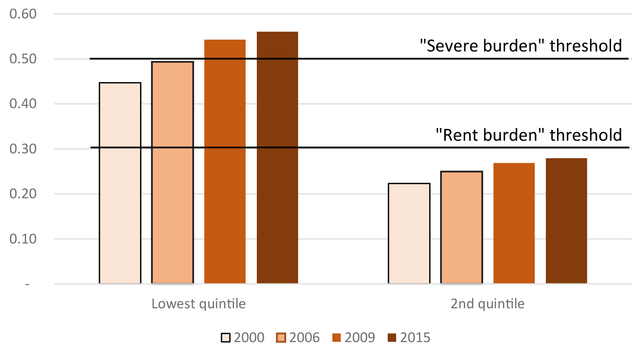
A December report on the housing crisis that appeared in a publication of the Board of Governors of the US Federal Reserve, called FEDS Notes, reports on the distress for families in the lowest US income quintile brought on by a squeeze in monthly income from rising rents and stagnant or falling wages.
In general, these families earn under $25,000 annually. The lowest-paid fifth of US households includes workers making more than minimum wage. In Michigan a minimum wage job for a worker employed every week for the whole year yields about $18,000. Rent increases have rapidly and relentlessly outstripped stagnant or declining annual wages for workers at the lowest income levels.
Written by researchers from the US Federal Reserve and the Brookings Institution, the December report notes that the portion of monthly income that low-income households must spend on rent has been rising through the last several business cycles. “Rent burdens have increased over the past 15 years, due to both increasing rents and decreasing incomes,” they say.
The squeeze is relentless. Families at the bottom end of the pay scale have not been able to get out of the squeeze in the business recovery after a recession. They note: “This increase in rent burdens over the past 15 years occurred through each business cycle period including both the period prior to the financial crisis (2000-2006), the economic downturn (2006-2009) and the subsequent recovery (2009-2015). Although rent-to income ratios are greatest among low-income households, the share of income spent on rent also rose among higher income renters.”
They also explain the main economic sources of the plight of low-income renters: “Of the overall decline in residual income since 2000, around two-thirds came from declines in income among renters and one third resulted from rising rents.”
The FEDS Notes release in late December used statistics from the US Census Bureau American Community Survey. Their report provides a window into the desperate circumstances working class families, especially those at the low end of the income scale, now face when seeking housing.
They note the deterioration of renter family’s ability to cope with the ever-rising rents. “The median renter in the lowest income quintile pays 56 percent of monthly income on rent,” exceeding HUD’s standard for rent burdened, paying more than 30 percent of income on rent and severe rent burdened, paying more than half of income for rent. “Though the rent burden has increased at every income level, it is especially acute at the lower end of the US income scale,” they say.
“Such renters have little left for paying everything else,” according to the report. “In the lowest income quintile in the US a family has just $476 left after housing costs for all other basic needs,” noting Census bureau estimates that a family needs nearly three times this—$1,400—for these basic needs.
Last fall Freddie Mac Multifamily presented detail that throws light on the trend of rising rents. Researchers there noted how rapidly rents in multi-family units they finance are going up. Increases on rents on existing properties in apartments were squeezing low-income renters, following a general trend in US rental housing reported elsewhere by housing advocacy groups.
The Federal Mortgage Home Loan Corporation (FMHLC) or Freddie Mac, is one of two major US housing finance entities, along with Fannie Mae.
Some sixty to eighty percent of affordable rental apartments in privately owned multi-family apartment buildings financed by mortgage lender Freddie Mac have been eliminated in the US since 2010.
Very low income households, used in the Freddie Mac report, are defined for various US government agencies as families making half or less than the median income in a particular geographical area. This is a step above HUD’s Extremely Low Income designation, and falls in the same range as the lowest quintile households covered in the FEDS Notes report.
In the Detroit metropolitan area in 2016, very low income was about $24,000 for an individual renter. By comparison, extremely low income individuals have annual incomes of about $14,000.
Along with a dearth of building in the low-income rental market—most new apartments are built and command rents only affordable to the much better off—the report notes that housing construction costs are also a factor and have been exacerbated by the hurricane destruction in Texas, Florida and Puerto Rico.
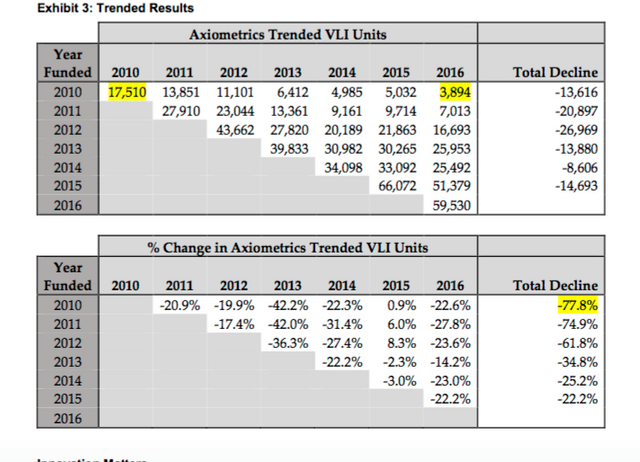
Freddie Mac researchers compiled figures back to 2010 on lending to multi-family projects, that is apartment buildings they financed twice during that period: “[W]e analyzed the affordability of the exact same units at two different, but close, points in time.”
Families denoted as VLI necessarily had not moved out as rents increased year by year. Instead the same population living in the buildings ended up paying what amount to unsustainable housing costs, paying rents exceeding the HUD affordability benchmark.
The Freddie Mac researchers used two sets of data to look into affordable housing for very low income renters. The first used internal numbers on a relatively small set of data to examine how it compared with overall trends in rental housing adversely impacting lowest income renters being reported elsewhere.
In the 97,000 rental units in multi-family buildings Freddie Mac financed in 2010 and then again in 2016, the percentage of units affordable for very low income households dropped by more than half, from 11.2 percent to 4.3 percent nationwide. These were refinances of the exact same units.
Some states were hit hard. For example, in Colorado in 2010 about a third—32 percent of the 5,100 rental apartments financed with Freddie Mac loans were affordable for very low income households. By 2016 the same buildings were re-financed by the agency and only 7.5 percent of the very same apartments were VLI affordable.
An expanded part of their analysis looked at all multi-family housing projects they originated from 2010 to 2016 and found an even greater decline of 78 percent between 2010 and 2016 of apartments deemed affordable to very low-income renters when Freddie Mac lent to the owners. Rent increases had wiped out affordability at tens of thousands of units by 2016.
It is remarkable that warnings usually heard from housing agencies and advocacy groups—that is groups dedicated to advocating for the vulnerable—are the subject of earnest reports advanced by financial entities at the commanding heights of the US economy. The Federal Reserve is a key player in fueling the general investment frenzy leading to the stock market rise and contributing to driving up rents.
The few solutions being offered are less than inadequate. Freddie Mac indicates in its report that one approach to addressing the problem is to look to financing manufactured homes—that is, into one of the most dangerous housing options one can find! This parallels the sclerotic federal and state efforts, often advanced by sections of the Democratic Party, to provide funding for assistance. Even existing programs, woefully underfunded, face decimation under the Trump administration to pay for tax cuts to the wealthy.

Bangladeshi teachers end “fast-unto-death”

Nancy Hanover

Several thousand Bangladeshi teachers, who began a “fast-unto-death” on December 31 at the National Press Club in the capital of Dhaka, called off their protest on Friday January 5.
“Over the past 12 years, I have been working without any pay and living in inhumane conditions,” said Sohrab Hossain, one of the teachers. “It is better to die here than return home with empty hands,” he told a representative of the European Pressphoto Agency last week.
Since December 26, thousands of teachers have been engaged in a round-the-clock sit-in protest outside the Press Club despite shivering cold temperatures. When the sit-in failed to secure their demands, they began a hunger strike five days later. Their chief demand was to gain coverage under the government’s Monthly Payment Order (MPO) system.
Over the course of the six-day hunger strike 117 of the teachers required hospitalization.
Nearly 80,000 Bangladeshi teachers and employees at 6,000 government-recognized schools work without government pay, house rent or medical allowance. And this state of affairs has existed, according to the protestors, for 15 or even 20 years in some cases.
Sohrab said he received just over $12 a month at the madrassa school where he works, requiring him to take on private classes and employment at a store in the evenings to survive. Those who gain access to the MPO system receive the country’s minimum wage of $137 a month from the government, reported news4europe.
On Friday, Prime Minister Sheikh Hasina promised to meet these demands. Non-MPO Educational Institutions’ Teachers and Employees Federation Secretary Binoy Bhushan Roy accepted the prime minister’s assurances and shut down the protests. The acting president of the Federation Golam Mahmaudunnabi Dollar declared, “We believed that she [the prime minister] would listen to us. We are going home today.”
Earlier in the week, the group had rebuffed offers by the Education Minister Nurul Nahid, stating that the government had falsely promised job regularization 22 times in the past, without doing so. Prime Minister Hasina’s Awami League coalition faces national elections at the end of 2018 or early 2019.
Mohiuddin Alamgir noted in the Bangladesh paper New Age, “Teachers from primary schools to colleges have frequently been observing hunger strikes, abstaining from work, holding sit-ins and taking part in processions over the last couple of months and have warned of continuation of such demonstrations until their demands were met.”
There are three basic educational systems in Bangladesh. The majority are public schools, which serve about one million children. This is followed by private English medium schools, serving 700,000 students. and religious-based Madrassas, which have about 250,000 attendees.
According to a 2016 report “Educational System in Bangladesh,” a major factor “discouraging” teachers is the “lack of the most basic facilities such as chairs and tables, water, electricity, and even toilets are absent in many schools outside the city corporation areas. In many cases there are even no buildings. Five percent of schools do not have toilet facilities in Bangladesh while another 14% have to make do with just one.” The report also pointed to the high class sizes, an average of 54 students to one teacher in public schools and slightly lower ratios in private schools and madrassas.
The government’s promised increases in education spending have not materialized. Last year the already minuscule spending on education and health (about two percent of the gross domestic product) was cut by 10 percent, despite the claim of a 14 percent increase.
At least 80-110 million Bangladeshi people live on less than $2 a day, according to the Financial Express. The Hasina government has responded to a deteriorating financial situation—declining remittances from overseas workers, food price rises and lower export growth—by assaulting garment workers striking for higher pay, demanding the removal of Rohingya refugees and pushing a 14-year plan to build 100 cheap labor zones.

Zimbabwe graphite miners strike at former German-owned mine

Dietmar Henning

More than 200 workers at the Lynx graphite mine near Karoi in northern Zimbabwe have been on strike since the end of December to protest the fact they have not received their wages for more than a year.
Workers have reportedly vowed to continue their strike and have blockaded six trucks that sought to remove graphite from the mine until they get paid and see an improvement in working conditions.
Until September 2017, the mine in Karoi was a joint venture between the Zimbabwe Mining Development Corporation (ZMDC) and the German firm Graphit Kropfmühl GmbH. The mine has operated since 1965 and employs a total of 260 workers.
Four months ago, after more than 50 years of production in Zimbabwe, Graphit Kropfmühl ceded its 50 percent share to ZMDC for the symbolic price of one US dollar. “Fruitful cooperation is no longer possible,” explained Graphit Kropfmühl Managing Director Thomas Junker at the time to the Passauer Neue Presse.
A worker who wished to remain anonymous told the Zimbabwean News Daythat workers had not received their wages for 13 months. “We live in the dark because there is no electricity in the mine. It was shut down because the company did not settle its debts of several hundred thousand [dollars] with Zesa”, Zimbabwe Electricity Supply Authority) the state electricity supplier. The worker reported that he and his colleagues were now forced to drink untreated water from the mine’s reservoir due to the lack of electricity.
“Some suppliers came and seized property from the mine because their debts were not paid,” the worker continued. “In December, 14 containers were suddenly loaded with graphite, but there are no wages for us.”
Money was being used to pay people who “manage the mine at the expense of the suffering miners,” the worker suspected. “We do not know what they are using the proceeds for, since they claim the company is in the red.”
An unnamed representative of Lynx Mine, who had no official approval to speak to the media, said the current situation was due to falling world market prices for graphite. “We used to get $600 a ton, but right now it’s only $340.”
Production had been discontinued in September due to a lack of capital. On October 1, the Zimbabwe-based Sunday Mail reported that Lynx Mine was negotiating with investors for a $5 million investment to secure long-term production. Lynx Mine CEO Cris Chitambira told the newspaper that this meant the mine could produce 500 tonnes a month.
Graphite is mainly needed to produce batteries, fuel cells and plastics, but also in other products of the chemical industry. Together with lithium, graphite is one of the future “strategic minerals” of the world economy, mainly due to the switch to electromobility in the automotive industry. The worldwide graphite market is currently estimated at an annual volume of one million tonnes. The Lynx mine in Karoi has reserves for the next 12 to 18 years.
Graphit Kropfmühl is a Bavarian-based company with over 140 years history. Since 2008, the company has been part of the global AMG Group which is headquartered in the Netherlands, probably for tax purposes, but is run out of the US.
AMG group employs around 3,000 people worldwide in the precious metals and rare earths business. In addition to sales offices in Russia and Japan, a 2015 corporate brochure lists locations in Germany, the United Kingdom, France, the USA, the Czech Republic, China, Mexico, Brazil, Sri Lanka, Congo, Mozambique and Zimbabwe.
While workers in Zimbabwe are struggling under inhumane conditions, deprived of wages, five weeks ago Graphit Kropfmühl celebrated “a new record turnover, a comprehensive concept for the future and secure jobs,” according to the regional press. The managing director of the graphite group at AMG, Thomas Junker, is quoted as saying: “The year 2017 continued the company’s success story.”
According to the Passauer Neue Presse the annual “St Barbara’s festival of the large Kropfmühler graphite family” was a “sign of the close links between the workforce and the management.” Of course the African workers who mine the graphite do not count as part of the family; they are left to fend for themselves.
Far from seeking to mobilize the working class to defend the Lynx miners the general secretary of the Zimbabwe Diamond Workers’ Union, Justice Chinhema, has made an empty appeal to management to quickly resolve the workers’ complaints. “We hope that management will address the issues raised by the workers, such as paying wages and improving working conditions,” he pleaded. He himself had addressed these questions several times with the responsible ministers and the ZMDC, but to no avail, he said.
When Zimbabwe’s former President Robert Mugabe was overthrown and replaced by Emmerson Mnangagwa just over a month ago, the mass of the Zimbabwean population had responded with joyful celebrations. Many hoped that the social decline and the suppression of democratic rights would now come to an end.
The World Socialist Web Site warned that those who believed Mugabe’s downfall would bring an improvement in their lives will be cruelly disappointed. “The military and the faction of the ruling ZANU-PF led by Emmerson Mnangagwa have used Mugabe’s 37 years as head of state to channel social discontent against him and his wife Grace and the nouveau riche.” Mnangagwa’s reign will do nothing to change the miserable social conditions workers confront. The current struggle of the Lynx miners confirms this.
The working class must maintain its political independence from all representatives of the national bourgeoisie and the imperialist powers. This applies to all the current political parties and their supporting trade union federations. Zimbabwean workers will find their real allies in the workers of Africa, Asia, Australia, Europe and the Americas.

UK workers confront rising job losses in 2018

Tony Robson

The closing months of 2017 and the beginning of this year saw a wave of redundancies in the UK, totalling in the thousands, as major corporations and banks announced job losses. The layoffs are part of long-term cost cutting to downsize workforces and close factories and high street branches of supermarket and other retail chains.
Mass redundancies have also resulted from companies being driven into bankruptcy or near administration, as larger corporations strengthen their monopoly position under conditions of declining investment and markets.
• General Electric will cut 1,100 jobs from its UK power division, which produces wind turbines for energy generation. This represents a six percent reduction of its national workforce of 18,000, with the majority of job losses in Rugby and Stafford. This is part of a global restructuring program by the US company to shed 12,000 jobs.
• Britvic, the UK’s second largest manufacturer of soft drinks, has announced the closure of its Norwich factory with the loss of around 240 jobs by the end of 2019. The Carrow Row Works is co-owned with Unilever, which is conducting a review of all options, including closure of the site, which has produced the world-famous Colman’s Mustard brand from 1860. This will put 113 jobs at risk.
The company aims to transfer production of its Robinsons and Fruit Shoot brands to other sites in the UK. “Significant productivity and efficiency savings,” executives said, would result from transferring production to its sites in Rugby, east London and Leeds.
• Sainsbury’s, the UK’s second largest supermarket, is cutting 2,000 jobs, including 1,400 payroll and HR staff and 600 support staff. The company, which employs 119,000 full-time workers nationally, has a three-year plan to cut costs by £500 million by March 2018 and has employed McKinsey consultancy to manage “head count reduction.”
• Tesco, the largest UK supermarket had already announced 2,300 jobs cuts, which include one in four of its head office staff and 1,100 at its call centre in Cardiff, which is due for closure this year.
• Asda has plans to make 800 workers redundant or accept pay cuts. Already this year the supermarket chain, owned by the world’s largest retailer, Wal-Mart, has made hundreds of redundancies at 18 stores described as underperforming.
• Toys R Us UK is to close 26 of its stores, around a quarter of the total, starting in the Spring 2018, threatening at least 800 jobs. Its US parent company filed for Chapter 11 bankruptcy last year. The UK subsidiary faced administration in December until a last-minute deal involving a bailout of its pension scheme by the state-backed Pension Protection Fund. This enabled it to win support from its creditors for the restructuring program.
• Palmer & Harvey (P&H), the grocery wholesaler, went into administration in November resulting in 2,500 redundancies. Attempts by the administrators to hive off sections of the company failed, with a further 400 jobs lost just two weeks before Christmas.
• Babcock International Group at Rosyth dockyards in Fife, Scotland has announced around 250 jobs to go as the contract to complete two Royal Navy aircraft carriers nears completion.
• Royal Bank of Scotland (RBS) and Lloyds, the UK’s third and fourth largest banks, along with the country’s second largest building society Yorkshire Building Society, have announced another round of branch closures. RBS plans to close 1 in 4 of its branches, totalling 259 with 680 job losses. This is in addition to the 200 redundancies and 100 branches slated for closure earlier in the year. Lloyds Banking Group and the Yorkshire Building Society are to close 49 and 13 branches, with the loss of 99 and 250 jobs respectively.
• Around 230 jobs are scheduled to go by the summer at the Cleveland Potash mine in Boulby in northeast England. Cleveland Potash is owned by the multinational company, ICL, one of the world’s largest fertilizer companies. The job losses will go as the mine switches from mining dwindling supplies of Muriate of Potash to producing the polyhalite fertilizer, polysulphate. Currently there are around 700 jobs remaining at Boulby. 220 jobs were there lost in 2015 as potash production was cut back. The area already has high levels of unemployment. In 2015 steel production ended at nearby Redcar with the loss of over 2,000 jobs.
The official indifference to the livelihoods under threat was epitomised by Britvic. Local media sources reported that the company confirmed the closure of the factory with the workforce on the same day as the annual Christmas dinner. This followed a consultation process with the Unite and the GMB unions.
At no point have Unite, GMB, the retail workers union, USDAW, or any other, even mooted a fight in defence of a single job. At Britvic, Unite food and drink sector national officer Julia Long said, “It is bad news for the wider Norfolk economy, especially as we face challenging economic times in 2018,” adding only, “Unite will work tirelessly with all key stakeholders to see what can be done, even at this eleventh hour.”
At Babcock, Gary Cook, the Scotland chair of the Confederation of Shipbuilding and Engineering Unions, which incorporates the GMB and Unite unions, centred his plea for the redundancies to be carried out on a voluntary and nationalist basis. “First and foremost, achieving these redundancies on a voluntary basis is entirely within Babcock’s gift and it is the least this employer can do to recognise the massive contribution of the workforce to the delivery of the aircraft carrier programme.”
Unite national officer Rob MacGregor said regarding the job losses at Lloyds Banking Group, “Having returned to profitability Lloyds needs to stop ignoring its corporate social responsibilities.”
Such invocations of corporate social responsibility are aimed at disarming workers and providing justification for the continuing inaction of the unions. Lloyds was one of the recipients of the Labour government’s £1 trillion bailout of the banking sector following the world financial collapse of 2008. It received over £20 billion of taxpayers’ money and was taken into 43 percent state ownership. Last year it was transferred back into private hands and soon after posted a doubling of its pre-tax profits for the third quarter of 2017.