2 Feb 2018

Fear of working class upsurge triggers plunge in financial markets

Barry Grey

Increasing volatility on US and world stock markets erupted Friday in a steep decline in stock prices, led by a 665-point drop in the Dow Jones Industrial Average. The 2.54 percent fall in the Dow, the biggest single-day decline since June 2016, was accompanied by similar drops in the other US stock indexes and a broad sell-off on European markets, topped by a 1.68 percent decline in the German DAX index.
With Friday’s plunge, the major US indexes posted their worst weekly performance in two years. The financial press tied the stock sell-off to rising interest rates on US government bonds and the jobs report for January, released on Friday, which showed a 0.9 percent year-on-year increase in average wages, the biggest rise since 2009.
It remains to be seen whether Friday’s sell-off is the beginning of the implosion of asset bubbles about which a growing chorus of economists has warned. But whatever the immediate fate of the markets, there are many indications that the increased volatility marks an inflection point in the world economic and political crisis of capitalism.
It takes place amidst a confluence of factors, at the center of which are clear signs of a resurgence of working class struggle on an international scale. The American ruling class reacted with alarm to the modest increase in wages in January because it is seen connected to a growth of working class militancy and a determination to win back what has been taken away in wages, jobs and living standards over the past four decades.
The US jobs report came in the midst of a resurgence of working class resistance across Europe. Hundreds of thousands of German industrial workers are striking to reverse decades of austerity and mounting social inequality in the biggest labor action in that country in 15 years.
The militant mood of the workers is making it more difficult for the trade union leaders to impose a sellout. Moreover, the strike is threatening to undercut negotiations between the union-backed Social Democrats and the conservative parties aimed at installing the most right-wing, militaristic government since the fall of Hitler’s Third Reich.
The German strikes follow mass protests in Greece against the Syriza government, strikes by autoworkers in Eastern Europe, rail strikes in Britain and mass working class protests in Iran and Tunisia.
The uptick in US wages is a major factor driving a sudden and rapid increase in interest rates, which threatens to undercut the entire basis of the stock market boom and obscene enrichment of the corporate-financial elite, particularly since the Wall Street crash of 2008. The yield on the benchmark 10-year US Treasury bond rose to 2.85 percent, the highest point in four years. Government bond rates are also rising in Europe.
The New York Times wrote, “The immediate catalyst [of the fall] was the jobs report, which showed the strong United States economy might finally be translating into rising wages for American workers—a sign that higher inflation could be around the corner.”
Financial Times columnist John Authers commented: “The shark is growing more visible. For years now, the possibility of a sharp upward shift in bond yields, and a return to inflation psychology, has been by far the most menacing risk for markets. As in Stephen Spielberg’s classic Jaws, the menace is always there, under the surface, but largely only hinted at and unseen. When the behemoth finally comes into view, it is terrifying…”
Other factors driving the crisis in the markets include:
* Mounting geo-political and economic tensions, with a looming threat of war and trade war, driven by the Trump administration’s “America First” agenda of economic nationalism and militarism.
* Political instability within the US, Germany, the UK, France and other major powers. The American ruling elite is locked in internal political warfare, which threatens to bring down the Trump administration; Germany has yet to form a new government nearly five months after its national election; Britain’s ruling elite and its major parties are hopelessly divided over Brexit, and the country is headed by a government seen to be a lame duck.
* A massive overhang of government and corporate debt. An end to low rates threatens to plunge corporations and entire countries that have relied on the availability of limitless and cheap credit into bankruptcy.
Since 2009, the US government and the Federal Reserve have effectively guaranteed an unlimited supply of virtually free money to the banks, hedge funds and big investors. They have done so by keeping interest rates at super-low levels and pumping cash into the financial markets by means of the money-printing operation dubbed “quantitative easing.” With the major imperialist governments and central banks in Europe and Asia following the US lead, trillions of dollars of worthless assets have been shifted from the balance sheets of the banks to the state ledgers.
This vast operation to rescue the global financial oligarchy from the consequences of its own criminal actions and ensure its further enrichment has been carried out on the backs of the working class. Austerity, wage-cutting and speedup have been used to drive down the living standards and social conditions of the masses. In the US, this has been the policy of Democratic no less than Republican administrations.
The past ten years have seen an intensification of a social counterrevolution underway for decades. The intensity and effectiveness of this ruling class offensive has been reflected in the steady rise in stock prices since the Reagan administration.
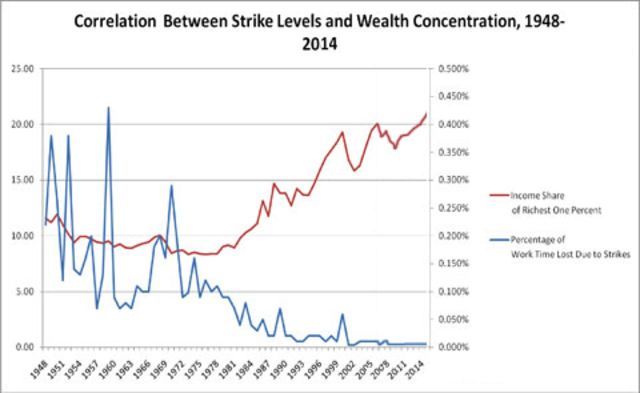
Correlation between strike levels and wealth concentration: 1948-2014
This process depended on the suppression of the class struggle. The ruling class relied on the trade unions to undermine working class opposition, block strikes, and isolate and betray them when they broke out. The fever chart of rising stock prices, accordingly, is in inverse proportion to the decline and virtual disappearance of strikes in the United States over this period.
But the ability of the ruling class to count on the unions to police the workers is breaking down. In the United States, the United Auto Workers union is completely exposed and discredited by a corruption scandal involving company bribes to union officials in return for the imposition of concessions contracts on the workers.
As the World Socialist Web Site stressed at the beginning of the year, 2018 will be marked above all by a rise in social tensions and a revival of working class struggle on an international scale.
The long historical cycle dominated by the artificial suppression of the class struggle is coming to an end. A new period, which will see a counteroffensive by the working class to win back all that it has lost and more, has opened up.

Nigeria Energy Forum Africa Energy Ideas Competition for Early-stage Entrepreneurs 2018

Application Timeline: 
  1. Deadline for proposal submission: 20th February, 2018
  2. Announcement of submissions selected for the final round: 4th March, 2018
  3. Deadline for final submissions: 23rd March, 2018
  4. Announcement of winners: 17th April, 2018.
Eligible Countries: African countries
To Be Taken At (Country): Lagos, Nigeria
About the Award: The 2018 Africa Energy Innovation Competiton is set to accelerate the development of early-stage energy firms across Africa. Across Africa, the main energy challenge is to rapidly deliver modern energy services to millions of households and businesses using sustainable and affordable energy technologies. This competition challenges early-stage energy entrepreneurs from Africa to collaborate with local research institutions or industries to develop a prototype model of a key device/equipment for a social energy enterprise or energy management system using local resources.
Type: Contest, Entrepreneurship
Eligibility: Young professionals between the ages of 18 and 35 years from Africa are invited to participate in the competition and nominate a relevant local research institution or organization. Applications may be submitted by a team of up to three people. At least 1 member of the team must be from the local research institution or industry. Teams may be formed across different schools, institutions, companies, countries etc. Individuals or teams may submit multiple applications.
Selection Criteria: The first round of submissions will be evaluated using the following attributes:
  • Local Content: utilize local resources, demonstrate the use of local expertise, alternative energy services or efficient solutions for powering agriculture, education, healthcare, industries etc.; and be significant enough to impact large numbers of people, households and/or businesses.
  • Originality and creativity: present solutions that are original, creative in areas that are either underdeveloped or severely underdeveloped in research and literature.
  • Commercial Viability: proposed prototype model should be realistic, practical rather than just theory, cost-efficient and outline commercial arrangements that address obvious roadblocks, using a specific prototype model.
  • Clarity: ideas should be presented in a clear and concise manner with realistic completion timeline.
Value of Award: The finalists and winners will be selected by a panel of academics and experienced development professionals from public and private sector institutions. Winners of the competition get the opportunity to:
  • ⇒  Pitch their proposed prototype model at the 2018 Nigeria Energy Forum, in Lagos, Nigeria, using a poster and short video.
  • ⇒   Benefit from unique networking opportunities with other young leaders as well as some of the most senior decision-makers in government, international development, academia and the private sector.
  • ⇒ Attend a range of business development workshops, receive support from a dedicated start-up incubator and a cash prize of up to $3,000 to demonstrate the proposed solution.
How to Apply: Your proposed prototype model submission must not exceed 1-side of an A4 page and should include the following:
  • Project Title
  • Your solution (250 words)
  • Partner Institution or Industry
  • Expected impact (50 words)
  • Short abstract (50 words)
  • Design tools and method (50 words)
  • Problem Statement (50 words)
Estimated costs and timeline (50 words)
  • Submissions must be in Microsoft Word or PDF format by email to info@thenef.org.
  • The subject line of the email should follow the format: [Country] Title of the Project.
  • Submissions that exceed the word count may be disqualified. Shortlisted submissions would be invited to participate in the final round by submitting a 1-page poster to summarize their design, with a detailed budget, 2-page Design Brief, and a Short 2-minute video to describe a prototype model of the proposed solution.
Award Providers: Nigeria Energy Forum
Important Notes: Disclaimer: By participating, applicants accept and understand the contest guidelines and agree to the decisions made by the judges; and to release, discharge or hold the Nigeria Energy Forum Committee from all claims arising from their participation in the contest. Participants also release the rights to their entries upon submission. The NEF team reserve the right to make changes to the contest

Academy of Science of South Africa (ASSAf)/The World Academy of Sciences Regional Office for sub-Saharan Africa (TWAS-ROSSA)/American Association for the Advancement of Science (AAAS) Regional Training Workshop for African Researchers 2018

Application Deadline: 9th February 2018
Eligible Countries: Countries in sub-Saharan Africa
To Be Taken At (Country): South Africa
About the Award: Two trends are becoming clear in the early part of this century: the majority of challenges facing society have an international or global dimension; and science, technology and their applications underpin the cause of or the solution to these challenges. As a result, science and technology are becoming ever more embedded into the foreign policies and development agendas of nations. Moreover, cooperation in science and technology is increasingly benefiting
from both the technical and political interactions between states.
Given the growing role of science and technology in international relations, this 5-day workshop will expose participants to key contemporary international and regional science policy issues including large scientific collaborative infrastructure, transnational approaches to biodiversity conservation, food and energy security, water management and health, among others, while providing an overview of how science, technology and innovation contribute to policy development, global governance and conflict resolution.
Another focus of the meeting will be to gain a better understanding of, and appreciation for, the roles that governments, academia, international organisations and the private sector play in addressing complex science-based issues such as the Sustainable Development Goals (SDGs), and the different governance structures required for the involvement of these different stakeholders.
Finally, the workshop will take stock of science diplomacy case studies and experiences in the various forms that they take in Africa and build strong networks to foster the next generation of science diplomats in the region.
This workshop will encourage active interaction among participants, speakers and facilitators as they develop ideas and strategies to enhance science diplomacy in the region.
Type: Workshop, Training
Eligibility: 
  • Applications are invited from young scientists (up to the age of 40), as well as scientists and/or government officials, etc., with more experience in the policymaking arena (‘science diplomacy ambassadors’).
  • This training workshop is designed for young scientists (below the age of 40) living and working in sub-Saharan Africa and whose research and wider engagement has brought them into the international policy-making arena, as well as policymakers and diplomats interested in some of the central science-based themes that might influence their work, and representatives from NGOs and other sectors working at the science-diplomacy interface. Alumni will join a global
    network of young leaders and innovators reaching across borders to address societal challenges and become agents of change in their countries and sectors.
  • Women from Science & Technology Lagging Countries (STLCs) are especially encouraged to apply. These countries include: Angola, Benin, Burkina Faso, Burundi, Cameroon, Central African Republic, Chad, Comoros, Congo, Côte d’Ivoire, Democratic Republic of Congo, Eritrea, Ethiopia, Equatorial Guinea, Gambia, Ghana, Guinea, Guinea-Bissau, Kenya, Lesotho, Liberia, Madagascar, Malawi, Mali, Mauritania, Mozambique, Niger, Rwanda, Sao Tome and Principe, Senegal, Sierra Leone, Somalia, South Sudan, Sudan, Swaziland, Tanzania, Togo, Uganda, Zambia, and Zimbabwe
Number of Awards: Not specified
Value of Award: Economy class flights, local transport and accommodation in South Africa will be covered for selected participants. A limited number of spaces for self-funded and partially-funded candidates will also be available. We encourage applicants to seek support from their institutions and to include a plan for how they will apply the newly gained knowledge and skills back in their organisation.
Duration of Program: 21 to 25 May 2018.
How to Apply: The completed application should be submitted via the online system which is accessible on: http://bit.ly/sciencedipcourse
Award Providers: Academy of Science of South Africa (ASSAf)/The World Academy of Sciences Regional Office for sub-Saharan Africa (TWAS-ROSSA)/American Association for the Advancement of Science (AAAS)

UNESCO/ISEDC Co-Sponsored Fellowships Program for Developing Countries 2018 – Russia

Application Deadline: 3rd April 2018
Offered Annually? Yes
Eligible Countries: See list below
To be Taken at (Country): Russia
About the Award: The aim of this fellowships programme is to enhance the capacity-building and human resources development in the area of sustainable and renewable energy sources in developing countries and countries in transition. The training activities in the framework of these fellowships are tenable in specialized institutions in the Russian Federation. The medium of instruction will be English. UNESCO will solicit applications from the developing countries and countries in transition.
Fields of Study: The candidates may choose to study in the following fields of study, which are aligned with UNESCO’s objectives and programme priorities, as per approved 35 C/5 and in accordance with the decisions made by the Executive Board (161 EX/Decision 3.6.3 and 165 EX/Decision 8.6) :
(a) Energy and sustainable development;
(b) Ecological management of energy resources;
(c) Renewable energy;
(d) Sustainable and renewable energy power generation.
Type: fellowship
Eligibility: Candidates must meet the following criteria:
(a) Holder of at least a BSc degree or BA in Economics;
(b) Proficient in English language;
(c) Not more than 35 years of age;
Number of Awards: Twenty (20)
Duration of Award: One month duration: from 1 to 26 October 2018.
AFRICA (46 Member States): Angola*, Benin*, Botswana, Burkina Faso*, Burundi*, Cameroon, Cape Verde*, Central African Republic*, Chad*, Comoros*, Congo, Côte d’Ivoire, Democratic Republic of the Congo*, Djibouti*, Equatorial Guinea*, Eritrea*, Ethiopia*, Gabon, Gambia*, Ghana, Guinea*, Guinea-Bissau*, Kenya, Lesotho*, Liberia*, Madagascar*, Malawi*, Mali*, Mauritius, Mozambique*, Namibia, Niger, Nigeria, Rwanda*, Sao Tome and Principe*, Senegal*, Seychelles, Sierra Leone*, Somalia*, South Africa, Swaziland, Togo*, Uganda*, United Republic of Tanzania*, Zambia*, and Zimbabwe
ARAB STATES (15 Member States): Algeria, Bahrain, Egypt, Iraq, Jordan, Lebanon, Mauritania*, Morocco, Oman, Palestine, Saudi Arabia, Sudan*, Syrian Arab Republic, Tunisia, Yemen*
ASIA and THE PACIFIC (39 Member States): Afghanistan*, Bangladesh*, Bhutan*, Cambodia*, China, Cook Islands, Federal States of Micronesia, Fiji, India, Indonesia, Iran (Islamic Republic of), Kazakhstan, Kiribati*, Kyrgyzstan, Lao People’s Democratic Republic*, Malaysia, Maldives*, Marshall Islands, Mongolia, Myanmar*, Nauru, Nepal*, Niue, Pakistan, Palau, Papua New Guinea, Philippines, Samoa*, Solomon Islands*, Sri Lanka, Tajikistan, Thailand, Timor – Leste, Tonga, Turkmenistan, Tuvalu*, Uzbekistan, Vanuatu*, Viet Nam
LATIN AMERICA AND THE CARIBBEAN (32 Member States): Antigua and Barbuda, Argentina, Barbados, Belize, Bolivia (plurinacional State of), Brazil, Chile, Colombia, Costa Rica, Cuba, Dominica, Dominican Republic, Ecuador, El Salvador, Grenada, Guatemala, Guyana, Haiti*, Honduras, Jamaica, Mexico, Nicaragua, Panama, Paraguay, Peru, Saint Kitts and Nevis, Saint Lucia, Saint Vincent and the Grenadines, Suriname, Trinidad and Tobago, Uruguay, Venezuela
EUROPE (22 Member States): Albania, Armenia, Azerbaijan, Belarus, Bosnia and Herzegovina, Bulgaria, Croatia, Czech Republic, Estonia, Georgia, Hungary, Latvia, Lithuania, Poland, Montenegro, Republic of Moldova, Republic of Serbia, Romania, Slovak Republic, The former Yugolsav Republic of Macedonia, Turkey, and Ukraine
ASSOCIATE MEMBER STATE (1): Tokelau
How to Apply:
(a) All applications should be endorsed by the National Commission for UNESCO and must be duly completed in English or French with the following attachments in DUPLICATE:
  • The prescribed UNESCO fellowship application form;
  • Six photographs;
  • Certified photocopies of Diplomas
  • Certificate of English Language Proficiency.
  • Subsequently, for those who have been selected, the UNESCO medical examination form duly completed by a recognized physician (not more than four months before the actual date of studies)
The prescribed form of which will be sent along with the letter of award.
(b) Files which are incomplete or received after the deadline for the submission of applications and candidatures, and do not fulfil the requirements mentioned above, will not be considered.
(c) Each invited Member State is requested to nominate not more than two (2) candidates.
Sponsors: UNESCO, International Center for Sustainable Energy Development (ISEDC)
Important Notes: Selected fellows from countries where there are Russian Federation Embassies or Consulates must obtain their entry visa in their country prior to their departure. Fellows from countries where no such embassy/consulate exists must secure their visa through the nearest country where the Embassy or Consulate of the Russian Federation can be found.
UNESCO and ISEDC provide no allowance to defray passport and visa expenses.

World Citizen Talent Scholarship for International Students 2018/2019 – The Netherlands

Application Deadline: 31st March, 2018
Offered annually? Yes
Eligible Countries: Students from outside the European Union (and not from Iceland, Norway, Liechtenstein, Switzerland or Suriname)
To be taken at (country): The Hague University of Applied Sciences, Netherlands
Type: Bachelors/Masters
Eligibility: To be eligible for a World Citizen Talent Scholarship, candidate must:
  • Come from outside the European Union (and not from Iceland, Norway, Liechtenstein, Switzerland or Surinam).
  • Be enrolling for the first time at The Hague University of Applied Sciences.
  • have to pay the full institutional tuition fee rate.
  • Have never applied for this scholarship before.
  • Have not applied for the Holland Scholarship.
  • Have been provisionally accepted as a student (also-called offer of student position) on or before 1 May 2018.
Selection Criteria: Appointed judges will select the 54 students whose essays will have impressed them most to receive the scholarship. The decision of the jury is binding and you will be informed about it via email before 15 May 2018.
Number of Awardees: 54
Value of Scholarship: €5,000.
Duration of Scholarship: One-time
How to Apply: To apply for the scholarship, you must first apply to the Bachelor or Master programme of your choice and write an essay following the essay guidelines.
  1. Apply for the Master programme of your choice by using the online Osiris application tool.
  2. Write an essay (in English, 950 to 1100 words ) explaining why and how you can contribute to the multinational, multicultural beehive that is The Hague University of Applied Sciences. Please read the essay guidelines and information on the assessment procedure below before you start writing.
  3. Submit your essay by completing the scholarship application form between 1 November – 31 March.
Award Provider: The Hague University of Applied Sciences, Netherlands
Important Notes: Please note that you will only be awarded the scholarship after you have been conditionally accepted and have met all terms and conditions of enrolment. You will receive the scholarship amount of € 5.000, after your arrival in The Hague and have set up a Dutch bank account.

Transform Together Full-Time Scholarships at Sheffield Hallam University 2018/2019 – Undergraduate and Masters

Application Deadlines: 31st May 2018 for September 2018 start
Offered annually? Yes
Eligible Countries: International
To be taken at (country): Sheffield Hallam University UK
About Scholarship: Are you ambitious? Do you want to represent international students at Sheffield Hallam University now and in the future? If so, these exclusive and competitive scholarships are aimed at you.
Transform Together scholarships are open to students from any non-EU country applying to study at Sheffield Hallam University to enrol in the next academic year.
The scholarships will be awarded to well-qualified students who demonstrate academic, personal or professional achievement on their scholarship application form. Successful applicants will be awarded with a certificate to mark their achievement following enrolment on their course.
Type: Undergraduate and Postgraduate
Selection Criteria and Eligibility: To be eligible to apply for one of these scholarships you must;
  • Be an international or a European Union (non-UK) fee paying student
  • Postgraduate only – have achieved a minimum 2.1 or equivalent in your honours degree and must meet the English and academic entry requirements for your course.
  • Undergraduate only – have achieved the English and academic entry requirements for the course. If you are awarded an undergraduate scholarship, you must successfully complete each year of study to continue to receive the fee waiver.
  • Have accepted an offer for a full-time taught undergraduate or postgraduate course at Sheffield Hallam University.
  • Be fully self-funding your studies
  • Be able to pay any additional fees your course may require, for example field trips
You are not eligible to apply if you
  • Are receiving full or part funding for your studies from a sponsor or other scholarship provider
  • Are studying a Sheffield Hallam course at a partner institution, or
  • Have an offer for our Graduate Certificate International Pre-Masters in Business and English or International Foundation Programme in art, design and media or business, law and social sciences, and Science, Technology, Engineering and Maths. You can apply for a scholarship for the course that you will progress onto following successful completion of the preparation programme.
Number of Scholarships: Not specified
Value of Scholarship: Half fee waiver (50%) is available for postgraduate courses and for each year of an undergraduate degree.
A package of incentives is to be confirmed, but will include
  • the opportunity to become an alumni ambassador back in your home country
  • a programme of events which aims to enhance your learning and social experience with fellow scholars
  • a Sheffield Hallam University hoodie
Successful scholars will be expected to represent Sheffield Hallam University through various activities during the academic year and after graduation.
Duration of Scholarship: for full period of study
How to Apply: To apply for a Transform Together Scholarship, please follow these steps
  • Apply for a course at Sheffield Hallam. If you have not applied for a course, please visit our online prospectus
  • Check you meet the scholarship eligibility criteria listed below
  • When you have accepted an offer to study on a course here, apply for a scholarship online using the link below by the closing date of 31 May 2018
  • Send your academic transcripts to globalscholarshiptranscripts@shu.ac.uk by 31 May 2018
  • You will be notified if you have been successful within one month of the deadline. All decisions are at the University’s discretion and are final.
Sponsors: Sheffield Hallam University

Rice University Business Plan Competition for Student Entrepreneurs 2018

Application Deadline: 5:00 pm CST, Friday, 9th February, 2018
  • Accepted teams will have until 5:00 PM CDT Monday, March 12, 2018 to submit a 10-page (maximum) Business Plan and Media materials
  • Accepted teams have the option (but are not required) to make revisions to their business plan and submit a new version by 5:00 PM CDT Saturday, March 31, 2018
Eligible Countries: All
To Be Taken At (Country): Houston, Texas
About the Award: The Rice Business Plan Competition is the world’s richest and largest graduate-level student startup competition. It is hosted and organized by the Jesse H. Jones Graduate School of Business at Rice University and the Rice Alliance for Technology and Entrepreneurship, Rice University’s internationally-recognized initiative devoted to the support of entrepreneurship. This is the 18th year for the competition. In that time, it has grown from nine teams competing for $10,000 in prize money in 2001, to 42 teams from around the world competing for more than $1 million in cash and prizes.
Sectors: business plans and companies should fall into one of four categories, or sectors:
  1. Life Science – includes (but not limited to) Medical Devices, Therapeutics, Diagnostics, Health IT, Biotechnology
  2. Energy/Clean Technology – includes (but not limited to) Sustainability, Water, Battery Technologies, Control Systems, Smart Metering, PV Technology, Natural Gas, Transportation/Mobility, Oil & Gas Technologies, Algae, Fuel Cells, Hybrid Vehicles
  3. Information Technology – Includes (but is not limited to): Mobile Apps, Software, Digital Media, Consumer Web, Bto-B Applications, Enterprise Software, SAAS, Internet, Web, Virtual Reality, Big Data, Machine Learning, Artificial Intelligence, Drones, Hardware, Robotics, Unmanned Vehicles
  4. Other Innovations – Includes (but is not limited to): Advanced Materials, Nanotechnology, Composites
Teams must choose one sector/category for their companies. Teams may chose a second sector/category, though a second sector/category is optional and not required. Please choose sectors/categories that best align with your company’s product, technology, system or mission.
Type: Entrepreneurship/Contest
Eligibility: Teams must meet all the following eligibility requirements in order to be selected to compete:
  • Student Enrollment: The competition is for degree-seeking students currently enrolled on a full- or part-time basis (i.e., in the academic year from July 1, 2017 through June 30, 2018). This includes students who graduated, or will graduate any time after July 1, 2017. (For example, December 2017 graduates are eligible to compete). Students who graduated before July 1, 2017 are not eligible to participate. Adjustments may be made for teams from non-U.S. universities that have a different academic calendar; please contact the RBPC director if you are from a non-U.S. school and feel this applies to you.
  • Outside Funding Limitations: All ventures must be seeking outside equity capital, typically early-stage venture capital investment or early-stage angel investment. All ventures must be “for profit” entities. This is an early-stage pitch competition, therefore, startups that have raised more than $250,000 in equity capital from sources other than the students or their friends or families prior to July 1, 2017 are not eligible to compete. Startup teams may have raised  ANY level of equity funding AFTER July 1, 2017. Equity funding awarded as part of an accelerator/incubator program does count toward funding limits.
  • The following do not count toward funding limit: Research and other grants; competition winnings; traditional loans; and any friends and family funding.
  • Revenue Limitations: Ventures with more than $100,000 in revenues in prior academic years (before July 1, 2017), are
    excluded.
  • Prior Activity: Both student and other team members may have worked on an idea or new technology in previous academic years, or in the case of the student team members, even prior to entering graduate school, provided that their venture’s revenues and equity capital raised does not exceed the above limits.
  • Team Composition: This is a competition primarily for graduate-level students. All graduate students, not just MBA candidates, are eligible to participate in the competition. This includes, but is not limited to, PhD candidates, MBA students, MD candidates, JD candidates, and other Masters candidates. Competing team members may be from different disciplines and/or different universities. However, undergraduates are allowed to compete fully, as long as at least one member of the presenting team at the RBPC is a currently-enrolled graduate student and a member of the venture’s startup management team, and part of the team that presents in the competition (competing team). In other words, a team of two students could be comprised of one undergraduate student and one graduate student. Alternatively, a team of five students could be comprised of four undergraduates and one graduate student.
  • Minimum Team Size: The presenting team that competes at Rice University must include at least two current students and not exceed five current students. In other words, at least two members from each startup team must travel to Rice to compete, and both of these two members must be current students. The purpose of this rule is to encourage startups to enlist at least two founders in order to increase the potential for a successful startup.
    Maximum Team Size: Teams may bring up to five startup team members who participate in the presentations on Friday and Saturday. In other words, at least two and no more than five startup team members may participate in the verbal presentations on Friday and Saturday. Others involved in the venture (non-students, faculty advisors or mentors) are welcome to travel to Rice with the competing student team, but are prohibited from participating in the presentations or Q&A sessions. More than five students can travel to Rice with the team, but only five students can serve as presenters. In fact, we encourage the team to bring a faculty, staff or other advisor with them to the RBPC, and we will invite them to attend our special lunch with the Dean of the Rice business school on Friday afternoon.
  • Team Presentation: at least two student members of the startup should participate in every round of presenting the startup’s investment pitch (i.e., the startup business plan presentation) on Friday and Saturday, April 6-7. Of the team members presenting, at least two of them must verbally present in the rounds they are involved in. To “verbally Present” means give/speak at least 20-30% of the presentation. The intention is that at least two team members share speaking responsibilities in the presentation section. The Q&A does not count toward the presentation time. The team may divide speaking time in their presentation however they choose, but a minimum of two members must speak at some point in the main presentation.
    The exception is the Elevator Pitch Competition on Thursday, April 5, where only one member of the team will be able to give the 60-second presentation.
  • Student Involvement: The competition is for student-created and student-managed ventures, including new ventures launched by licensing university technology. Students participating in the competition (i.e. members of the founding team) are expected to:
    • be a driving force behind the new venture,
    • have played a primary role in developing the business strategy
    • have key management roles in the startup venture, and
    • own significant equity in the startup venture.
  • Faculty Involvement: Each team MUST have the endorsement of a faculty or staff advisor at their school and must provide contact information for their faculty advisor, regardless of whether or not the advisor will travel with the team to Rice University. All faculty advisors will be asked to confirm the eligibility of the team.
  • Nature of Ventures: The competition is for new, independent ventures in the seed, start-up, or early growth stages. Generally excluded are the following: buy-outs of existing businesses, expansions of existing companies, real estate syndications, tax shelters, franchises, licensing agreements for distribution in a different geographical area, and spinouts from existing corporations. Licensing technologies from universities or research labs is encouraged.
  • Prior Activity: Technologies may be presented in the RBPC only once. Competing team members may participate in the RBPC more than once if entering with a new venture/new technology.
  • Attendance: To be considered for any award, all competing (presenting) team members must arrive at Rice on Thursday, April 5, 2018 by 12:00 PM (Noon) CDT and be present on campus on Thursday, April 5, 2018 at 6:30 PM CDT for the Elevator Pitch Competition; on Friday, April 6, 2018 at 8:30 AM CDT for the First Round; and on Saturday, April 7, 2018 at 8:00 AM CDT for the Semi-Final or Challenge Round. Teams may not add or substitute presenting members during the competition. Teams must attend the Awards Banquet on Saturday night to receive their awards. Teams should plan their return travel no earlier than Sunday morning.
  • Required Forms: Each team will be required to provide appropriate documentation to receive award payments which include W-9 and/or EIN forms for US teams, and W-8 BEN forms for International teams No prizes can be awarded without the required forms submitted.
Value of Award: 
  • Rice University will provide an intense, immersive experience over the course three days for student startup founders to pitch to investors, receive multiple rounds of feedback and advance their startup.
  • There will be over $1 million in prizes, and all 42 teams who compete at Rice University in Houston are guaranteed to win cash prizes. The minimum cash prize is $500 and the grand prize winner receives a $300,000 investment (typically in the form of a convertible debt note, without geographic restrictions.)
Duration of Program: April 5-7, 2018
How to Apply: Submit your application online at www.rbpc.rice.edu
  • One member of your team, the designated team leader, should complete the simple online application. The application consists of contact information and eligibility requirements, a 2-5 page Executive Summary, and an optional 1-2 minute
    Video Elevator Pitch.
  • There is no cost to apply or to compete. Multiple student startup teams from the same school, institution or university center may apply to compete. There is no limit on the number of applications per school. The startup teams competing at Rice must include at least two degree-seeking students, including at least one graduate level student. (See details in Eligibility Requirements section.)
  • Once an application is submitted, no changes can be made.
  • We hope to offer all teams all teams that complete an application will receive a free 6-month subscription to Live Plan by Palo Alto Software. Instructions about your subscription will be provided after the application deadline.
  • Teams invited to compete in the Rice Business Plan Competition will be notified by email on or before Thursday, March 1, 2018.
Award Providers: Rice University

Ayada Lab French-German Incubation Lab for Entrepreneurs in West Africa 2018

Application Deadline: 16th February 2018
Eligible Countries: West African countries
To Be Taken At (Country):  Côte d’Ivoire, Cameroon, Nigeria, Senegal and Ghana
About the Award: It consists of local and regional workshops, mentoring by some of the best African entrepreneurs in the fields of cultural, digital and social entrepreneurship, networking with leading German and French cultural, social and digital entrepreneurs. The program takes place in English and French, the two languages of the Lab.
Type: Entrepreneurship
Eligibility: Young West Africans entrepreneurs who meet the following criteria are more than welcome to apply :
  • Aged between 20 and 35
  • Be a national of and based in either Côte d’Ivoire, Ghana, Senegal, Nigeria or Cameroon
  • Have a 1 year project experience or a tested idea creating value of innovation with high impact on society
  • Have a project in the Cultural and Creative industries (fashion, books, cinema, etc.), Digital (online courses, e-learning, digital education), or Civil society issues (education, women rights and empowerment, civic tech, active citizens)
Number of Awards: Not specified
Value of Award: 
    • Networking trips: to France and Germany to meet with European creative and tech industries experts
    • Individual mentoring: Round 2 selection of candidates for a full year individual mentoring and participation in the AYADA Lab regional workshop
    • Local & regional workshops: Taking place in Côte d’Ivoire, Ghana, Senegal, Nigeria and Cameroon, with African cultural, social and digital experts to bolster the startups
Duration of Program: 12 months
How to Apply: Apply Now
Award Providers: Institut Francais, Goethe Institut

European Journalism Centre (EJC) Journalism Grants for Reporting on Opportunities for Women in Developing Countries (€200,000 Grant Award) 2018

Application Deadline: 21st February 2018 (22:00 CET)
Eligible Countries: All
About the Award: “The Innovation in Development Reporting Grant Programme has granted over €4.5m to almost 400 grantees worldwide. In this latest round, we’re looking to add to that community by supporting newsrooms and freelancers covering compelling topics,” said European Journalism Centre Director Adam Thomas. “The jury are first and foremost looking for a strong, under-reported story angle. Regardless of innovative format, whether it’s via print or virtual reality, awarded projects will also demonstrate a strategic and focused approach to reaching the right audience, at the right time.”
Type: Grants
Eligibility: The stories must report on one or more of the world’s developing countries, (ideally Least Developed Countries (LDCs)), and/or the key European donor countries’ development relations with these countries.
  • Whether tackling women’s lifelong learning, health, jobs, entrepreneurship, or new roles in their communities, the projects pitched should be original, under-reported, critical and nuanced.
  • Freelancers, staffers and media organisations are eligible to apply.
  • There is no citizenship, nationality or residence/location restriction on the applicants as long as the final results are published in media outlets with significant reach to audiences in the following European countries: France, Germany, the Netherlands, Sweden and United Kingdom.
  • Journalists who are not specialists in development issues are strongly encouraged to apply as well.
Selection Criteria: Selection criteria include editorial focus and quality, impact and reach, and innovation. Previous winners have involved creative uses of video, audio, imagery, data, text, maps, graphics, quizzes, animation and other engaging content forms.
Number of Awards: Not specified
Value of Award: The grant given is up to €20,000 per project.
How to Apply: Applications can only be submitted via this online application form
For further information on applications eligibility criteria, click here.
Award Providers: The European Journalism Centre is running the Journalism Grants Programme with support from the Bill & Melinda Gates Foundation.

Bristol University Think Big Scholarships for Undergraduate and Postgraduate International Students 2018 – UK

Application Deadlines: 
  • The deadline for the first round is Friday 23rd March 2018.
  • The deadline for the second round is Friday 29th June 2018.
Eligible Countries: International
To Be Taken At (Country): University of Bristol, UK
About the Award: Bristol University is committed to helping and nurturing global talent to produce the future leaders of tomorrow.
Field of Study: Any full-time Undergraduate programme (except Medicine, Dentistry and Veterinary Science) or Postgraduate programme offered at the University
Type: Undergraduate, Postgraduate
Eligibility: You can apply for a Think Big Scholarship if you:
  • •  are classed as an overseas student for fee purposes AND
  • •  applied to start a full-time undergraduate degree in one of the qualifying course or one year, full-time taught postgraduate programme at the University of Bristol in September 2018.
Number of Awards: 26 Undergraduate scholarships AND 26 Postgraduate scholarships.
Value of Award: Award covers between 25 and 100 per cent of tuition fees for the duration of your course.
Duration of Program: Duration of candidate’s chosen program
How to Apply: To apply for this scholarship, download and complete the required (either undergraduate or postgraduate) application form on the Program Webpage and email it to international-partnerships[at]bristol.ac.uk.
Go through the Application procedure on the Program Webpage before applying.
Award Providers: Bristol University

United Nations Teen Advisors Program for Young Girls around the World 2018

Application Deadline: 12th February 2018
Eligible Countries: All
About the Award: The Teen Advisor program is where Girl Up truly lives out its “by girls, for girls” mission. Composed of a widely diverse group of teenage girls, Teen Advisors are passionate change-makers who together spread and fuel Girl Up’s work. As Teen Advisors, they are central to all Girl Up decision-making including advocacy, fundraising and communications strategy. To support the Teen Advisors in this task, Girl Up provides skills-based trainings, professional development opportunities, hands-on learning, and most significantly, personal relationships with the staff.
Since the first Teen Advisor class served the 2010-2011 school year, these seven classes collectively have raised, 117 Teen Advisors have collectively raised nearly $500,000, completed more than 7,000 hours of service, hosted hundreds of events in their communities around the world and performed nearly 500 advocacy actions – including in-district meetings and countless letters and calls to congress.
Teen Advisor Responsibilities include:
  • Attend and actively participate in and prepare for monthly calls/webinars (scheduled for the second Sunday of every month)
  • Attend two mandatory in-person meetings — one preceding the annual Leadership Summit in Washington D.C. (mid-July), the other in January or February of the following year (for those U.S. applicants, the weekend generally follows either MLK….”
  • Start and/or lead a Girl Up Club in your school or surrounding community
  • Regularly contribute to the Girl Up Community, an online hub for Girl Up Clubs and Campuses
  • Represent Girl Up in the media and at events in their communities
Type: Training
Eligibility: Applications are open to self-identified girls from the U.S and outside the U.S. Applicants:
  • Must be entering the U.S. equivalent of 9th-12th grades
  • Display a sense of maturity, cultural-sensitivity, and openness to learning about different cultures
  • Be committed to the empowerment of girls and women
  • Possess strong leadership skills and have proven desire to become a globally-minded citizen through meaningful discussion, learning and action in their community and school
  • Have knowledge of and passion for Girl Up’s mission and vision for adolescent girls around the world
  • Be able to complete all Teen Advisor responsibilities as outlined below
Number of Awards: Not specified
Value of Award: 
  • Access to United Nations speakers, agencies and initiatives
  • Access and financial support to attend speaking and blogging opportunities for special events and conferences like the Social Good Summit and International Day of the Girl
  • Intensive skills-based trainings, professional development opportunities, hands-on learning
  • An insider’s view into Girl Up through constant communication with staff, and most significantly, personal relationships
  • Decision-making power in the work of the campaign
Duration of Program: Program starts June 1 2018. Runs for 1 year
How to Apply: Every January, Girl Up opens the first round of applications to teen girls who are ready and excited to change the world. Girl Up selects girls from the first round and invites them to complete the full second round application. Girl Up reviews those applications and notifies the new class of Teen Advisors in mid-April. Teen Advisors serve for one year beginning June 1.
Award Providers: United Nations Foundation.