9 Apr 2016

Western powers press ahead with plans for new war in Libya

Marianne Arens

Five years after NATO's Libya war, Italy, the EU and the US are in the advanced stages of preparations for the next military intervention. The Western imperialist powers want to establish their own military bases in Libya in order to control the country's massive sources of oil and natural gas, and secure an important gateway to Africa.
For months, the North African country has seen a secret build-up of American, British, French and Italian agents and officers, while reconnaissance and armed drones controlled from Sigonella in Sicily have conducted surveillance missions and air strikes in Libya.
Last week, the EU and US moved forward with the installation of their puppet regime in Tripoli. The designated government leader, Fayiz as-Sarraj, left his exile in Tunisia on Wednesday by ship and arrived in the Libyan capital at the head of a nine-member-strong government delegation. As-Sarraj is a front man built up by German UN negotiator Martin Kobler, and has been tasked with demanding an official military intervention at the United Nations as soon as possible against ISIS forces in Libya.
As-Sarraj, a 54-year old architect from Tripoli, has been dispatched to form a so-called government of national unity. He has returned to a deeply-divided and ruined country, in which at least two governments and five militias are conducting a bloody civil war. As-Sarraj can at most rely on the half-hearted support of a section of the internationally recognised parliament which is currently located in Tobruk in the east of the country.
A counter-parliament sits in Tripoli, supported by the Muslim Brotherhood, along with a counter-government under Chalifa al-Ghweil.
A special role is being played by General Chalifa Haftar, a former officer in the government of Muammar Gaddafi, who participated in Gaddafi’s overthrow in 2011 on behalf of the CIA. Haftar now commands the Libyan Army. Neither Haftar nor the counter-parliament in Tripoli has recognised the legitimacy of the as-Sarraj government.
Since Saturday, Al-Ghweil and his followers have gone to ground. As the ruler of Tripoli, he had previously opposed the arrival of as-Sarraj with all means at his disposal. He had imposed a state of emergency on the city and closed the airport. Then he had demanded as-Sarraj either surrender or return to Tunisia. He called him an "illegal intruder" who wanted to subordinate the country to international forces.
By necessity, as-Sarraj had to hole up in the naval base at Abu Sittah since all the roads to Tripoli were blocked. From there, in his first government statement, he promised to lead the country in a struggle against ISIS, respect Sharia Law and reopen the Libyan central bank.
For its part, the central bank issued a statement welcoming the as-Sarraj government as the "start of a new era". It called for "the production and export of oil and gas" to be restarted. A similar statement was issued by the National Oil Company.
In the meantime, in Tripoli, the shooting and bloody battles between the rival militias intensified. On the night following as-Sarraj's arrival, at least one man was killed. Militias supporting the counter-government stormed the Qatar-financed broadcaster Nabaa, closing it down. Schools and public facilities remained closed.
Like the US in Kabul in 2001 or Bagdad in 2003, Italy and the European Union now confront the problem of needing a militarily-secured "Green Zone" for their puppet regime in Tripoli. But to do this they only have recourse to a few forces in Libya. As the Intercept has exposed, a private mercenary outfit headed by Blackwater founder Erik Prince has already offered its services.
A Libyan military unit from Misrata has declared its support for the new government. Its fighters are in the pay of the Italian government and are protecting oil extraction facilities owned by the Italian oil company ENI in western Libya. Italy has never shut down its oil and gas extraction in Libya.
The Western powers are not choosy in their alleged fight against Islamic State, relying on other extremist Islamic forces. The criteria are not "Western values," as is typically claimed, but exclusively the willingness to collaborate with the imperialists. The militias are paid using the remains of Libya's state finances, which have sat in frozen bank accounts in Europe since the overthrow of Gaddafi.
Significantly, the list of 32 ministers in as-Sarraj's new government contains four people who are regarded as Islamic fundamentalists since they belong either to the Muslim Brotherhood or the Libyan Islamic Fighting Group (LIFG). The founder of the LIFG, Abdel Hakim Belhadj, is a former al-Qaida fighter and confidante of Osama bin Laden. As the blogger Angelika Gutschke revealed in the newspaper Freitag, the UN negotiator Martin Kobler met with Belhadj in Turkey to discuss the formation of a new government.
Upon his arrival in Libya, the US, the European Union, Italy, Germany, France and the UK congratulated as-Sarraj and immediately recognised his government as the "only legitimate representative of Libya". German Foreign Minister Frank-Walter Steinmeier expressly welcomed the "unity government". On the fringes of a meeting in Uzbekistan, he called for "all political forces in the country" to support the new government in Tripoli.
The EU has imposed sanctions against Libyan politicians like al-Ghweil for fighting against as-Sarraj, also imposing a travel ban to the EU and freezing his European bank accounts.
Following as-Sarraj’s imposition, French Foreign Minister Jean-Marc Ayraul spoke expressly in favour of an intervention: "We must be prepared to react if the unity government of Fayiz as-Sarraj asks for help, if necessary on the military front."
The Italian Foreign Minister Paolo Gentiloni demanded all those holding power in Libya to quickly recognise the new government, otherwise threatening that the "international community" would intervene with military strikes all the more rapidly. The Italian Parliamentary Speaker Laura Boldrini, a party colleague of Left Ecology Freedom’s Nichi Vendola, also did not oppose air strikes, but merely tied them to the demand that "there must be a unity government, which asks for an intervention."
Such an intervention has been in the works for more than a year. In mid-March, Italian Defence Minister Roberta Pinotti confirmed that plans for an intervention have existed for over a year. Italy would head a UN mission with up to 6,000 soldiers, which would be supported by air strikes from airbases at Trapani and Sigonella in Sicily.
Dozens of Italian Special Forces, from the military and intelligence agencies, have been active in Libya for weeks, working alongside military "specialists" from Britain, France and the US. A February 10 decision of the Italian government places the Italian forces in Libya under the direct control of the Prime Minister Matteo Renzi.
When as-Sarraj landed in Tripoli, Renzi was attending the summit on nuclear safety in Washington. Above all, President Barrack Obama spoke there in favour of an intervention, since the installation of as-Sarraj could at best "strengthen the structure” of the Libyan state.
The Italian elites are pushing to play a leading role in any military mission. Under the headline "Libya: Preparing for intervention," the right-wing newspaper Centro-Destra wrote that military control of the Mediterranean was of crucial importance, saying this time Italy must play a leading role. It was a priority to avoid "Italian interests being ignored in Libya. ... In other words: If Italy had only a minor role and not the role of the protagonist, then everything would be in vain. That would be the farce of the 2011 tragedy."
In the daily Corriere della Sera, the US Ambassador in Rome, John Phillips, demanded the deployment of up to 5,000 Italian soldiers. He said, "Libya is a top priority for Italy, and is also very relevant for us. It is important that Italy takes the lead of an international action."
In contrast, the vast majority of the Italian population rejects military intervention in Libya. Even Centro-Destra had to admit: "The shadow standing over the whole thing is that a survey recently showed that 81 percent of citizens are against any kind of intervention."
The imperialist powers are exploiting the chaos that they themselves have created as a pretext for a massive intervention. Five years ago, the pretext was that civilians in Benghazi had to be saved from an impending massacre by Gaddafi's army. As a result, approximately 30,000 fell victim to the NATO military operation. Gaddafi was murdered in a lynch mob, Libya's civilization, economy and infrastructure were destroyed, approximately two million Libyans were forced into exile and hundreds of thousands became displaced persons inside their own country.
According to the Economist, Libya is the state "with the world's fastest shrinking economy in 2016". Oil production is at an all-time low; the infrastructure has collapsed. The Libyan Dinar is at its lowest level since its introduction, and many banks are closed. Prices are rising constantly. One third of the Libyan population of six million lives in poverty, and one million people suffer from hunger.
In the 2011 war, NATO unleashed Islamist fighters as proxies and ground forces, and supplied them with weapons, partly through Turkey, Saudi Arabia and Qatar. They thus laid the foundation for today's rival militias, and also for the development and advance of ISIS in Syria, Iraq and Libya itself.
The Islamic fundamentalists were first armed and supported against Gaddafi. Later, with vast quantities of arms from Gaddafi's arsenals, they were deployed to Syria where they fought against Assad. Since 2015, ISIS fighters have begun returning to Libya, where they now serve the Western powers as the pretext for a new intervention.
Every city that put up resistance to the Islamists was bombed to the ground by NATO fighter jets. For example, Sirte, the birthplace of Gaddafi, which put up the longest resistance to the NATO war, was so badly damaged that ISIS was able easily capture it last year.
The Italian government has also named as a further casus belli the halting of the desperate flight of refugees from the imperialist wars in the Middle East and North Africa to Europe through Libya, or, as it is euphemistically referred to in official circles, the "fight against criminal traffickers.”
In an interview that was published prominently in several newspapers, Interior Minister Angelino Alfano said, "For Italy, the stability of Libya is not only decisive with regard to the anti-IS fight, but also for the issue of immigration, because over ninety percent of the ships start from there."
Following the closure of the so-called Balkan route, it is expected that once again refugees will undertake the dangerous passage across the Mediterranean to Europe. It is estimated that some 500,000 to 800,000 people have crossed the Sahara during the winter months in order to reach Libya, where they are now waiting for warmer weather to make the treacherous trip across the Mediterranean in hopes of reaching Europe.


Amid deepening slump, geopolitical and class tensions intensify

Nick Beams

The World Trade Organisation reported earlier this week that 2016 will see the growth in world trade fall below 3 percent for the fifth consecutive year, the slowest rate since the 1980s. This is another indication that, far from experiencing a “recovery,” the world economy is gripped by worsening stagnation.
The WTO said the volume of world trade would increase by only 2.8 percent this year, the same as in 2015. Significantly, it did not predict a bounce back in trade as it has in recent years.
The latest forecast is in line with a clear pattern established over the past six years. In the wake of the global financial crisis of 2008, world trade plunged in 2009, at one point falling at an even faster rate than at the beginning of the 1930s. There was a sharp recovery in 2010-2011, but since then the rate of increase of world trade has consistently remained below even the meagre levels of global economic growth. WTO economists wrote that “such a long, uninterrupted spell of slow but positive trade growth is unprecedented.”
The present situation stands in marked contrast to the years leading up to 2008, when trade experienced a rapid expansion, roughly double the rate of growth of the global economy.
The WTO report was issued on the eve of next week’s spring meetings of the International Monetary Fund and the World Bank, at which the IMF is expected to follow the pattern of recent years and revise downward its world economic growth forecast.
In a speech delivered in Frankfurt earlier this week, IMF Managing Director Christine Lagarde set the tone for the meetings, declaring that while the “recovery continues,” it remains “too slow, too fragile, and risks to its durability are increasing.”
She noted that world trade growth had slowed and financial stability risks had increased, with recent market turbulence “reflecting lower confidence in the effectiveness of policies”—a reference to fears that the quantitative easing measures of central banks, together with negative interest rates, are worsening, not improving, the situation. She added that “these dynamics could become self-reinforcing.”
The global outlook had weakened further over the past six months, she said, “exacerbated by China’s relative slowdown, lower commodity prices, and the prospect of financial tightening for many countries.” Emerging markets had largely driven what recovery had taken place, and it had been expected that advanced economies would “pick up the ‘growth baton.’”
However, Lagarde acknowledged, “That has not happened.” Downturns in Russia and Brazil had been larger than expected, while “many African and low-income countries also face diminished prospects.”
The worsening situation facing Africa was highlighted by a report issued by Capital Economics, a consultancy firm, which predicted that growth in the sub-Saharan region would fall this year to just 2.9 percent, its lowest rate in 17 years. John Ashbourne, the economist who prepared the report, said that risks to the “bleak forecast” were “almost entirely to the downside,” and that even the lowered growth prediction would be achieved only if “acute crises are avoided.” He concluded that “In sum, the much-vaunted ‘rise” [of Africa] seems to have stalled.”
In the face of this worsening global economic outlook, Lagarde repeated the IMF’s warnings of a tendency to turn inwards, close borders and retreat into protectionism. “As history has told us—time and again—this would be a tragic course,” she said. The answer was not fragmentation, but cooperation.
But every tendency is heading in the other direction. At the G20 meeting earlier this year, the IMF’s call for a coordinated economic boost to the world economy was rejected before it could even be placed on the table because of irreconcilable differences between the major economic powers.
Rather than increased collaboration, the geopolitical situation is characterised by a rise of economic nationalism reminiscent of the conditions that led to World War II, as every capitalist government, faced with a slowdown in world trade and growth, seeks to boost its position at the expense of its rivals through protectionist measures and the lowering of the value of its currency.
Both the European Central Bank and the Bank of Japan have sought to advance their own economic agendas by pushing down the value of the euro and the yen through negative interest rates and quantitative easing measures.
However, with the US Federal Reserve for the present moving away from further interest rate hikes, their efforts have been thwarted as the value of the US dollar has stopped rising. This has prompted an angry response in Japan—the Financial Times headlined an article “Japan lashed out against rise of the yen”—with the chief cabinet secretary, Yoshihide Suga, telling a press conference that the government was watching the foreign exchange markets with a “sense of tension” and would “take measures as appropriate.”
All of the major capitalist governments, having no economic solution, are increasing military spending and making their preparations for war, seeking to resolve the crisis by what Leon Trotsky called “mechanical means.”
The ongoing economic breakdown of the global capitalist system and the accompanying drive to war can be resolved only through the intervention of the international working class, the initial signs of which are emerging.
The growing support in the United States for Bernie Sanders, based on his denunciations of social inequality and Wall Street and his claims to be a socialist, and the mounting crisis of the official two-party system are of profound global significance.
Notwithstanding the fact that Sanders himself does not represent socialism, but rather is seeking to channel the movement back behind the Democratic party, the US presidential campaign indicates that in a country where any reference to socialism was taboo and anticommunism was a virtual state religion, the sleeping giant of world politics, the American working class, is beginning to stir into action.
Likewise, the eruption of strikes and demonstrations against the Hollande government in France, in the face of antidemocratic laws imposed as part of the bogus “war on terror,” has brought a “whiff of 1968” to the air.
The ruling classes are conscious of the potential dangers they face in the US, Europe and around the world. As she issued her downbeat assessment of global prospects, Lagarde warned of dangers to social stability and remarked that with the growth of individual fortunes and “persistent, excessive and rising inequality,” it is no wonder that “perceptions abound that the cards are stacked against the common man—and woman—in favour of elites.”
This potential must be actualised through the construction of the world party, the International Committee of the Fourth International, to arm the emerging struggles with a revolutionary socialist and internationalist program.

8 Apr 2016

IDRC Doctoral Research Awards

CALL FOR: APPLICATIONS
Deadline: May 18, 2016 by 16:00 (04:00 PM) (UTC-05:00) Eastern Time (US and Canada)
Eligibility:​This call is open to Canadians, permanent residents of Canada, and citizens of developing countries pursuing doctoral studies at a Canadian university.
Other eligibility requirements include:
  • Your research proposal must be approved by your thesis supervisor. Please provide proof.
  • Your proposed field research must take place in one or more developing countries, be conducted for a doctoral dissertation, and correspond to IDRC thematic priorities.
  • You must provide evidence of affiliation with an institution or organization in the developing region(s) in which the research will take place.
  • You must have completed coursework and passed comprehensive exams before taking up the award.
Duration: 3-12 months
Budget: Approximately 20 grants of a maximum of CA$20,000 each
Scope: IDRC Doctoral Research Awards are intended to promote the growth of Canadian and developing country capacity in research to improve the lives of people in the developing world. These awards are intended for field research in one or more developing countries. IDRC Doctoral Research Awards are intended to promote the growth of Canadian and developing country capacity in research to improve the lives of people in the developing world. These awards are intended for field research in one or more developing countries.

Special note: Candidates applying to this call for IDRC Doctoral Research Awards (IDRA) and indicating their area of work as related to the IDRC theme of Agriculture and Environment, will automatically be considered for what was previously entitled the Bentley Cropping Systems Fellowship and will henceforth be known as the Bentley Research Fellowship.
Access the call document, frequently asked questions (FAQs), and supporting documents
All additional questions should be addressed to awards@idrc.ca

The Undemocratic Means Of A Democratic State

Muneeb Yousuf

Kashmir has largely been in the media for the violence that took several of its forms in the last few decades. Culturally rich region, beautiful landscape and importantly compassionate subjects of it have severely been affected by the perilous policies of the two rival states that were created by the partition of the British India of which the state of Jammu and Kashmir was one among the several Princely States.
Since the event of partition, Jammu and Kashmir has witnessed numerous movements against government machinery in general and the oppression of India in particular. The politics of the valley took several shapes, but has profoundly remained enveloped in the identity of Kashmiriyat. Sheikh Abdullah was successful in bargaining few important issues with the Indian government, which resulted in popular land reforms along with important special status. Sheikh's charisma and his farsightedness injected the democratic coarse in the polity of Jammu and Kashmir. Accession of the state in the Indian camp and Pakistan's response through proxy wars compounded the nature of the conflict. Over the years, both states have claimed the geography of the valley under the rubric of the idea of their respective state formation.
Being the world's largest democratic state, India has always choked the voices for democracy. Begining by sacking, later imprisonment of Sheikh Abdullah, Indian state went against the basic premises for which it feels proud about. The story doesn't end here. Installing center backed leaders who hardly had any support among the masses created a sense of alienation among the larger sections of the valley. Apparently discontentment began to gain ground and already created plebiscite front had a much greater appeal. The mounting resentment was largely dealt with providing subsidies across different sectors. The huge amount of money was fluxed into the valley to undercover the basic issue. Till now the state of India has not deviated from this policy. The successive governments of India have announced massive economic packages which have like the past being failures in dealing Kashmir issue or building democracy in it.
Kashmir is an internationally recognized dispute! No, it is not. The Indian state has a deep skepticism of such recognition. Then what does India think of Kashmir? For India, Kashmir is its integral part. The state that fulfills the India's idea of secularism and heterogeneity for which India makes a proud distinction from rival Pakistan has successively undergone atrocious policies by the state whose idea has been deeply shaped by those of Gandhi and Tagore.
Coming to the terms of human rights which are the core values of any democratic state, India has been alleged of gross human rights violations in the valley of Kashmir. International Human rights organizations established in South Asia and elsewhere have time and again reported the violations and have been calling up the state to end these atrocities.
Media, they say, is the engine of a progressive nation which has a job to unfold reality and to discuss different tales and narratives among others. There are certain codes to every profession and few responsibilities also. Anchors of few popular news channels of India have taken the agenda of projecting Kashmiri's in anti-national and terrorist framework which aggravates the prevalent sense of alienation. Paradoxically speaking, these agendas signify the dubious character of a much talked democracy.
Even after six decades of turmoil and violence, Kashmir is witnessing a new form of violence that seems to be much more potent and lethal. Several recent reports have suggested that more educated youths have joined militancy which has serious consequences on the polity and stability of Kashmir. India has considerably and continuously failed in providing a healthy and peaceful environment which an "integral area" deserves.

Global Tax Havens or Havens For Dirty Money

Abdus Sattar Ghazali

Gabriel Zucman, the author of the 2015 book “The Hidden Wealth of Nations: The Scourge of Tax Havens,” estimates that $7.6 trillion is stashed in tax havens. This amounts to 8 percent of the world’s personal financial wealth. The author believes that if all of this illegally hidden money were properly recorded and taxed, global tax revenues would grow by more than $200 billion a year.
Interestingly, on April 3, 2016, the International Consortium of Investigative Journalists, leaked massive documents known as “Panama Papers” which reveal the shadowy world of hidden offshore finances of presidents and prime ministers. The biggest leak of financial data in history exposes the offshore holdings of 12 current and former world leaders and provides details of the hidden financial dealings of 128 more politicians and public officials around the world.
The German newspaper, Süddeutsche Zeitung (SZ), which worked on the leaked documents with the International Consortium of Investigative Journalists, said the data provides rare insights into a world that can only exist in the shadows. It proves how a global industry led by major banks, legal firms, and asset management companies secretly manages the estates of the world’s rich and famous: from politicians, FIFA officials, fraudsters and drug smugglers, to celebrities and professional athletes.
According to The Guardian, the Panama Papers are an unprecedented leak of 11.5m files from the database of the world’s fourth biggest offshore law firm, Mossack Fonseca. The documents show the myriad ways in which the rich can exploit secretive offshore tax regimes. The massive leak of confidential documents from a Panamanian law firm has shown how some of the world's richest people hide assets to avoid paying taxes.
Among national leaders with offshore wealth are Nawaz Sharif, Pakistan’s prime minister; Ayad Allawi, ex-interim prime minister and former vice-president of Iraq; Petro Poroshenko, president of Ukraine; Alaa Mubarak, son of Egypt’s former president; and the prime minister of Iceland, Sigmundur Davíð Gunnlaugsson.
Pakistan Prime Minister Nawaz Sharif has formed a high-level judicial commission to probe any financial wrongdoing, a day after three of his children were named in the 'Panama Papers' for owning offshore companies prompting demands for an enquiry by the opposition. Documents on the ICIJ website said Sharif's children - Mariam, Hasan and Hussain - "were owners or had the right to authorize transactions for several companies". Punjab Chief Minister Shahbaz Sharif’s relatives Samina Durrani and Ilyas Mehraj have also figured in the documents examined.
Iceland’s prime minister, Sigmundur Davíð Gunnlaugsson, became the first major casualty of the Panama Papers, stepping aside from his office amid mounting public outrage that his family had sheltered money offshore.
A $2bn trail leads all the way to Vladimir Putin’s best friend Sergei Roldugin who is at the centre of a scheme in which money from Russian state banks is hidden offshore. A spokesman for Russian President Vladimir Putin told The Guardian that the media investigation into offshore accounts is motivated by “Putinphobia,” and that he has not been implicated in any wrongdoing.
Putin’s spokesman Dmitry Peskov said “it’s obvious that the main target of such attacks is our president,” and claimed that the publication was aimed at influencing Russia’s stability and parliamentary elections scheduled for September. He suggested the Washington-based International Consortium of Investigative Journalists, which co-ordinated the international investigation, has ties to the U.S. government.
Family members of at least eight current or former members of China’s Politburo Standing Committee, the country’s main ruling body, have offshore companies arranged though Mossack Fonseca. They include President Xi’s brother-in-law, who set up two British Virgin Islands companies in 2009. China’s foreign ministry dismissed reports of the leaks from the Mossack Fonseca database as ‘groundless accusations’. A Communist party censorship directive instructed news organizations to purge all reports, blogs, bulletin boards and comments relating to Panama Papers revelations.
Twenty-three individuals who have had sanctions imposed on them for supporting the regimes in North Korea, Zimbabwe, Russia, Iran and Syria have been clients of Mossack Fonseca. Their companies were harbored by the Seychelles, the British Virgin Islands, Panama and other jurisdictions.
Tax Havens
Jill Lawless of the Associated Press says there's one part of the British Empire on which the sun still does not set: its tax havens. Britain's former world dominance has left it with a string of tiny territories scattered around the globe, and many of them have become hubs for hiding money. Despite growing political pressure, shutting down these and other tax havens may be easier said than done, Jill said.
As Britain's colonies gained independence after World War II, London encouraged several small Caribbean islands to become tax havens as a means to self-sufficiency. As a result, many of the world's tax havens have British links, including overseas territories such as the British Virgin Islands, Bermuda and the Cayman Islands. The Channel Islands of Jersey and Guernsey off the French coast, which are possessions of the British Crown, have been havens for the wealthy and their money for almost a century.
More than half the 200,000 companies set up for clients by Panamanian firm Mossack Fonseca in the leaked files are registered in the British Virgin Islands, a British overseas territory in the Caribbean.
According to the BBC two broad qualifications for being a tax haven are to have a low or zero rate of income tax and guarantee the rich a cloak of secrecy they would not receive in their own country. They have also been used to cover up criminal activity.
Since 2009, many attempts have been made to crack down on abuses. More than 700 tax transparency deals have been signed globally. Places including Switzerland, the Channel Islands and Luxembourg have tightened the rules, but Panama and the British Virgin Islands are among those criticized for not doing enough. The Organization for Economic Cooperation and Development and the Group of 20 nations have persuaded more than 90 countries to share financial data in a bid to crack down on secret dealings.
Mossack Fonseca
The Panama Papers make it clear that major banks are big drivers behind the creation of hard-to-trace companies in the British Virgin Islands, Panama and other offshore havens. They list nearly 15,600 paper companies that banks set up for clients who want keep their finances under wraps, including thousands created by international giants UBS and HSBC.
Mossack Fonseca is one of the world’s top creators of shell companies, corporate structures that can be used to hide ownership of assets. The law firm’s leaked internal files contain information on 214,488 offshore entities connected to people in more than 200 countries and territories.
The offshore system relies on a sprawling global industry of bankers, lawyers, accountants and these go-betweens who work together to protect their clients’ secrets. These secrecy experts use anonymous companies, trusts and other paper entities to create complex structures that can be used to disguise the origins of dirty money.
The Mossack Fonseca law firm has worked closely with big banks and big law firms in places like The Netherlands, Mexico, the United States and Switzerland, helping clients move money or slash their tax bills, the secret records show.
Big U.S. firms hold $2.1 trillion overseas to avoid taxes
Not surprisingly, in October 2015, an economic study revealed that the 500 largest American companies hold more than $2.1 trillion in accumulated profits offshore to avoid U.S. taxes and would collectively owe an estimated $620 billion in U.S. taxes if they repatriated the funds.
The study, by Citizens for Tax Justice and the U.S. Public Interest Research Group Education Fund, found that nearly three-quarters of the firms on the Fortune 500 list of biggest American companies by gross revenue operate tax haven subsidiaries in countries like Bermuda, Ireland, Luxembourg and the Netherlands.
Apple was holding $181.1 billion offshore, more than any other U.S. company, and would owe an estimated $59.2 billion in U.S. taxes if it tried to bring the money back to the United States from its three overseas tax havens, the study said.
General Electric has booked $119 billion offshore in 18 tax havens, software firm Microsoft is holding $108.3 billion in five tax haven subsidiaries and drug company Pfizer is holding $74 billion in 151 subsidiaries, the study said.
"At least 358 companies, nearly 72 percent of the Fortune 500, operate subsidiaries in tax haven jurisdictions as of the end of 2014," the study said. "All told these 358 companies maintain at least 7,622 tax haven subsidiaries."
Fortune 500 companies hold more than $2.1 trillion in accumulated profits offshore to avoid taxes, with just 30 of the firms accounting for $1.4 trillion of that amount, or 65 percent, the study found.
In September 2015, a U.S. federal judge authorized the Internal Revenue Service to seek the names of Americans using accounts at two Belize banks.

New Zealand First proposes army training for unemployed youth

Tom Peters

On March 30, the right-wing populist New Zealand First Party MP Darroch Ball announced a private member’s bill that would enable “youth as young as 15 to go into the army for job training” for three years.
Ball, a former army officer, said in a statement that the Youth Employment, Training and Education (YETE) Bill would address the problem of “over 70,000 young people aged between 15 and 24” who are unemployed and not in education or training. Although the scheme would be voluntary, New Zealand First envisages that thousands of youth would be enticed by the promise of free trades training.
The proposal is cynically presented as a solution to youth unemployment, which officially stands at 15 percent. Its real aim is to subject working-class youth to military discipline and channel rising class tensions produced by social inequality in the most reactionary, nationalist direction. Sending thousands of young people into the army would militarise society and indoctrinate them to support overseas interventions.
Such a scheme would be a step towards conscription, which would be imposed in the event of the outbreak of war. In the years leading up to World War I, New Zealand’s ruling elite prepared the younger generation to fight by introducing military training in schools.
NZ First’s proposal comes amid intense geo-political volatility produced by Washington’s strategic “pivot to Asia,” its aggressive and reckless military build-up and preparations for war against China. The world increasingly resembles the period prior to the outbreak of World War I and World War II, as the imperialist powers, led by the US, seek to offset their economic decline through the use of military methods.
The Australian government is preparing a huge increase in defence spending in order to assist its integration into the “pivot.” In New Zealand, Labour and National Party governments have strengthened military and intelligence ties with the US by sending troops to Afghanistan and Iraq. The spy agency, the GCSB, carries out espionage against China on behalf of the US National Security Agency. New Zealand has increased its participation in US-led military exercises, such as last month’s drills in South Korea, and has invited US troops to train in New Zealand.
NZ First’s YETE Bill fits in with the pro-war atmosphere being cultivated by the entire political establishment. The National government, supported by Labour, is spending more than $100 million on events and exhibitions commemorating the centenary of World War I, in which 18,000 New Zealand soldiers were killed and 41,000 wounded. The purpose is to glorify NZ’s involvement in order to prepare the population for future wars.
The YETE Bill has not yet been set down for debate in parliament and has received almost no media coverage. None of the parliamentary parties has condemned its proposal for thousands of youth to be trained by the army—an indication of the shift to the right by the entire spectrum of bourgeois politics.
Signicantly, the only publication to report on the Bill was the Daily Blog, which is funded by five trade unions—Unite, the Dairy Workers Union, the Rail and Maritime Transport Union, the Maritime Union and the Meat Workers Union. It published an enthusiastic endorsement of the policy by Curwen Rolinson, a NZ First member who writes regularly for the blog, promoting his party’s militarist and nationalist politics.
Rolinson described the YETE Bill as “a revolutionary concept” that would “teach the youths in question a trade and some skills, instill discipline through living in a controlled environment” and “turn lives around for thousands.”
NZ First is a right wing nationalistic party, founded in 1991 on a platform of opposition to Asian immigration. In response to the deepening social crisis, the party has attacked immigrants from China, India and the Pacific Islands, including low-paid seasonal workers and foreign students. It also calls for a major increase in spending on the armed forces and tougher “law and order” policies.
NZ First been embraced by the opposition Labour Party, the Greens, the Maori nationalist Mana Party and the trade union bureaucracy. All three parties, along with the Daily Blog, supported NZ First leader Winston Peters’ by-election campaign last year in the Northland electorate.
Labour leader Andrew Little is courting NZ First and the Greens as potential coalition partners in the 2017 election. He has echoed NZ First’s attacks on immigrants, particularly those from China and India. Labour and Mana last year scapegoated Chinese people for the lack of affordable housing in Auckland.
The Daily Blog ’s support for NZ First and its military training policy flows from the nationalism of the trade union bureaucracy. These organisations basically agree with the National government’s austerity measures; their leaders have worked hand-in-hand with big business to sack thousands of workers following the financial crisis of 2008, in the name of national competitiveness. The unions represent an upper middle class layer whose privileged position derives, in the final analysis, from the strength of New Zealand capitalism.
For more than a century the labour aristocracy has promoted militarism and xenophobia to divide the working class and assist the New Zealand ruling elite’s own imperialist ambitions. In World War I, leaders of the Social Democratic Party (which became the Labour Party in 1916) and the unions—like their counterparts in Australia and Europe—loudly supported joining the war as a junior partner in the British Empire. When mass opposition to the war erupted in the working class, the Labour Party sought to contain it with a limited campaign against conscription.
The first Labour government, supported by the unions and the Stalinist Communist Party, took the country into World War II, imposed conscription and imprisoned 700 conscientious objectors.
After WWII, Labour and the union leadership whipped up anti-communist sentiment and backed New Zealand’s contribution to the Korean War and the ANZUS military alliance with Washington. In 1949 Labour reintroduced compulsory military training for youth, which was only ended in 1972 following mass protests against the Vietnam War.
The union-funded Daily Blog’s endorsement of NZ First’s army training plan, and the alignment of Labour, Greens and Mana with this chauvinist party, must be taken as a sharp warning. These pro-capitalist organisations are locking the country into US imperialism’s preparations for another world war.

French troops accused of sexual violence in the Central African Republic

Francis Dubois

A new series of charges of sexual violence against minors has been brought in recent days against UN forces soldiers in the Central African Republic (CAR), and especially against soldiers of the French operation Sangaris. This intervention of the French army had been endorsed in December 2013 by the United Nations Security Council following a resolution sponsored by France.
France has mobilised up to 2,500 troops as part of this operation and still officially has 900 men in CAR. The other UN operation, Minusca, currently has about 12,600 military and police.
The latest accusations were triggered by a report comprising the testimonies of victims of sexual violence by the NGO AIDS-Free World and transmitted to the UN, which said it would launch a formal investigation into recent allegations.
According to a UN official in New York the latest charges against French soldiers involved forced sex with animals in exchange for money. AIDS-Free World reports that three girls told a UN official that they had been stripped naked and tied up in a camp by a Sangaris commander then forced to have sex with a dog.
These are just the latest of persistent reports of abuse and sexual violence that have followed the intervention of French troops and UN “peacekeeping” operations for over two years. It has now reached the scale of a full-blown scandal. Press reports last year already pointed to the “multiplication of the number of cases” and the UN had relieved its Special Representative of his duties in Bangui, the CAR capital.
Recently, UN Secretary General Ban Ki-moon had described the sexual violence committed by the troops operating in CAR as a “cancer.”
Six months after the start of the Sangaris operation, a UN humanitarian worker had already leaked to French authorities a United Nations report revealing that about 10 French soldiers in the Sangaris operation were accused of having sexually abused children between December 2013 and May-June 2014.
Jeune Afrique magazine quoted the High Commissioner for Human Rights of the UN, Zeid Ra’ad Al Hussein, saying he “takes these [latest] allegations, some of which are particularly odious, extremely seriously.” And the French ambassador to the UN, François Delattre, said, “Cases of abuse and allegations of sexual exploitation are particularly shocking and heinous.”
Since the beginning of the year the cases of sexual violence against minors continue to multiply, according to the UN.
In the last several months, demonstrations of hostility to the French troops on the part of the local population are on the increase. French military convoys were booed as they passed by hostile crowds who shouted slogans alluding to theft and sexual attacks.
According to official statements, the Sangaris operation was intended to “stop communalist slaughter.” Hollande had claimed that the policy of his government was to disarm the warring groups and restore stability to avoid more bloodshed. The mission of France was “necessary if we want to avoid massacres taking place here,” he said.
“France is coming to defend human dignity with you,” contended Hollande in Bangui a few days after the start of the operation.
These scandals shockingly expose the pretext that the Socialist Party (PS) government sent its parachute regiments and the Foreign Legion to CAR for “humanitarian” reasons. The heinous acts the French troops are accused of are a true reflection in the psychology and behaviour of individual officers and soldiers of the oppressive imperialist relations of French capitalism with the oppressed masses in Africa.
In agreement with the Obama administration, the French military intervention was intended to counteract the growing influence of China in Central Africa, which is rich in mineral and energy resources. Paris aims to control this country, strategically located at the centre of Africa, and destroy the influence of China. Under former President François Bozizé the Chinese had concluded several key agreements with CAR, including oil contracts and military cooperation.
Bozizé himself accused French imperialism of trying to overthrow him because he had made oil deals with China before being overthrown by the Seleka militia encouraged by France.
When the operation was launched, the French company Areva was in the process of preparing one of the largest investments in CAR, a proposed uranium mine in the south of the country.
The recent elections held in the context of the Sangaris operation and the UN Minusca operation produced a new government backed by France in February. The French foreign minister, Jean-Marc Ayrault, and the defence minister, Jean-Yves Le Drian, were present on March 30 for the inauguration of the new president, Bozizé’s former prime minister, Faustin-Archange Touadéra.
Le Drian announced the same day the withdrawal in 2016 of Sangaris forces, estimating that their mission had been accomplished. One of the first statements of Touadéra was to say he was worried about the departure of French troops. “Of course, there are the UN forces but these two entities complement each other in their actions,” he said. “Since the territory is large and the threats are still there, we still have concerns.”
The revelation of the behaviour of the French troops with regard to the African population exposes pseudo-left organisations such as the NPA (New Anti-capitalist Party), which, after greeting the attack on Libya by NATO on the basis of fraudulent claims of its “humanitarian” nature, has sought to cover the military intervention of the PS government in the Sahel and in Central Africa, claiming it sought to ensure “security.”
In September 2014, Jean Batou, a member of the Swiss SolidaritéS organisation affiliated to the NPA, expressly denied that the PS government had predatory aims in the English organ of the NPA, International Viewpoint, at the same time trying to recycle the discredited “humanitarian grounds” excuse with the claim of “Defending the security of the population” along with Hollande and the PS.
He wrote that “the economic ulterior motives” of Nicolas Sarkozy in Libya and Ivory Coast seemed “less clear when considering those of François Hollande in Mali, and very questionable in CAR.”
“It seems clear,” he wrote, “that sending shock troops to avoid the final shipwreck of ‘failed states,’ such as in Central Africa, obeys first the need to maintain security in its ‘backyard.’”
What “seems clear,” on the contrary, is that the shock troops of French imperialism became the refuge of fascist elements and pro-Nazis who reconnect with the traditions of those used by French imperialism in its colonial wars of the 1950s and 1960s, of which the National Front’s Jean-Marie Le Pen is an example.
In December 2013 a photo appeared on the Facebook page of the French army. It was then removed. The photo showed a French sergeant from a paratrooper regiment in Castres in CAR. On his uniform he wore a badge with the SS motto “Meine Ehre heisst Treue” (My honour is loyalty).
In November 2013 the French press published a photo of a legionnaire in the Serval operation in Mali wearing a scarf depicting a skull on his face, another SS symbol. In 2008, an engineering paratrooper regiment based in Montauban was rocked by a scandal exposed by the Canard enchainé, which showed photos of three of its soldiers, neo-Nazis, making the Hitler salute whilst wrapped in a swastika flag.
The unbroken chain of revelations of sexual violence since the start of the French imperialist intervention in Central Africa shows that followers of these traditions, encouraged by the reactionary policies of the PS and the pseudo-left, and the rise of the National Front in France, now feel legitimised to practice all forms of oppression against the African population.

Thousands of jobs threatened by Australian steel company collapse

Mike Head

One of Australia’s two remaining steel manufacturers was placed in voluntary administration by its management yesterday, directly imperiling the jobs of nearly 7,000 workers across Australia, including almost 2,000 in the South Australian regional city of Whyalla. About 1,300 jobs are threatened in Arrium’s operation in 14 other countries, with many more endangered by flow-on effects.
Arrium’s bankruptcy is part of a worldwide crisis in the steel and iron ore industries, in which hundreds of thousands of workers’ jobs are being destroyed—half a million of them in China alone. The deepening impact of the 2008 global financial crash has produced a gathering world slump that has caused a dramatic decline in demand for steel. Since 2011, there has been a 60 percent fall in steel prices and a collapse in iron ore prices from $US190 a tonne to $US55.
Workers in Australia, like those in China and around the world, are being made to pay for a colossal breakdown in the world capitalist economy.
If Arrium is liquidated, or restructured, Whyalla, a city of 22,000 people, will be the hardest hit. Without Arrium’s steelworks, the city’s only major employer, many residents fear Whyalla will become a ghost town. Nearby iron ore mines will also be affected. This will deepen the toll already being inflicted on South Australian workers by the shutdown of the General Motors Holden assembly plant in Adelaide by the end of 2017.
The fallout extends further. The company, which also trades as OneSteel, employs 2,800 in New South Wales, 930 in Victoria, 900 in Queensland, 350 in Western Australia, 60 in Tasmania, 40 in the Northern Territory and 30 in the Australian Capital Territory. Globally, Arrium also has a mining consumables business, including Moly-Cop, the world’s largest supplier of grinding balls and rods, as well as Canada-based AltaSteel.
Arrium’s implosion is a damning exposure of the operations of big business in Australia and globally. The company went into administration owing more than $A2.8 billion to banks and other creditors, $1 billion to suppliers and $500 million to workers. Much of the debt was incurred when the management borrowed heavily to acquire iron ore mines and overseas plants after the 2008 crash on the expectation that the mining boom, largely fuelled by China’s rapid growth, would continue indefinitely.
Arrium, which was spun out of Australian mining giant BHP in 2000 as OneSteel, was also saddled from birth by BHP with $1 billion in debt. BHP went on to merge with South African- and British-based Billiton to form the world’s biggest mining conglomerate. It offloaded OneSteel and other businesses that it no longer regarded as sufficiently profitable, after extracting massive profits from their workers for decades.
These BHP Billiton discards included Queensland Nickel, which has now been liquidated, destroying more than 1,000 jobs in the northern Australian regional city of Townsville. Also spun-off was BlueScope Steel, Australia’s other remaining steel maker. BlueScope has slashed jobs, wages and conditions at its operations in the city of Wollongong and other sites, with the collaboration of the trade unions.
Arrium was finally forced to go into administration after its bank creditors last week rejected a $1.2 billion recapitalisation proposal by vulture fund GSO Capital, the credit arm of US private equity giant Blackstone. This proposal—essentially for Blackstone to carve-up Arrium for quick profit—would have meant a banking syndicate, including Australia’s big four banks, losing about 55 percent of the funds it lent Arrium.
Arrium workers interviewed by the media have voiced intense anger. Plant operator Michael Jones, who works at the Whyalla steel plant for a contractor, told the Australian he was concerned about the future of his wife and two young children. “Everyone is worried. Everyone is calling and asking me whether I’m safe… I put all our savings into Arrium shares, hoping to live the dream and make a bit of money.”
Both the Liberal-National Coalition government and the Labor Party opposition, together with the trade unions, are feigning sympathy for the workers. For decades, successive Labor and Coalition governments, assisted by the unions, have worked hand-in-glove with the banks and companies like BHP to eliminate jobs and conditions in order to shore up corporate profits.
Rifts have appeared in Prime Minister Malcolm Turnbull’s government over how to deal with the Arrium disaster. Turnbull and other senior ministers rejected bailing out the company, saying that this would breach trade agreements. South Australian-based Industry Minister Christopher Pyne, however, backed the Labor Party’s call for government infrastructure projects to purchase Australian steel to shore up Arrium.
In part, Pyne’s stance reflects fears that the government will suffer heavy losses in South Australia in the looming federal election. He claimed that out of Arrium’s “ashes” could arise a “phoenix” that would generate “jobs and growth”—one of the government’s current slogans.
Labor and the unions are trying to divert the anger of workers in a reactionary nationalist direction, and away from the root causes of Arrium’s collapse, which lie in the private profit system itself. Opposition leader Bill Shorten pledged a Labor government would compel federal, state and local government agencies to buy Australian steel. “What is wrong with requiring Australian content in the steel?” Shorten declared. He said he would not apologise for being “nationalistic.”
The Australian Workers Union (AWU), which covers most of Arrium’s Australian workforce, is pushing a similar line, laced with denunciations of China. AWU national secretary Scott McDine stated: “The first thing the federal government must do is introduce emergency safeguard tariffs on imported steel. Allowing anti-fair market distortions from foreign steel, especially from China, is no longer a luxury Australia can afford.”
At the same time, the union is working closely with Australia’s corporate establishment. The AWU today rushed into talks with the major banks and the liquidators to try to develop a so-called rescue package. Any such package will hinge on forcing workers to accept the destruction of hundreds of jobs, pay cuts and the elimination of hard-won conditions, as the AWU and other unions have imposed on BlueScope Steel workers at the Port Kembla steelworks in Wollongong.
This partnership with big business underscores the class content of the nationalist sentiment that Labor and the unions are seeking to whip up. It serves to subordinate the working class to the cost-cutting dictates of Australian-based companies and finance houses, while pitting workers in Australia against their Chinese and other international brothers and sisters, who are facing the same onslaught.
Because of the world slump and the resulting downturn in China, Chinese companies, which make just over half of the world’s steel, are currently producing 400 million tonnes more each year than they can sell domestically. In response to Chinese steel exports, governments around the world are starting to impose tariffs or other protectionist measures.
More than eight million workers are employed in the steel industry globally. These workers and those in related industries are all threatened with job losses, attacks on wages and pension rights. By far the biggest assault is occurring in China, where firms are shedding 500,000 jobs in steel.
Last week, one of the biggest global steel producers, Tata, announced it planned to hive off its entire British operation, threatening 15,000 jobs, along with another 25,000 jobs in the supply chain. Just like their Australian counterparts, the British Labour Party and union leaders have responded by demanding protectionist measures, supposedly to defend jobs. British Labour Party leader Jeremy Corbyn called for a state buyout of Tata “to protect our steel industry and not see it destroyed on the altar of global corporations.”
Far from opposing the rule of global corporations, this economic nationalism ties the working class to its “own” corporations and throws them into struggle against each other.

European steel workers face massive attacks on jobs and pensions

Dietmar Henning

On March 29, the Indian steel corporation Tata Steel announced that it would completely withdraw its operations from Great Britain and sell the steel plants it acquired in 2007. Fifteen thousand jobs in the steel industry, 25,000 in the supply industry, as well as the pensions of 130,000 former and currently employed steel workers, are in danger as a consequence.
Only two days later, the Düsseldorf newspaper Rheinische Post reported that Tata Steel wanted to merge with the steel division of the German corporation Thyssen Krupp. Negotiations in “Berlin ruling circles” are quite advanced, theRheinische Post reported. Several variants were discussed, including a “joint venture with the option of adding on shares at a later point.”
The hedge fund Cevian, a major shareholder at Thyssen Krupp since December 2013, has insisted for a long time that the conglomerate should be split up and unprofitable parts of the business disposed of.
While the Rheinische Poste reports a possible takeover of the steel division of Thyssen Krupp by Tata Steel, the British Observer has speculated about a takeover by Thyssen Krupp of the Tata steel plant in Port Talbot in Wales.
The German steel corporation did not begin negotiations with Tata Steel about the takeover of its European division until three months ago, said theObserver. The deal fell through on account of the high pension obligations of almost £15 billion and the heavy losses at British Tata plants. They could “potentially rescue the deal with the Germans if the UK government provided substantial financial support and the pension scheme, which has 130,000 members, were restructured.”
What is certain is that the entire European steel industry faces a vast consolidation and downsizing, which threatens the jobs as well as wages and pensions of 10,000 former and currently employed steel workers. According to the Reinischer Post, a merger of Thyssen Krupp and Salzgitter into a single German “steel giant” is being discussed as an alternative to the merger of Tata Steel and Thyssen Krupp. In either case, the consequence would be job cuts and possible plant closings.
A merger of Tata Steel and Thyssen Krupp would, without a doubt, have consequences for the Thyssen Krupp steel plant in Duisburg, where almost 13,000 people are employed. Tata operates “one of the most profitable steel plants in Europe, only 200 kilometres away in the town of Ijmuiden in the Netherlands,” said the Rheinischer Post. It is directly connected with the North Sea and thereby reduces the high cost of transporting iron ore via the River Rhine to Duisburg.
Pension provisions, totalling €7.7 billion in the last business year, are an obstacle to the sale or merger plans of Thyssen Krupp Steel, just as they are at Tata plants in Great Britain. Both corporations are striving to get rid of this “extraordinary burden.”
The consolidation plans of the steel corporations are a reaction to the high levels of overcapacity of steel production on the world market. The Organization for Economic Cooperation and Development (OECD) reports that global production capacity has more than doubled since the beginning of this century, while the demand for steel has drastically diminished since the financial and economic crisis of 2008. Within the EU alone, 85,000 jobs have been destroyed since—but that is not enough for the corporations.
An even more massive round of cuts is now being prepared. Hundreds of thousands of jobs in the US, South America, China, Japan, Russia, Europe and many other countries are at stake. According to a European Union report, in China alone, the overcapacity of raw steel production is estimated at 350 million tons, which is almost double the entire yearly production volume in the EU. The Chinese government has already announced that it will wind down steel production and wipe out 500,000 jobs.
The CEO of Thyssen Krupp, Heinrich Hiesinger, has prepared his shareholders for losses. The decline in steel prices has left a lasting mark. In spite of constant economizing at the expense of its employees, Thyssen Krupp recorded losses once again in the 2015/2016 fiscal year. The steel division of Salzgitter AG, the second largest German steel corporation, also ended the year 2015 with heavy losses. The largest steel producer in the world, ArcelorMittal, also suffered losses in the billions.
Now workers will be forced to pay and steel corporations expect major opposition from their employees. Opposition to the production cuts is high in Europe, according to Roland Döhrn, a steel expert at the Rheinland-Westphalian Institute for Economic Research (RWI) who was quoted in theWestdeutsche Allgemeine Zeitung (WAZ). “That is a rather large number of jobs in one sweep,” he said.
Meanwhile, the ground is being prepared for massive layoffs. One of the steel corporations in a study ordered by the research institute Prognos has estimated the national economic consequences—through the year 2030—of the weakening of the steel sector in Germany. “Employment reductions by 380,000 jobs are bound up with this,” says the study.
In Germany, about 87,000 workers are employed directly in the steel industry, including 47,600 in North Rhine Westphalia. An additional 3.5 million jobs in Germany depend directly or indirectly on steel. Prognos discussed the role of the steel industry as a supplier for the manufacturing industry with branches in the manufacturing of machines and trucks and electronics.
The steel trade association, to which the corporations Thyssen Krupp and Salzgitter belong, the union IG Metall, the works councils of the steel plants and the German government, as well as the state governments concerned, have joined together to impose the impending layoffs and social attacks.
They declare that “import dumping” from China as well as a planned change in climate protection in the EU responsible for the impending layoffs. In order to prevent the steel workers from solidarizing worldwide and taking up a struggle against the planned attacks and their cause, the capitalist system, they demand punitive tariffs and other protectionist measures as well as the loosening of climate protection requirements.
In the middle of February, the European trade associations and unions demonstrated together in Brussels for trade war measures against China and Russia—a strategy that hasn’t prevented them from playing the steel workers of the individual locations and European countries against one another.
On April 11, IG Metall called a nationwide “steel day of action” in Germany with demonstrations and rallies in Duisburg, Berlin, Salzgitter and Saarland. The aim of this “day of action” is not to mobilize steel workers to defend their jobs and social achievements, but to provide a platform for the corporate bosses and bourgeois politicians who are responsible for the attacks.
In Duisburg, IG Metall President Jörg Hofmann and a number of works councils will speak at the rally. Federal Minister for the Economy Sigmar Gabriel, NRW Minister President Hannelore Kraft (both social democrats) and Hans-Jürgen Kerkhoff, president of the steel trade association will speak as well. Minister President Annegret Kramp-Karrenbauer (Chrisitan Democratic Union) will speak at a rally in Saarbrücken, and Minister President Stephan Weil (Social Democratic Party) will speak at a rally in Salzgitter.
The general tenor of their speeches can be gathered from statements they have made in interviews. “We also want global competition in the steel sector—but it must be fair,” said Gabriel. Kraft proclaimed in the WAZ: “I share the concern of the German steel industry about unfair competition on the international steel market as a consequence of Chinese price dumping.”
Knut Giesler, head of IG Metall in NRW, also railed against China: “The EU must decide. Does it want clean steel from the most environmentally friendly steel plants—or will it make a policy that will help the dirty steel plants in China?”
IG Metall expects only 10,000 participants all over Germany to attend the rallies, in other words, mainly functionaries of the unions and works councils above. In Duisburg, which, despite massive cuts, remains the largest steel location in Europe, there are just under 17,000 steel workers. In addition to the almost 13,000 workers at Thyssen Krupp, there are an additional 3,300 workers at the Krupp Mannesmann smelting works, and almost 1,000 at ArcelorMittal Steel.

Fiat Chrysler layoffs hit workers in suburban Detroit

Jerry White

The announcement that Fiat Chrysler is eliminating the second shift at its Sterling Heights assembly plant in suburban Detroit, wiping out 1,420 jobs, has sent a chill through autoworkers who see this as the writing on the wall for future layoffs throughout the industry.
Citing falling sales volumes for its mid-sized Chrysler 200 model, Fiat Chrysler Automobiles (FCA) announced Wednesday it would start permanent layoffs in July at the giant plant, which has been temporarily closed since February 1. A spokesperson said the job cuts were needed “to better align production with demand.”
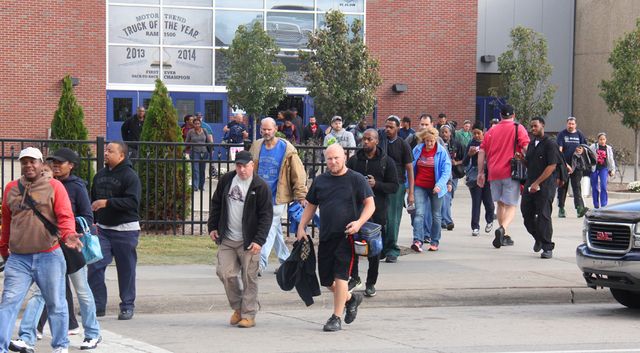
Workers leaving the Warren Truck Plant at shift change
Autoworkers in the Detroit area expressed concern that the impact of the layoffs—which include 120 at the neighboring Sterling Heights Stamping Plant—would reverberate throughout the metropolitan area.
Workers at the Warren Truck Assembly Plant feared that many lower-seniority workers at the factory, including part-timers and temporary workers, would be bumped out and lose their livelihoods. 
The job cuts are the first permanent layoffs in the US industry since Obama’s bankruptcy restructuring of General Motors and Chrysler in 2009. In the aftermath of the deep wage and benefit cuts imposed by the United Auto Workers as a condition of the White House bailout, FCA, General Motors and Ford hired some 40,000 workers at nearly half the pay of the existing workforce.
Due to record auto sales—fueled by pent-up demand since the 2008 crash, lower gas prices and relatively low financing costs, including subprime auto loans—the United States has become a profit center for the global automakers, which have faced depressed markets in Europe, Latin America and increasingly China. Increasingly, however, industry analysts are warning about a downturn in US car sales and “overcapacity” in the US auto industry. This foreshadows the type of bloodletting in the industry that has already destroyed tens of thousands of jobs in the steel, mining and energy industries.
This is part of a global process, as transnational corporations and governments in every country are making the working class pay for the global capitalist crisis. In China, some 1.6 million steelworkers and coal miners face the loss of their jobs. The mass layoffs and mill closures recently announced by Indian-based conglomerate Tata threaten to end steelmaking in Great Britain, while possible mergers between Germany’s Thyssen Krupp and Salzgitter or Thyssen Krupp and Tata would lead to tens of thousands of layoffs. The takeover of Virgin America by Alaska Airlines this week is a sign that a new wave of mergers and acquisitions will soon hit the global airline industry, also leading to job cuts.
The worldwide assault on jobs and wages has become a driving force in the class struggle with strikes since the beginning of the year by workers in China, ArcelorMittal steelworkers and Nissan autoworkers in Mexico, Tata Nano autoworkers in India, and others.
The increase in the official employment rate in the United States is chiefly due to record low levels of labor force participation and the growth of part-time, temporary and contract work, with most new jobs paying low wages. Manufacturing workers were once one of the most highly paid sections of the working class, but today, one-quarter of all manufacturing workers earn $11.91 an hour or less.
The job cuts at Fiat Chrysler confirm the warnings the World Socialist Web Site made last fall when it said the four-year labor agreements pushed by the United Auto Workers (UAW) would only facilitate the destruction of jobs, wages and work conditions.
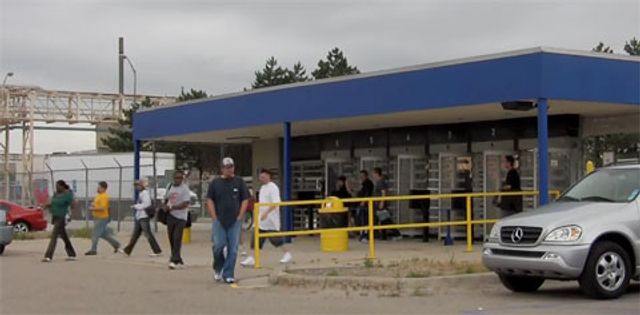
Shift change at Sterling Heights Assembly Plant
After FCA workers rejected the first proposal by the UAW by a 2-to-1 margin in September 2015, defeating a UAW-backed national contract for the first time in 33 years, the union hired a public relations firm to push through a second deal, claiming it contained “product commitments” and “job security” protections against future layoffs.
The WSWS Autoworker Newsletter warned that FCA boss Sergio Marchionne, “has made no secret that he wants to make FCA a more attractive partner for a mega-merger to eliminate ‘overcapacity’ and share capital costs, a move that would trigger a further consolidation of the global auto industry at the cost of tens of thousands of jobs.” As for the job security pledges of the UAW, they “include an escape clause allowing the closure, sale or spin-off of business assets if conditions ‘arise that are beyond the control of the company’ including ‘market-related volume declines or significant economic decline’.”
The claim that the hated two-tier wage system was being eliminated and that lower-wage “in-progression” workers would receive top pay by 2023 means nothing if they do not last that long on the job. In fact, the contracts sanction the use of more temporary, part-time workers who can be hired and fired at will and lower supplemental unemployment benefits for “in-progression” workers, meaning that it will be cheaper for the corporations to lay them off.
In its response to the Sterling Heights announcement, the UAW made it clear it would do nothing to stop workers from being tossed onto the streets. UAW Vice President Norwood Jewell—who made $155,459, plus perks, last year and whose son is also on the UAW International payroll making $117,196—called the announcement “unfortunate” but “not unexpected.”
“FCA is not the only company experiencing a slow market for small cars,” Jewell declared, adding, “The company has been planning to increase its capacity to build more trucks and SUVs. I believe in the long term this move will be a positive one for our members and the company.” The slashing of FCA workers’ jobs was not “unexpected” because the UAW is working hand-in-glove with the corporations to slash jobs and labor costs.
Marchionne has threatened to “outsource” all small car production and keep only highly profitable pickup and SUV production in the company’s US plants. The Chrysler 200 and Dodge Dart models will likely be moved to lower-wage factories in Mexico. Earlier this week Ford announced it will build a new $1.6 billion assembly plant in the Mexican state of San Luis Potosi for small car production.
Hostile to any fight to unify US, Canadian and Mexican workers in a common struggle against the global corporations, the UAW is once again promoting “Buy American” national chauvinism to conceal its complicity with the corporations. In an op-ed piece in the New York Times earlier this week, UAW President Dennis Williams denounced the North American Free Trade Agreement (NAFTA) and other trade deals for allowing corporations to “outsource hundreds of thousands of jobs” and reducing American wages. Wages were low in Mexico, he said, because unlike the US, Williams claimed, “Company unions there are more aligned with employers than with workers.”
There are few, if any, organizations on this planet that are more “aligned with the employers” than the UAW. For nearly four decades it has been based on a corporatist perspective, which claims that workers have no interests that are apart from and independent from the auto bosses. In the name of making the US-based corporations “more competitive” and profitable, it has all but banned strikes, abandoned any representation of workers on the shop floor and functioned as industrial police force, imposing labor discipline, speed up and brutal exploitation in the factories.
The anti-Mexico rhetoric of the UAW, moreover, is entirely cynical. Writing in the in-house newspaper of the auto industry, Detroit News columnist Daniel Howes referred to the “faux outrage” of the UAW, acknowledging that one of the “dirty little secrets” of last year’s contract was that “Ford effectively won union acquiescence to move small car production to Mexico.” Meanwhile, the chief strategy of the UAW is to persuade the company to move assembly of larger vehicles back to the US by offering to cut the cost of production: in other words, cutting the wages and benefits of American workers.
The fight to defend secure and good-paying jobs requires a global strategy to unify workers around the world. This means rejecting the economic nationalism and corporatist labor-management “partnership” policies of the UAW, and building a powerful political movement fighting for socialism, including the nationalization of the banks and basic industries, under the democratic control and collective ownership of the working class.