26 Aug 2016

Hillary Clinton Is Spreading Islamist Extremism

Andre Vltchek


If the West in general and the United States in particular, left the Arab and Muslim world alone and in peace, we would most likely never see all those terrorist attacks, which are rocking the world from Indonesia to France. There would be no Mujahedeen and its mutation into al-Qaida; in Afghanistan or elsewhere. There would be no traces of the ISIS (or ISIL or I.S. or Daesh or however you choose to call it), in Syria, Iraq, Libya or anywhere else.
And the super-conservative Wahhabi Islam, that outdated, freak Saudi mutant, would remain in the religious schools of the ultra-regressive Kingdom, instead of gaining ground all over the Southeast Asia, the Middle East and Africa.
But the West embarked on a brutal, Machiavellian path: it decided to destroy socialist Islam – that (historically) moderate, compassionate and progressive religion. It smashed once secular Egypt;it overthrew the government in socialist Iran and then in near-Communist Indonesia, implanting in all these places horrifically degenerate and fully outdated religious concepts. It used extremists to destroy healthy patriotism and socialism. Like the Brits in the 19th Century (“You can control people’s brains, while we will control your natural resources”), the West embraced Wahhabi teaching, because it was able to guarantee full obedience, dictatorial (pro-Western) governance and oppressivefeudalism.
Islam has been used and abused, manipulated and virtually stripped of its essence. The processhas gone so far that two leading Iranian scholars, during my visit last-year to Teheran, declared to me: “In so many parts of the world, the West created an absolutely new religion. We don’t recognize it, anymore. It has nothing to do with Islam.”
Correct. Like a naughty, spoiled and heartless child, the West, after destroying the Soviet Union, painstakingly constructed its new enemy – “militant Islam” – so it could continue indulging in its favorite activity, which is perpetual conflict, endless wars and plunder.
It is as simple as that.
The greatest oppressors of the Muslim people, those in Saudi Arabia, Bahrain, and Indonesia have all been closely allied to the West. The most terrible terrorist “Muslim” organizations, from Al-Qaida to ISIS, have been created, armed and supported by the West and its cronies.
In Europe and in the United States, the “fear of terrorists” is fully exploited by the Western regime.It still clings to power mainly thanks to such fear implanted in the brains of ‘ordinary people’.
And what about the “War on Terror”? Yes, there really is such war, but the West is not the one who fights it. As this goes to print, the war against terrorism is being fought by Russia, Iran, China, Syria, Hezbollah and their allies!
subcription2016
*
The West is still closely collaborating with the terrorists. It miraculously ‘avoids targeting them’ when ‘fighting wars against them’; it financially supports some and trains others. It criticizes and antagonizes those who are actually fighting the extremist militant groups.
Extremists have been unleashed, like Rottweiler fighting dogs, against almost all progressive governments in the Middle East, but also against China and Russia. Extremist Muslims, extremist Christians, even extremist Buddhists!
In turn, the politicians in the United States are regularly supported, financially, by the regimes (including those of Saudi Arabia, Bahrain, etc.) that are spreading, relentlessly, throughout the world, the most intolerant and grotesquely violent religious concepts.
Despite their essential servility and cowardice, even some North Americanmainstream media outlets are now actively discussing variousschemes involving the financing of the Clinton Foundation by Saudi Arabia(alongsideseveral leading transnational corporations and Wall Street’s largest banks).
On its “Breaking News”, as far back as in 2008, the CNN reported:
“The donations to the William J. Clinton Foundation include amounts of $10 million to $25 million from the Kingdom of Saudi Arabia, the Bill and Melinda Gates Foundation and real estate mogul Stephen Bing, a personal friend of Clinton’s.
The Clintons came under intense pressure during Hillary Clinton’s campaign for the Democratic presidential nomination to release the names of donors to both the Foundation and to the Clinton presidential library in Arkansas.
Bill Clinton agreed to the release of the list after President-elect Barack Obama nominated Hillary Clinton to become Secretary of State.
The governments of Kuwait and Qatar are also on the list, as is Saudi businessman Nasser Al-Rashid, who has close ties to the Saudi royal family. Saudi Sheikh Mohammed H. Al-Amoudi, reputed to be one of the richest men in the world, is among the donors as well. Both Saudis contributed in the $1 million to $5 million range. A group called Friends of Saudi Arabia and the Dubai Foundation appear in the same category.”
As recently as on August 20th, 2016, The New York Times wrote something similar, essentially reconfirming the validity of the earlier reports, while adding many more details and adjusting the figures:
“The kingdom of Saudi Arabia donated more than $10 million. Through a foundation, so did the son-in-law of a former Ukrainian president whose government was widely criticized for corruption and the murder of journalists. A Lebanese-Nigerian developer with vast business interests contributed as much as $5 million.
For years the Bill, Hillary and Chelsea Clinton Foundation thrived largely on the generosity of foreign donors and individuals who gave hundreds of millions of dollars to the global charity. But now, as Mrs. Clinton seeks the White House, the funding of the sprawling philanthropy has become an Achilles’ heel for her campaign and, if she is victorious, potentially her administration as well.”
References to ‘Lebanese-Nigerian developer’ are actually related to Gilbert Chagouri, the controversial Lebanese-Nigerian billionaire construction magnate.
Long timeClinton’stop aide,HumaAbedin(who spent part of her childhood in Saudi Arabia) has been an intermediary between the former Secretary of State and pro-Saudi interests. She also negotiated financial support for Ms. Clinton from Mr. Chagouri and other individuals, organizations and businessesoriginating from the Middle East.
The accusations and evidence keep coming in, from different media outlets, both left wing and right wing. On August 1st, 2016, the conservative Breitbart News stated:
“Khizr Khan, the Muslim Gold Star father that the mainstream media and former Secretary of State Hillary Clinton have been using to criticize Donald J. Trump, has deep ties to the government of Saudi Arabia—and to international Islamist investors through his own law firm. In addition to those ties to the wealthy Islamist nation, Khan also has ties to controversial immigration programs that wealthy foreigners can use to essentially buy their way into the United States—and has deep ties to the “Clinton Cash” narrative through the Clinton Foundation.”
Hillary Clinton’s dependence on Saudi sponsors has been strongly influencing her decision to maintain a foreign policy in the service of Riyadh and support for various terrorist groups controlled by Saudi Arabia and Qatar, in and beyond the Middle East region.
In reality, she is simply representing ‘continuity’ of an already existing, deadly trend. The regime has been ‘evolving’ for decades, but especially since the Ronald Reagan years. Republicans or Democrats: it truly matters very little.Both parties spread terror all over the world. True, George W. Bush invaded Iraq, but people like Bill Clinton are close friends and supporters of Paul Kagame, the Rwandese ‘butcher of Congo’, with the blood of some 10 million people on his hands. Democrat and ‘moderate’, Bill Clinton, was also responsible for the criminal bombing and destruction of socialist Yugoslavia. And so it goes…
But under Barack Obama’s rule, the last hope for an independent Middle East and the Arab world hasvirtually evaporated. Libya has beendestroyed;the Syrian civil war was launched from Washington, London and Paris. Saudis bathed rebellious Yemen in blood using UK and US produced weapons. Virtually all ‘Arab Spring revolutions’ were infiltrated and diverted. And in Bahrain,the Shi’a majority was literally raped by Saudi Arabia and its own ruthless rulers, with British advisors standing-by.
The US and Europe has kept selling arms to the Gulf, building new military bases while supporting the most appalling and bloodthirsty regimes.
The ‘Obama/ (Hilary) Clinton Era’has greatly ‘improved’ the symbioses of Western imperialism, big business, and pro-Western fascist regimes worldwide, but particularly in the Middle East and Africa.
This toxic embrace has proved fatal to millions of people in these two parts of the world. Hopes for self-governance have been ruined. Corpses keep piling up in Syria, Iraq, Libya, Yemen, South Sudan, Somalia, the Democratic Republic of Congo (DRC), and elsewhere.
The West does not care, as long as it stays in charge of the ‘show’, and for as long as hundreds of billions of dollars are made by weapons’ producers. Even if millions are dying, there is still an uninterrupted flow of raw materials to the West and Japan. Therefore, it is ‘business as usual’. ‘Un-people’ and their lives are worth nothing.
*
At one point, Russia, Iran, China and others have said “enough is enough; let’s fight against the true terrorists! Let’s fight ISIS and other bigots! Let’s give hand to the independence-minded, socially-oriented patriots”.
This led to total outrage in Washington, London, and Paris (and Tokyo). Disobedience and rebellion against the global (Western) order could not be tolerated! It had to be crushed, even at the cost of new and deadly world war.
NATO, Washington, Europe, Japan, and South Korea –all started a direct confrontation policy against Russia, China, Iran, North Korea (DPRK) and other members of the ‘Coalition of Daring’. Brazil, an important member of BRICS, was recently destroyed by the extreme-right coup supported by the West.
Even the Republican Presidential candidate Donald Trump, in his rare moments of sanity, is clearly aware of the danger. He does not wish to confront Russia. He is obviously not willing to sacrifice tens of millions of human lives for some grotesque dreams of total world domination by market fundamentalism backed by the white (or Western) supremacist dogmas.
But Trump’s moments of sanity are defined as ‘madness’ by the mainstream propaganda. Not surprisingly! As was correctly stated by the great Indian thinker, Arundhati Roy,some several years ago: “now war is called peace and black is called white”.
*
The Clinton campaign has gone into overdrive. It attempts to distract attention from its own funding scandals, by accusing Donald Trump’s aides of receiving financing from abroad. Trump is now described as ‘Russia’s agent’.
This game – it is all self-serving: nothing to do with the interests of the world, or even the interests of the common ‘American people’.
For as long as the general political trend of the West does not radically change, or for as long as the West is not stopped by outside forces, perpetual wars will continue. Monstrous genocides in Africa, the destruction of entire states and regions in the Middle East, all this could easily spread to other parts of the Planet.
It is clear now that if provoked and confronted, countries like China, Russia and Iran would not hesitate to fight back. They also may fight for others – for their tortured allies.
The Western implants and buddies, Mujahedeen/Al-Qaida, have already destroyed Afghanistan and the Soviet Union. ISIS, another mutant unleashed by the West and its allies, have been devastating Iraq, Syria, Libya and now what is left of Afghanistan.
These ‘movements’ have really nothing to do with Islam. They were manufactured in Washington, Riyadh, London, and Doha (and most likely even in Tel Aviv), for several concrete purposes, all of them thoroughly foul.
They are making sure to ruin the socialist nature of Islam, insisting exclusively on the implementation of outdated fundamentalist interpretations.
*
Huma Abedin’s mother, Dr. Saleha Mahmood Abedin, is one of the founding members of the Muslim Sisterhood, and chairperson of the “International Islamic Committee for Woman and Child” (IICWC). She is also a well known writer and editor based in Saudi Arabia.Her organization (IICWC) had repeatedly argued that laws banning female circumcision should be revoked, as well as laws prohibiting child marriage and marital rape. During her visit to KSA, Hillary Clinton spoke at the Islamic college of Dar El-Hekma (where Dr. SalehaAbedin was a vice-dean) shoulder-to-shoulder with her favorite aide -Huma.
Was this just an insignificant episode? Like those millions of dollars in Saudi Arabian funding for Clinton’s foundation? Like the US ‘foreign policy’ in the Gulf and in the Middle East, like spreading Muslim extremist groups to all corners of the world, from Africa, the Middle East, to Southeast Asia and even China? Like unleashing conservative Islam against socialist Muslim countries?
Too many ‘episodes’! Too much blood… It is time to say what is by now obvious: “The US establishment is not fighting ‘Muslim terrorism’ or even ‘extremism’; it is manufacturing it, and injecting it everywhere.”
The only real enemy that Washington, London and Paris have, for decades, even for centuries, is the anti-colonialist struggle, and the burning desire of people, worldwide, to terminate the West’s global dictatorship.

Turkey And The End Of An Era Of Imperial Control

Junaid S. Ahmad


The attempted coup and its aftermath in Turkey on July 15th have provoked heated debate on its meaning and ramifications. The will of the Turkish people to unflinchingly defend their democratic experiment, regardless of the particular regime or leader in power, has been remarkable. Nevertheless, critics are pointing to the Turkish leader Erdogan’s heavy-handed tactics to consolidate power afterwards, involving mass arrests, detentions, dismissals in all realms of state and society. Both sides seem to have compelling cases as to what ought – and ought not – to be done in such tumultuous circumstances. But it will be a rare soul who will not acknowledge that rolling back the right of the Turkish military to crush democracy in such a way, as it has done multiple times in the past, is a true milestone in the struggle for the sovereignty of the Turkish people of the country’s destiny. They are now the custodians of that future, not the armed forces.
The character of Erdogan though, in Western policy circles, has been subject to an absurd amount of scrutiny. Even before the events of July 15th, there were observers pointing out how Erdogan was undertaking significant shifts in foreign policy. The boiling point for NATO was how the Turkish leader all of a sudden decided to pursue some form of rapprochement with Russia, enemy number one for the Western military alliance, despite the end of the Cold War. Erdogan’s apology to the Russians for shooting down their jet last year sent shockwaves to Washington and Berlin. The coup-makers, whether supported directly or indirectly by these outside forces, at least thought they would have their blessing in getting rid of a ruler increasingly unpredictable and unreliable for the purposes of NATO militarism and expansionism.
Turkey and the Turkish military have been central to NATO’s formation in 1949. Though not deployed in direct aggression, Turkey has been expected to be at the forefront of any confrontation Eastwards. For NATO, it has been the threat of all of the military stockpile housed in Turkish bases, including nuclear weapons, that was supposed to keep the Russians and any powers with any ambition to disturb Western hegemony at bay.
The weakening of the West’s trusted ally, the Turkish military, and its replacement by ‘Islamist’-oriented democrats, has been treated with a great deal of suspicion, if not outright opposition. What slowed down any attempts to flagrantly dislodge Turkish democracy during the recent period (at least until July 15th) was of course the AKP’s more or less cooperation with Western and NATO war aims, especially in the case of Syria.
subcription2016
But this was camouflaging deep-seated tensions. The whole Western repertoire being regurgitated ad nauseum for years, around Erdogan’s ‘creeping authoritarianism, had very little to do with Erdogan himself. The ‘crime’ of Erdogan is not that he is power-hungry or authoritarian. Such a narrative should be laughed at for its hypocrisy when considering the dozens of allies of Washington in the region who don’t even give lip service to a semblance of democracy. Furthermore, the police state practices and concentration of power in the ‘unitary executives’ in the Western democracies/plutocracies during the ‘War on Terror’ regime give such countries no moral authority to pontificate to other countries on these matters.
Indeed, the ‘crime’ of the Turkish leader and the AKP is something else. It has to do with Western anxiety over yet another rising power in the region, and globally. It has to do with the ongoing challenge to, and breakdown of, the global unipolar moment that the US imperium achieved after the collapse of the Soviet Union. Multi-polarity is not simply about the rise of China or the re-emergence of Russia as a ‘great power’ anymore. It is about the rise and assertion of sovereignty of an increasing number of nations, including Turkey.
In fact, the problem for Washington is even deeper than that. Turkey has been central to NATO, but it has been even more pivotal to the US specifically because it has been one of the central satraps of American control of the resource-rich West Asia and North Africa (WANA). After World War II, in order to control what Washington planners described as, “a stupendous source of strategic power, and one of the greatest material prizes in world history,” the US decided to establish an architecture of political tyranny throughout the region to ensure that only Washington called the shots about where the oil went, and where it did not.
Tyrannical regimes in the region that were subservient to the US were central to this objective. Arab nationalism and Nasserism challenged this order of things temporarily, but were defeated in the 1967 war with Israel.
The Zionist state and its services to tyranny and empire in the region have been crucial. What in the past was the unstated unholy alliance, has now become overt and explicit: Arab monarchies and autocrats aligned with Israel, with the backing of their overlord, Washington.
But there were other non-Arab regimes in and around the region that Washington deemed absolutely essential to upholding this unnatural and grotesquely unjust order in the Arab world: Iran, Turkey, and Pakistan.
The US overthrew the democratically elected government of Mohammad Mosaddegh in 1953, and imposed the brutal Shah who slavishly performed these services for Washington. Until the Islamic Revolution in Iran in 1979, when ‘we lost Iran.’
Iran’s real crime was and is not its human rights abuses and repression, which, as in all states, do exist. Its crime for which it is vilified since the moment of the overthrow of the dictatorial Shah was disobedience to the global mafia don, and its challenge to the US imperium in the region.
Erdogan and Turkey’s crime seems to be pointing in this direction. Perhaps Pakistan as well. These countries are not entirely predictable, act on their own sometimes, and – God forbid – may pursue their own interests that not only may be independent of those of Washington’s, but may in fact be done in cooperation with those that the US and NATO deem as rivals and want to undermine: China, Russia, Iran, and so on.
Does this mean these countries and their rulers are Fidel Castros? No. But for American geopolitics, this is irrelevant. The US only tolerates the completely obedient. The problem is that many politicians and planners in Washington have a difficult time in understanding that the world has changed, and in times of the ‘Empire of Chaos’ (as the astute journalist Pepe Escobar puts it), the American empire can both benefit from and be a victim of the chaos, destruction, and manipulation in which it engages. WANA is a great example of this, and countries like Turkey and Pakistan – pillars in the past of US control over the region  – can no longer be controlled in the way they used to be.
All of the talk concerning Erdogan and his desire to revive some Turkish sultanate, Islamism and/or nationalism (take your pick) going wild in Turkey and in Pakistan, is fundamentally about one thing: the geopolitical anxieties of an empire in decline, unable to exert much muscle in bullying as it used to, only able to profit from billions in weaponry being sold to its ‘moderate’ Arab allies like Saudi Arabia. And ultimately, attempts at the reassertion and projections of American power by ‘pivots’ and expanding bases are crude cover-ups for the moral, political, and economic decay of the American imperium.

Ethiopian government kills 100 civilians as protests sweep country

Joe Williams

International attention was focused on repression of the Oromo people in Ethiopia by the US-backed government in Addis Ababa, after Ethiopian marathon runner Feyisa Lilesa crossed the finish line August 21 with his arms crossed above his head, a gesture to condemn the government’s violent attacks on protesters in the Oromia region, where he was born.
Lilesa repeated the action during the award ceremony following the race, where he received the silver medal for finishing second. The 26-year-old refused to board the plane bearing Ethiopian athletes back to their home country from Rio de Janeiro, and indicated he might seek political asylum in the United States. He has a wife and children in Addis Ababa. Ethiopian officials refused to discuss his status or his medal-winning performance.
Earlier this month, Ethiopian security forces killed 100 people while putting down protests in the Oromia and Amhara regions. Deadly clashes took place in 10 Oromo towns, including Ambo, Dembi Dolo and Nekempt, while the violence in Amhara was focused on the city of Bahir Dar. Residents believe about 60 people were killed there.
The Oromia protests have been ongoing since November 2015, when the government resumed efforts to implement the Addis Ababa and the Surrounding Oromia Special Zone Integrated Development Plan. Popularly known simply as “the Master Plan,” it involves seizing land from its Oromo owners for little or no compensation so that it can be sold to international developers. Amnesty International estimates that 400 Oromo have been killed in the nine months since protests began, with tens of thousands more detained, and likely tortured.
The fact that the protests have spread to the Amhara region is a significant development that doubtlessly alarmed the government, and may have contributed to its decision to dramatically escalate the violence of its response. The Amhara and Oromo are historical enemies, and the government has exploited their enmity to keep the two influential ethnic groups fighting each other.
The government overplayed its hand, however, by attempting to arrest activists in the Amharic city of Gondar in July. They were opposing land grabs in the Wolkayt district similar to the ones being imposed on the Oromo, and the attempt at arresting them provoked two days of deadly clashes between civilians and security forces, and triggered mass consciousness of the fact that both ethnic groups are being manipulated against each other for the interests of the government. Two weeks later, tens of thousands of Amhara protesters took to the streets to declare solidarity with the Oromo.
Merera Gudina, chairman of the Oromo Federalist Congress, compared the protests to the most intense uprisings of the Palestinians against Zionist occupying forces, saying, “These protests are at the level of an intifada—people in their own ways are resisting the government pressure and demanding their rights. … I don’t think it’s going to die down.”
The protests come several weeks after the government shut down social media web sites for three days, possibly as a test run in anticipation of the uprising. The government’s claim that it did so to prevent students from being distracted during exams has now been exposed as a lie, as it took the exact same measures in response to the protests now sweeping the country. The botched arrest of activists that triggered the protests in Amhara took place during the supposedly exam-related Internet shutdown.
The government has been trying to control the flow of information since last year, when the country suffered a drought that has cut economic growth in half. The worst drought in over a decade, it caused a social and political crisis. The number of people receiving emergency food assistance more than doubled to 10.2 million, schools and hospitals have been shut down, and hundreds of thousands of children are experiencing malnutrition. A similar drought in 2011 killed 200,000 people in neighboring Somalia.
As the government came under fire domestically and internationally for its failure to respond to the crisis, it tried to intimidate journalists from covering it. According to Allafrica.com, “NGOs are being warned not to use the words ‘famine, starvation or death’ in their food appeals. Neither are they to say that ‘children are dying on a daily basis,’ or refer to ‘widespread famine’ or say that ‘the policies of the government in Ethiopia are partially to blame.’ Neither are they allowed to ‘compare the current crisis to the famine of the eighties.’ Instead, the latest drought in Ethiopia is to be described as ‘food insecurity caused by a drought related to El Nino.’ ” The last two Ethiopian regimes were overthrown during droughts that devastated the economy and caused food shortages.
The US embassy in Addis Ababa released a statement that tacitly supported the government’s actions. While claiming to be “deeply concerned” and expressing “deep condolences” to the dead and injured, the statement seeks to place the blame on the victims, noting that “the demonstrations took place without authorization,” along with the standard implorations to “all parties” to remain peaceful.
In 2015, Undersecretary of State Wendy Sherman described Ethiopia as “a democracy that is moving forward in an election that we expect to be free, fair, credible, open and inclusive. … Every time there is an election, it gets better and better.” In fact, that election proved to be a farce. The ruling Ethiopian People’s Revolutionary Democratic Front (EPRDF) received 100 percent of the vote, and the mass incarceration of political activists, including most of the leaders of the Oromo Federalist Congress, followed shortly thereafter.
The rigged election and subsequent repressions did not prevent Obama from travelling to Ethiopia last summer and declaring the regime to be “an outstanding partner” that had been “democratically elected.” He made clear his motives for falsifying the government’s record on democratic rights, as well as Ethiopia’s role in America’s regional foreign policy strategy, saying that the US doesn’t “need to send our own Marines in to do the fighting. The Ethiopians are tough fighters.”
The EPRDF government has provided basing for US drone operations and is propping up the US-backed regime in Somalia. Addis Ababa is currently hosting an emergency meeting of US allies in eastern Africa to form a Force Intervention Brigade to stabilize South Sudan. Unlike the UN peacekeeping mission currently deployed there, the Force Intervention Brigade will be authorized to carry out offensive missions.
At the same time, Ethiopia has responded positively to overtures from China, which include financing for badly needed infrastructure development in Ethiopia. Part of that development is the LAPSSET rail and transportation corridor, which would connect Ethiopia to Kenya, Uganda, Burundi, Rwanda, and South Sudan, while allowing transport of raw materials back to China. Chinese trade with Africa has grown rapidly since 2009.

Cross-party support for sweeping spy powers in New Zealand

John Braddock

Legislation to allow New Zealand’s foreign intelligence agency, the Government Communications Security Bureau (GCSB), to spy on New Zealand citizens passed its first reading in parliament on August 18, with overwhelming cross-party support.
The Labour Party, New Zealand First, Act and the Maori Party all backed the National Party government by voting for the Intelligence and Security Bill. Only the Greens and United Future’s Peter Dunne voted against sending the bill to the foreign affairs select committee, the next stage in its passage.
The bill is the result of a review conducted by former Labour Deputy Prime Minister Michael Cullen and lawyer Patsy Reddy. Cullen had served on parliament’s Intelligence and Security committee, which covers the spy services. Reddy has recently been named as the country’s next governor-general.
The legislation will have been drawn up in close consultation with Washington. In March, US National Intelligence Director James Clapper visited Wellington for talks on intelligence matters, including the Cullen-Reddy review. Clapper held discussions with both Prime Minister John Key and Labour leader Andrew Little.
Along with a history of illegal spying on New Zealand citizens, the GCSB services the needs of US imperialism. Documents leaked by former US National Security Agency (NSA) contractor Edward Snowden revealed that the GCSB carries out mass surveillance on Pacific island nations and several Asian countries, including China. According to Snowden, Washington highly values the intelligence gathered by the GCSB on its behalf, including in “areas and countries ... difficult for the US to access.”
The legislation breaks a longstanding separation between the domestic security agency, the Security Intelligence Service (SIS), and the GCSB. Previously, the GCSB could only legally spy on foreigners. After revelations that the agency illegally spied on over 80 NZ citizens, including prominent Internet entrepreneur Kim Dotcom, a law was rushed through in 2013 to allow the GCSB to carry out surveillance on behalf of the SIS, police and the Defence Force.
The 2013 law triggered nationwide protests by thousands of people. According to Cullen-Reddy, however, the 2013 legislation did not go far enough. It only allowed the GCSB to spy on citizens and residents in exceptional, albeit broadly defined, circumstances. Cullen complained the GCSB became “extremely risk adverse” around interpretation of its powers.
The new law runs counter to assurances given by Key in 2013 that the GCSB would not target citizens. It was introduced the same week that fresh information from Snowden revealed the GCSB’s monitoring of New Zealander Tony Fullman, who campaigned against the Fijian military regime following the 2006 coup.
The bill places the GCSB and the SIS under the same legislation and warranting regime. If the agencies operate under a joint warrant they will both be able to carry out all activities, including interception of communications, searches of premises, seizure and surveillance.
The minister in charge of the agencies, Christopher Finlayson, said citizens would be targeted by the GCSB only on “national security” grounds, unless a person was deemed an “agent” of a foreign power. In that instance, the GCSB already has the powers to spy on them.
The definition of “national security” is yet to be determined. Finlayson said the government wanted the select committee to have a “robust debate” on the definition, “rather than ministers make a decision.” Little thanked Finlayson for his “bipartisan approach” and for conducting himself with “considerable distinction.”
To further secure a parliamentary consensus on boosting the surveillance regime, Little said he wants membership of the Security and Intelligence committee expanded to include automatic representation from the Greens and NZ First. Labour previously gave one of its positions to former Green Party co-leader Russel Norman.
The Cullen-Reddy review was released under conditions of soaring social inequality, the collaboration of New Zealand in the US-led war in Iraq and escalating threats of a US war against Russia and China. As in America, Europe and Asia, there are signs that the turn to austerity and militarism is producing a shift to the left among workers and youth.
Under the rubric of the “war on terror,” the ruling elite is erecting the foundations for a police state in preparation to confront social and political opposition. The New Zealand Herald in March signalled media backing for unprecedented police and surveillance powers. It asserted that since the end of 2014, “the spectre of ISIS terrorism [has prompted] all Western states to adopt stronger measures of surveillance and passport control.”
The bill gives the agencies increased flexibility in obtaining warrants, including for classes of people and “purpose-based” warrants. The government raised the example of the intelligence agencies being alerted to a group of unidentified New Zealanders in Syria. A group warrant would allow the spy organisations to target them without having exact information on their identities.
A purpose-based warrant will specify the type of information sought—for example, a warrant to intercept communications ostensibly to find out if New Zealanders are fighting with ISIS.
“Whistle blowers” who leak government information will be targeted. A new offence is created for people who hold a government security clearance, or have access to classified information, and communicate, retain or copy it. If intelligence agency employees provide evidence of wrongdoing to others or the media they face up to five years’ imprisonment.
Successive governments have expanded the spy agencies’ powers and resources. The 1999–2008 Labour government passed the GCSB Act in 2003, establishing the agency as a separate department. Labour and National have worked closely with Washington to integrate the GCSB into the global “Five Eyes” alliance, as part of the overall strengthening of US-led military and intelligence ties.
In 2013 and 2014, Labour and NZ First appeared alongside the Greens and Internet-Mana at public meetings, claiming to oppose the extension of the GCSB’s powers. Labour made vague promises of a “review” into National’s legislation if elected. This supposed opposition was a complete fraud. Both parties are now backing legislation that goes even further.
The Green Party has declared its opposition to the legislation, on the basis that it is “invasive.” However, the Greens are not opposed to the activities of spy agencies in principle, only saying the proposed oversight measures do not go “far enough” and there should be a “clear distinction” between the SIS and the GCSB.

Australian “Heart Maps” reveal class divide

Cheryl Crisp

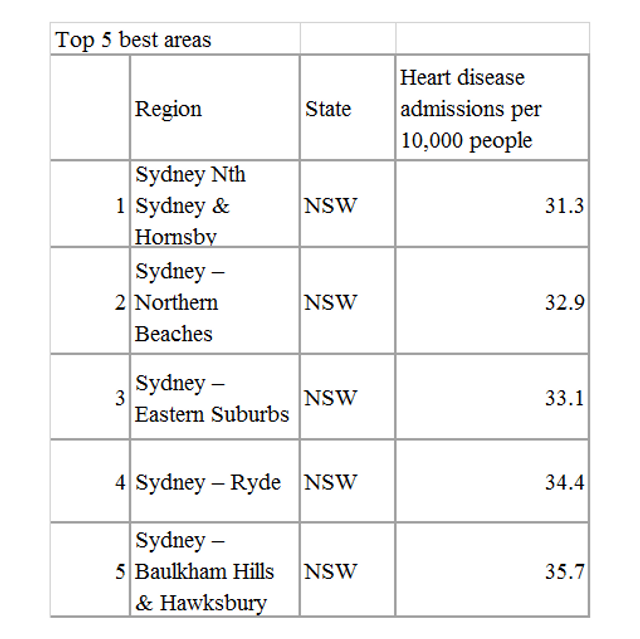
The National Heart Foundation last week released “Heart Maps” of hospital admissions due to heart disease, the first such Australia-wide report of its kind. The maps expose a health gulf between the wealthiest areas of the country and the poorest, as well as the impact that poverty, unemployment and lack of medical facilities have on health outcomes.
There is about a five-fold difference between the area with the highest rate of hospital admissions, the Northern Territory (NT) outback, and those with the lowest rates, situated in the most affluent suburbs of Sydney. The NT outback covers some of the most remote parts of Australia, furthest from metropolitan and regional cities.
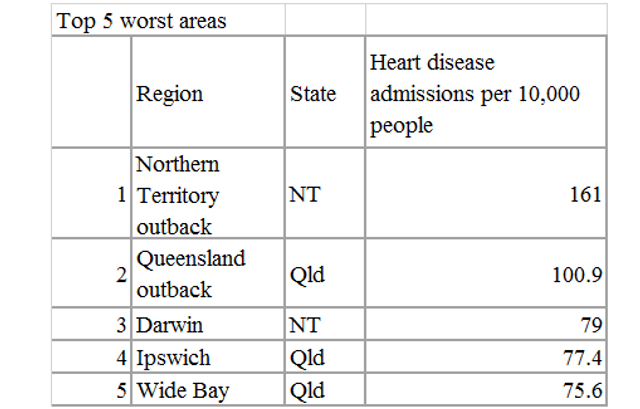
After the NT outback, which has an aged-standardised rate (ASR) of 161 admissions per 10,000 people, the next worst region is the neighbouring Queensland outback, followed by Darwin, the NT capital, and two areas north and west of the Queensland capital of Brisbane. Queensland recorded 12 of the worst 20 areas in the country.
Heart Foundation CEO John Kelly stated: “Those regions that rate in the top hotspot areas are regions where a large proportion of residents are of significant disadvantage. This disadvantage includes a person’s access to education, employment, housing, transport, affordable healthy food and social support.”
Overall, the report concluded that people in the “most disadvantaged areas are more than twice as likely to be admitted to hospital for a heart event than those living in the most advantaged areas.”
The Heart Maps display hospital separation data for two years (2012–13 and 2013–14), with a separation defined as a completed episode of patient care in hospital resulting in discharge, death, transfer or change in type of care (e.g. acute to rehabilitation.) The maps cover “All Heart Admissions,” including heart attacks, both STEMI and Non-STEMI.
STEMI is a severe form of heart attack caused by a significant or complete blockage of a coronary artery that results in full thickness damage to the heart muscle. Non-STEMI attacks, caused by a partial blockage of a coronary artery, result in less damage to the heart. The report does not include people who died of heart-related disease before they reached hospital.
In part, the report focusses on the impact of remoteness and the related issue of higher heart disease admissions among indigenous people, who make up a substantial part of the remote population.
According to the report, “the further a person lives from a major city the greater the rate of heart-related hospitalisations.” People living in a very remote area are almost twice as likely to visit a hospital for a heart event.
The report adds: “Along with higher rates of smoking, obesity and physical inactivity, remote Australia experiences higher levels of disadvantage, has poorer access to health services and the conditions needed for health such as an environment that supports physical activity, access to affordable healthy food, access to education and secure employment.”
Moreover, “Aboriginal and Torres Strait Islander peoples are two and a half times more likely to be admitted to hospital for heart events that non-Indigenous Australians.” For all separations, indigenous people have an admission rate of 117.9 per 100,000, compared to the non-Indigenous average of 48.9.
But the divide is not simply geographical or racial. It is essentially a class chasm. The working-class city of Ipswich, with a population of almost 200,000, has the fourth highest rate in Australia, even though it is less than 40 kms from the centre of Brisbane. Wide Bay, the fifth highest area, covers the coastal towns of Bundaberg, Maryborough and Gympie, just north of Brisbane.
Ipswich has an official unemployment rate of 10.3 percent—almost double the national rate of 5.7 percent. Wide Bay has a jobless rate of 9.5 percent, while the Queensland outback rate is even higher, at 13 percent. These figures, which exclude people working more than an hour a week, seriously underestimate the real levels of unemployment
By contrast, all the areas recording the lowest hospital admission rates are among the most expensive suburbs nationally in terms of housing prices and median income levels. “Sydney – Eastern Suburbs” includes Point Piper, Australia’s richest enclave, which falls within Prime Minister Malcolm Turnbull’s electorate of Wentworth. Point Piper has a median house price of almost $9.5 million.
According to the Australian Tax Office’s Taxation Statistics 2013–14, those residing in Australia’s richest postcode, which also includes Edgecliff and Darling Point, reported taxable incomes averaging $200,015 per year. The tax returns submitted in the poorest postcodes in the Queensland outback, had an average income of just $3,196—some 62 times less than the wealthiest postcode.
Professor Kelly refuted the often-stated myth that individuals simply make bad “lifestyle choices” about what they eat and how much activity they carry out, and therefore bear the sole responsibility for their health outcomes. Such assertions serve as justifications for slashing health funding, on the basis that society should not be burdened by the cost of health care for these people.
Kelly pointed to the pervasive impact of poverty on people’s lives. He noted: “These higher rates [of admissions] are not because poor people make unhealthy choices. They are the result of social, economic and physical conditions, like a person’s access to education, employment, housing, transport, affordable healthy food and social support…. These conditions shape matters such as people’s eating habits, participation in physical activity and their likelihood to see a doctor.”
Kelly added: “According to projections, we know that these inequities in heart health will only worsen as the gap between the rich and the poor widens… We all have a responsibility to take care of our own health, but it isn’t right when things outside our control impact on our heart health.”
With heart disease still the leading cause of death for both men and women nationally—15.6 percent and 13.7 percent respectively—the report is a damning indictment of the social conditions that working class people experience in Australia, for all the references to it being the “lucky country.”
Kelly implored governments, other sectors and health services to “work together” to improve access and opportunities for good health, in the hope that the stark figures contained in the report will shame governments into providing the resources necessary to turn around this dire situation.
The reality, however, is that successive governments, federal and state, Labor and Liberal-National alike, have cut public health spending, widening the social and class gap. National expenditure on health fell from 18.09 percent of total government outlays in 2006–07, when the last federal Labor government took office, to 15.97 percent by 2015–16. This has intensified the creation of a two-class health system, with profitable private clinics and hospitals flourishing alongside chronically-underfunded and over-stretched public hospitals.
The health divide documented in the Heart Maps is a product of the corporate assault on essential social services and working and living conditions that confronts working people throughout Australia and internationally.

Brazilian students return to the streets over classroom censorship laws

Gabriel Lemos

On August 11, national Student Day, Brazilian secondary students took to the streets of four state capitals in protest against cuts in education and a series of “Schools Without Parties” bills, the latest attack on public education in Brazil.
Mixing conservative Christian ideology and anti-communism, these bills have already been presented, but not yet approved, in more than 20 city and state legislatures as well as in the national Congress. Promoted mainly by Christian caucuses, they are meant to fight a supposed “ideological and political indoctrination” by left-wing teachers alleged to have taken place during the 13 years of Workers Party (PT) control of the national government. They are also justified in the name of defending “the religious convictions of the students’ families.”
If approved, the laws would allow for suspending and even firing public school teachers for teaching anything from history to evolution to sex education, based on charges filed by “offended” parents with education “ombudsmen”.
The largest demonstration, held in Sao Paulo, Brazil’s largest city, was harshly repressed by the Military Police. Before the demonstration started, when the students were still arriving at the meeting point, downtown’s Roosevelt Square, the Military Police used tear gas and pepper spray to intimidate and disperse the students, detaining three underage youth who were charged with contempt for law enforcement. After later allowing the march to proceed for a few blocks, the police finally dispersed it with tear gas.
This is however only the latest of a series of demonstrations since the aggravation of the economic crisis in the country. In Brazil, as elsewhere internationally, the cuts to the education budget are part of a broader program of attacks on the working class.
Last year, the PT government of President Dilma Rousseff cut 11 billion reals (US$3.4 billion) from education, reducing the education budget by 22 percent, and, this year, another 6 billion reals (US$1.9 billion) were cut before she was suspended by the ongoing impeachment process.
The interim government of president Michel Temer (Brazilian Democratic Movement Party—PMDB) promises to intensify the cuts in education even further. In his first 100 days in office, Temer has already gotten the lower house of the national legislature to approve two constitutional amendments that will impose even more sweeping reductions in the education budget. First, on June 8, an amendment was approved to the so-called “Divestment of the Union’s Revenues” articles of the constitution, allowing the federal government to divert constitutionally-mandated spending from several areas, increasing the total portion of the budget that can be diverted to 30 percent until 2023. This will reduce the education budget from the current 18 percent to 12.6 percent of the already contracting federal budget, and further imply a slashing of local-level education budgets from 25 percent to 17.5 percent of total local spending.
Then, on August 10, a bill was approved which restructures the states’ debts to the federal government, and will limit any increase in spending to the level of the previous year’s inflation for the next two years. Economists estimate that, if the rule had been in place since 2006, education would now be receiving only 30 percent of the current funding.
These cuts in education occur amidst an increasing deterioration of the Brazilian public schools and worsening of teachers’ working conditions. A study released in 2013 by researchers of Santa Catarina Federal University showed that 84 percent of Brazilian schools still don’t have either library, laboratory or sport facilities. Another report released in 2014 by the Organization of Economic Co-operation and Development (OECD) showed that among its 34 member countries, Brazilian teachers are second only to their Chilean counterparts in terms of the number of hours spent teaching. At the same time, Brazilian teachers receive just 55 percent of higher education professionals’ salaries, and 41 percent of them work extra hours to make up for their low monthly income.
With low wages and extended working hours, Brazilian teachers are increasingly getting sick and leaving the classroom. In the state of Sao Paulo, the richest and most industrialized in the country, 372 teachers take medical leaves a day, almost 30 percent of them due to mental and behavioral disorders. Between 2011 and 2014, the number of teachers working in alternate functions other than teaching on medical advice increased 24 percent, and last year 172 teachers a month gave up their careers in Sao Paulo public schools.
The teachers’ answer to their poor working conditions since last year has been a series of the longest strikes in the history of the Brazilian education system. In 2015, in a 44-day strike against pension cuts, teachers from Paraná made worldwide headlines for being brutally repressed by the military police with tear gas bombs and rubber bullets that left more than 200 wounded. Then, Sao Paulo’s teachers held their longest ever strike, for 92 days, followed by the teachers from the inland state of Goias, in an almost three-month long strike. In the first semester of this year, teachers held a 110-day strike in the state of Rio de Janeiro, went out for 53 days in Rio Grande do Sul and another 107 in the northeastern state of Ceará. In none of these strikes did they succeed in preventing wage and pension cuts.
In the last three states, moreover, the teachers’ strike was accompanied by wildcat school occupations by high school and even middle school students, many aged as young as 12, with 52 schools occupied in Ceará, 73 in Rio de Janeiro and 186 in Rio Grande do Sul. In Rio de Janeiro, the students’ schools occupations and the teachers’ strikes had minor gains in ending the state’s standardized testing system and initiating long-promised elections for school principals.
These occupations followed the 196 wildcat school occupations by students in São Paulo at the end of last year, which led the governor Geraldo Alckmin (Brazilian Social Democracy Party—PSDB) to suspend the closure of 94 public schools. Many of those students this year once again occupied their schools against the cuts to the education budget at the state level and the lack of school meals in 45 percent of São Paulo’s industrial-training schools. Now they are being brought back into struggle against the “School Without Parties” bills.
The teachers’ strikes, the students’ schools occupations and the demonstrations all over Brazil show, unequivocally, the willingness to fight on the part of both teachers and students.
However, this struggle has been constantly blocked by the teachers’ unions and student organizations linked to PT and other pseudo-left groups, which have done everything in their power to keep simultaneous strikes all over the country isolated from each other. The best example is the PT-dominated Teachers’ Union of Sao Paulo, APEOSP, among the largest unions in Latin America, which has consistently opposed the student movement in which not only the state government, but also the PT federal government is widely hated.

EpiPen maker Mylan’s other drug price hikes

Brad Dixon

The pharmaceutical company Mylan has been making headlines in recent weeks for hiking the price of its life-saving EpiPen device by more than 450 percent. A report released this past June, however, notes that the company has made similar price increases for a number of its drugs.
The report, “Is Mylan Next in Line for Pricing Scrutiny?” was written by Wells Fargo senior analyst David Maris.
It notes the following price hikes of drugs sold by Mylan:
  •  Ursodiol: a generic treatment for gallstones (542 percent increase).
  •  Metoclopramide: a generic treatment for gastroesophageal reflux (444 percent).
  •  Dicylcomine: a treatment for irritable bowel syndrome (400 percent).
  •  Tolterodine: a generic treatment for overactive bladders, and one of Mylan’s biggest selling generics (56 percent).
Maris noted that Mylan raised the price of 24 of its products by more than 20 percent and 7 of its products by more than 100 percent.
“It’s the everyday drugs that are going up by amounts that are just hard to conceptualize why,” Rodney Whitlock, a consultant for the Campaign for Sustainable Rx Pricing, told NBC News. “These drugs aren’t improving. They’re the same drugs approved by the FDA. They’re not getting better. But the prices are going up extensively more than inflation.”
“Think about if other industries behaved the same way,” Whitlock said. “Apple would still be selling the first-gen iPhone for 1,400 bucks. And Ford would be selling the Pinto for $84,000.”
When the report was released in June, Mylan spokeswoman Nina Devlin told CNBC that the analysis was “flawed” and “self-serving and misleading to investors.” She stated that the company was successful in “balancing numerous variables, including the natural price reductions that have always been inherent to the generics industry.”
It was unclear which dictionary Devlin consulted for the definition of “reductions.”
While these products “may be small relative to Mylan’s overall business, we do not believe that the price increases come without a real cost to patients,” wrote Maris.
At the same time that Mylan was jacking up its drug prices by over 400 percent, company executives were inflating their own compensation. Mylan CEO Heather Bresch, for example, increased her total compensation between 2007 and 2015 from $2.5 million to $18.9 million, according to NBC News. FiercePharma put Bresch’s total compensation in 2014 at $25.8 million.
Bresch’s rise and success as CEO of Mylan have been marked by signs of nepotism, if not outright corruption. Her father, Democratic Senator Joe Manchin from West Virginia, the state where Mylan was founded, assisted in pushing through rule changes that expanded the patient population for the EpiPen, along with legislation recommending that states require public schools to stock EpiPens, according to a story published last year by Bloomberg.
Mike Garrison—a former Mylan consultant and lobbyist, and a former high school classmate of Bresch and family friend—resigned as the president of West Virginia University when a 2008 inquiry found that Bresch never completed the coursework necessary for the MBA granted to her by the university, reports NBC News. Milan Puskar, Mylan’s chairman at the time, had donated $20 million to the university.
“In this environment,” wrote Maris, in a warning to investors, “we believe 400 percent and 500 percent price increases on products are beacons for scrutiny.”
That is, Mylan could face the same scrutiny from legislators and patient advocates that Valeant Pharmaceuticals and Turing Pharmaceuticals have received, both of which have been widely criticized over the past year for similar price hikes.
As the story of the price hikes on the EpiPen gained steam, a number of politicians took the opportunity to cynically condemn Mylan’s actions.
“Not only is this alarming price increase unjustified, it puts life-saving treatment out of reach to the consumers who need it most,” stated Senator Amy Klobuchar (Democrat, Minnesota). Klobuchar requested that the Federal Trade Commission investigate the pricing of EpiPens.
“The substantial price increase has caused significant concern among patients,” commented Senator Chuck Grassley (Republican, Iowa).
Senators Claire McCaskill and Susan Collins announced that they were requesting a briefing from Bresch to occur “at a mutually convenient time no later than two weeks from” Wednesday.
Hillary Clinton, the Democratic presidential candidate, called the price hikes “outrageous.”
No meaningful action will be taken by any of these politicians to address the widely publicized price hikes, along with the many others that have gone under the radar.
What concerns these politicians is that the blatant price-gouging by certain companies—like Mylan, Valeant, Turing, and Horizon Pharma—could threaten the subtler profiteering of more “responsible” pharmaceutical companies—like Pfizer, Gilead, Novartis, Amgen and, indeed, the pharmaceutical industry as a whole.
The pharmaceutical industry spent $240.2 million on lobbying in 2015, according to opensecrets.org.
Drug companies often claim that the high prices of drugs are due to the costs associated with the research and development necessary to discover and develop new drugs. An article published in the Journal of the American Medical Association this week, which surveyed peer-reviewed medical and health policy literature between 2005 and 2016, found just the opposite.
“Although prices are often justified by the high cost of drug development,” the article’s authors state, “there is no evidence of an association between research and development costs and prices; rather, prescription drugs are priced in the United States primarily on the basis of what the Market will bear.”

Death toll in Italian earthquake climbs to more than 250

Marianne Arens

One day after the devastating earthquake in central Italy, the death toll has climbed to more than 250. On Thursday evening, the Italian government declared a state of emergency.
Italy’s civil defence organisation earlier reported that 215 people had been pulled from the rubble in the earthquake region of Gran Sasso, with an additional 400 injured. In the destroyed villages of Amatrice, Accumoli, Arquata and Pescara del Tronto and the surrounding area, tens of thousands have lost all their belongings.
Throughout the night, volunteers continued to dig in hopes of saving those still buried alive. Civil defence and fire rescue services set up camps and army units have been called in.
The fear of aftershocks persists. According to the United States Geological Survey, 13 additional quakes were registered in Gran Sasso by Thursday evening, each with a magnitude of at least 2.5 on the Richter scale. As a precaution, the water reservoir at the Scandarello Lake Dam will be drained.
It is still unclear how many people actually remained in the numerous mountain villages on Tuesday. In any case, it is a much greater number than the normal population. An unusually large number of children are among the victims. It is a popular time for vacations in Italy and many families traditionally send their children to visit grandparents in the mountains.
Italian Prime Minister Matteo Renzi cancelled all appointments Wednesday morning in order to visit the disaster region. He promised all possible support to the population. “We will neglect no one,” he said, adding that rebuilding would take place “swiftly and effectively.”
The earthquake took the Renzi government by surprise. All of the warnings that followed the 2009 earthquake in L’Aquila had apparently come to nothing. No improvements had been made and any funds provided for them had leaked into the wrong channels. Renzi promised at a press conference that this time things would “not be as they were in L’Aquila.” Seven years after the earthquake there, thousands of people still live in intolerable emergency housing.
Today in Italy, one of the most earthquake-prone countries in the world, only 30 percent of all buildings meet the legal requirements for earthquake safety. These numbers were revealed by ENEA, the Italian National Agency for New Technologies, Energy and Sustainable Economic Development. Approximately 500 Italian hospitals were classified as vulnerable to earthquakes.
It is no accident that a primary school collapsed in Accumoli and a hospital and a hotel were destroyed in Amatrice. A new school building that also collapsed in the same location had been officially classified as earthquake proof.
On Thursday evening, Renzi’s cabinet met to declare a state of emergency and decide on relief measures. Renzi announced in a statement: “In the next hours, days and weeks, we must brace ourselves for a state of emergency. But digging out survivors remains our top priority. Italy weeps for its countrymen and shows the whole world its tears, but also the big heart of its volunteers, civil defence and governmental authorities.”
Other politicians have also discovered the “big heart of the volunteers.” Beppe Grillo of the Five Star Movement posted a similar comment online, in which he wrote: “Let us show our solidarity and recall that the Italians have a big heart.” In rare agreement with the government and the EU, against whom he otherwise spars so aggressively, Grillo appealed for quick aid measures. He called on the EU to make the European emergency fund available to the victims of the earthquake.
The Italian news media has also cited this “big-heartedness” and published images of overcrowded blood donation centres with the comment: “Parents and children, schoolmates, office workers and pensioners—all wait patiently for hours to donate blood for quake victims” (la Repubblica).
While the solidarity and willingness to help among the population is overwhelming, the grand statements of the ruling class leave a bitter aftertaste.
The politicians shed crocodile tears while at the same time preparing for war and further social cuts. The same propaganda machinery that elsewhere bemoans the innate propensity to violence and depravity of “human nature” has suddenly discovered the energy and generosity of people who must now, of course, “sacrifice whatever is necessary.”
Such hypocrisy is typical and by no means new. More than a hundred years ago, the great Marxist Rosa Luxemburg pointed it out during another terrible natural disaster. When the Mount Pelée volcano erupted on the Caribbean island of Martinique in 1902, engulfing 40,000 people, her keen eye recognized the contradiction between the “humanist” posturing of the ruling elite and the cruel policies of war and colonialism that they were carrying out at the same time.
Amid the ruins of the disaster, the governments were again “one heart and one soul,” wrote Luxemburg, contrasting this with the atrocities and colonial massacres that the same imperialists unleashed on Africans and Filipinos. She concluded her text with the words: “A day will come when another volcano will raise its thunderous voice, a volcano which seethes and boils, whether you know it or not, and will sweep the whole sanctimonious, blood-stained culture from the face of the earth.”
Matteo Renzi has every reason to fear this “coming day.” Just hours before he appeared as the devoted father of his country, he presented himself at the side of Angela Merkel and French President François Hollande on the Italian aircraft carrier Garibaldi. The European Union leaders are determined to proceed with their policies despite the Brexit, the UK vote to exit the EU. Those policies consist of enormous social attacks on the working class and joint military operations in Libya and the Middle East.

Turkey expands invasion of Syria

Jordan Shilton

With support from the US Air Force and military “advisers,” Turkish soldiers expanded their invasion of northern Syria Thursday.
Operation Euphrates Shield is being justified by Ankara as necessary to seize the town of Jarablus from Islamic State forces and push back the Syrian Kurdish People’s Protection Units (YPG) east of the Euphrates River. In reality, the military operation marks a major escalation of the US-backed regime change operation in Syria aimed at overthrowing the government of Bashar al-Assad in Damascus which threatens to plunge the entire region into conflict and draw in the major powers.
This was underscored Wednesday by a statement released by the White House in response to a United Nations-sponsored investigation which claimed that Assad’s forces had conducted two chemical weapons attacks over the past two years. Even though the inquiry found it impossible to apportion blame for the use of chemical weapons in six of the nine cases it examined, White House National Security Council spokesman Ned Price baldly declared in a statement, “It is now impossible to deny that the Syrian regime has repeatedly used industrial chlorine as a weapon against its own people in violation of the Chemical Weapons Convention and UN Security Council Resolution 2118.”
The Obama administration has repeatedly exploited fabricated allegations of chemical weapons use to increase pressure on the Assad regime and create a pretext for war. Earlier this month, unverified claims of a government chlorine gas attack in Idlib province were widely trumpeted, while confirmed instances of gas attacks by opposition forces on civilians in Aleppo were ignored.
Washington came to the brink of full-scale war with the Assad regime in August 2013 when a manufactured campaign claiming that the Syrian government had launched a chemical weapons attack in Gouta near Damascus was concocted, as a subsequent investigation by journalist Seymour Hersh proved. A substantial section of the political and military establishment in the US have never forgiven Obama for deciding against direct US intervention.
Predictably, Price made no mention of the atrocities conducted by the so-called moderate Islamist forces being financed and armed by the CIA and US military in Syria. The US-initiated war for regime change has seen Syria’s population shrink from 22-24 million to 17.1 million people, of which 12.2 million require humanitarian assistance and 8.7 million are internally displaced refugees. A further 4.8 million Syrians were recorded as refugees abroad by the UN in July.
The United States’ backing for the Turkish invasion, including from Vice President Joseph Biden who happened to be visiting Turkey the day it was launched, adds further fuel to a highly combustible political and military situation in the Middle East. Little more than a month has passed since a US-backed coup sought to overthrow the Erdogan government in Ankara, which was in part motivated by the Turkish president’s attempts to rebuild ties with Russia and Iran. Those tensions were on display Wednesday as Biden was questioned about the extradition of Turkish cleric Fathullah Gülen, who lives in Pennsylvania and is blamed by Erdogan for masterminding the 15 July coup attempt.
It is clear that Washington’s support for the Turkish invasion is aimed at creating the conditions for a broader intervention to topple the Assad regime. Turkey intends to establish a zone under its control in northern Syria along the Turkish border so as to block the emergence of a Kurdish-controlled area. But the seizing of Syrian territory in violation of international law prepares the ground for a direct clash or fabricated attack involving Assad’s forces that would serve as a justification for a wider NATO intervention. This would increase the likelihood of a war with nuclear-armed Russia, which intervened in Syria last year to defend its sole military base outside of the former Soviet Union and prop up its main ally in the region.
Just days before the Turkish intervention, the US accused the Assad regime of carrying out bombing raids close to an area where US special forces were operating in support of the YPG militia fighting ISIS in the town of Hasakeh. General Stephen Townsend, the US Army’s military commanding officer in Iraq and Syria, subsequently warned that US forces would defend themselves if they felt threatened–a tacit threat that Syrian government forces, or their Russian allies, would be fired upon.
Townsend also unveiled plans to step up US airstrikes in Syria and Iraq to assist its local proxy forces in the capture of Mosul and Raqqa from ISIS.
The Russian defence ministry reported Friday that two ships in the Mediterranean fired long-range cruise missiles for the first time against Jihadi targets within Syria. This comes on the heels of Moscow’s use of Iranian air bases to fly attacks in Syria.
Washington’s policies in Syria and the region more broadly are shot through with contradictions. Efforts at a rapprochement with Ankara threaten to undermine its previous policy in Iraq and Syria of relying on Kurdish militias, which have been supplied with extensive weaponry and training by the US and its allies, as key collaborators in the fight against the Islamic State. That this could have explosive consequences beyond these two countries by further stoking the civil war already raging in Turkey was shown on Wednesday, when the leader of the Turkish opposition Republican People’s Party (CHP) narrowly avoided two assassination attempts by Kurdish Workers Party (PKK) militants.
Even the immediate consequences of the Turkish incursion remain difficult to predict. Turkish and western officials claimed Thursday that YPG forces west of the Euphrates had begun retreating, but Kurdish representatives contacted by AP refused to confirm this. Turkey reportedly gave a deadline of a week for Kurdish forces to retreat.
Late yesterday, Turkish forces reportedly opened fire on US-backed YPG units south of Jarablus in what the Anadolu news agency referred to as warning shots. The Syrian Observatory for Human Rights reported that the YPG advanced eight kilometres northwards in a move aimed at preempting territorial gains by Turkish-backed Syrian rebels. Colonel Ahmad Osman, head of the Sultan Murad Group fighting alongside Turkey, explicitly threatened direct confrontation with the YPG if they failed to retreat. “We are currently planning not to confront them, but if we have to confront them, we will,” he told Reuters.
Clashes involving Turkish troops and the Kurdish militias could rapidly see the Syrian conflict, which has already claimed an estimated 400,000 lives, spill over into Turkey, a NATO member home to substantial deployments of US and other NATO forces and weaponry.
The very real prospect of a regional war rapidly spiralling out of control and engaging the major powers is the product of more than a quarter century of war waged by US imperialism and its allies throughout the Middle East, beginning with the 1991 Gulf War against Iraq. The sectarian divisions flaring up in Syria and across the region and the destruction of entire societies are rooted in Washington’s reckless drive to secure its hegemony over the world’s most important oil-producing region at the expense of its geopolitical rivals, above all Russia and China.
The US media has responded to the latest escalation of military violence in the Middle East by stepping up its propaganda campaign in favour of all-out war. Two pieces in the New York Times by two of the paper’s most notorious warmongers, Roger Cohen and Nicholas Kristof, attempted to provide Washington’s predatory imperialist interests with a veneer of “humanitarian” propaganda.
Cohen denounced Obama in his piece for his refusal to intervene more aggressively in Syria and pinned the blame exclusively on Russian President Vladimir Putin and Assad for the bloody civil war. Lamenting Obama’s failure to wage war in Syria in 2013 following the previous manufactured chemical weapons claim, Cohen proclaimed, “No outcome in Syria could be worse than the current one. Assad’s bomb-spewing jets and his airfields should have been taken out early in the war, before ISIS. The red line should have stood.”
In a nauseating piece of human rights hypocrisy, Kristof equated the Assad regime with Nazi Germany by arguing, “Today, to our shame, Anne Frank is a Syrian girl” and urging Obama “to do more to try to end the slaughter in Syria.”
These proponents of human rights imperialism ignore the fact that such well-worn pretexts have been invariably employed to legitimise a vast escalation of US-led militarist violence that has claimed the lives of millions of men, women and children across the region and beyond. Nor does it seem to trouble Cohen and Kristof that Washington’s allies in the Syrian bloodbath are extremist Islamist forces which only one month ago were the official Syrian section of the al-Qaida terrorist network.

Air of crisis overhangs central bankers’ meeting

Nick Beams

When the annual conclave of central bankers gets underway at Jackson Hole, Wyoming on Friday, the main focus of financial markets will be on the speech delivered by Federal Reserve Chairwoman Janet Yellen. They will be searching for clues as to if and when the Fed might start raising interest rates.
The Fed made the first increase in its base rate for a decade last December, lifting it by 0.25 percentage points. It indicated that a further rise would come in 2016, but has since kept it on hold. However, last week Fed Vice Chairman Stanley Fischer pointed to changes in the jobs market and inflation, saying the Fed might be getting close to its target on these two indices, remarks interpreted as favouring a rate rise.
But overshadowing the conjecture about short-term decisions on monetary policy is a growing sense in ruling circles that the quantitative easing (QE) program of pumping trillions of dollars into the financial system has completely failed. What’s worse, it is creating the conditions for a new crisis.
In an article on the upcoming meeting, the right-wing British Daily Telegraphsaid there were three tough questions central bankers needed to ask themselves: is quantitative easing actually working, has the banking system been broken by the spread of negative interest rates, and is it time to update an economic model that “no longer tells us much about the real world.”
The rationale for QE, which bailed out the banks and financial institutions responsible for the 2008 crisis and fostered further speculation, was that lower rates would stimulate finance capital to invest in the real economy. This has not happened.
Eight years on, investment worldwide is well below where it was before 2008 with no sign of any uplift. This has been coupled with a downturn in the rate of productivity growth because of the reduction in capital spending, as funds accumulated by major corporations are channelled into speculative activities such as share buy-backs and mergers. So sharp has been the decline that productivity in the US could well be in negative territory.
The chief effect of quantitative easing has been to increase financial asset prices. Share values in the US are at or near record highs under conditions where economic recovery is taking place at the slowest rate for any period since World War II. In major cities around the world, cheap money has fuelled a property boom.
The most significant impact of QE has been in the bond market. It has created a situation where some $13 trillion worth of government bonds are trading with negative yields, meaning the price of the bond is so high, and the yield so low (the two move in an inverse relationship to each other), that an investor purchasing a bond would receive a negative return if he held the bond to maturity. Bonds, however, continue to be purchased in the expectation that their price will rise even higher, leading to capital gains. But such has been the escalation in prices that there has been a series of warnings from hedge fund and bond traders of a massive bubble heading for collapse, sooner rather than later.
But even as these warnings are made, the financial madness continues. This week the Wall Street Journal reported, in an article entitled “Credit Markets: Stimulus Efforts Get Weirder,” that, as part of its quantitative easing program, the European Central Bank is inducing investment banks and companies to create new forms of debt.
Having turned money lending on its head by moving to negative interest rates, the article said, central banks were now “all but inviting private actors to concoct specific things for them to buy so they can continue pumping money into the financial system.” While the ECB arrived late to QE, it had now “embraced bond-buying with fervor.”
When the US Federal Reserve began its QE program, its then-chairman, Ben Bernanke, predicted its actions would turn the situation around, lifting inflation and returning the capitalist economy to its previous growth path. “We have a technology called the printing press,” he said in a major speech on deflation in 2002.
The contradictions of the capitalist system, however, have proven to be more powerful than even the most powerful of central bankers.
Despite QE, inflation is running at below historical norms in the US and the UK and close to zero in Japan and the eurozone. Far from overcoming the crisis, QE has exacerbated it.
Ultra-low and even negative interest rates have directly impacted on one of the pillars of the global financial system. Pension funds and insurance companies are now facing a situation where their returns on secure assets, principally government bonds, are so low that their entire funding model is under threat.
Former UK pensions minister Baroness Altmann has said the entire system is at a “crisis point,” blaming the policies of the Bank of England for driving down yields, while the Financial Times this week reported on the growing crisis facing pension funds that rely on steady returns from secure investments in government debt. It noted that pension funds run by companies in the S&P 500 index were underfunded by $562 billion at the end of last month, an increase of $160 billion over the past seven months because of low bond yields.
Apart from indications about future interest rate movements, one of the issues that will be most closely studied in Yellen’s remarks will be what she has to say about the so-called neutral rate of interest. This is the rate at which it is judged that the economy is in equilibrium—with interest rates neither too low to lead to high levels of inflation nor too high, resulting in recession and unemployment.
There is a growing fear this rate has fallen so low, largely because of a slowdown in US economic growth, that interest rates cannot be raised much further. This is of concern because without an increase in rates, the Fed has no room to manoeuvre downwards in the event of another recession.
On top of this there are concerns that the bond markets have been inflated to such a degree that any increase in real growth rates will put upward pressure on interest rates, bringing a fall in inflated bond prices. This will result in significant losses for investors and speculators who have bought into the market at already high levels, expecting that prices will rise even further. The Fitch ratings agency has calculated that even a return to the market conditions of 2011, when interest rates were already at very low levels, would bring losses totalling some $3.8 trillion. In other words, even a small “success” in moving back to more “normal” conditions could have the effect of triggering a financial crisis.
The central bankers and financial authorities gathered at Jackson Hole have no economic answer to the crisis of the profit system over which they preside. Their only “solution” is ever deeper attacks on the working class coupled with the development of more authoritarian forms of rule aimed at suppressing the social struggles this will produce.