3 Jan 2017

UK: Appalling warehouse working conditions exposed at JD Sports

Joe Mount

A Channel 4 News investigation has revealed that sportswear retailer JD Sports imposes draconian working conditions at its warehouses in northern England.
During a five-week investigation, undercover reporters for Channel 4 television recorded evidence of an oppressive and super-exploitative regime at the firm’s distribution centre in Rochdale, Greater Manchester that supplies UK stores. Video footage shows a supervisor explaining to an undercover reporter, “Three strikes and you’re sacked.”
The Rochdale warehouse employs 1,500 low-wage employees, hundreds of whom are on agency contracts.
Job insecurity and constant surveillance create Dickensian conditions of exploitation. One team leader is recorded warning, “No sitting down, no, you get fired. I’ve sacked people for sitting down.” Workers discuss the harsh policies which make their jobs “worse than a prison.”
Workers receive one strike for wearing branded clothes, two for using a mobile phone and one strike for bringing in food or drink, according to an internal company document brought to light by Channel 4. Management guidelines detail the strict regulations and punishments to be imposed on staff. The rules are reportedly less than two years old and remain in use.
Channel 4 News reported, “The investigation found many new staff taken on at the warehouse are employed through an employment agency called Assist Recruitment, which says it has been working with JD Sports for 12 years.
“The agency recruits are given ‘zero hours contracts’ with no guarantee of work and are paid the minimum wage of £7.20 per hour. The contracts allow the agency to dismiss them instantly without notice.
“After 12 weeks of work, the agency then guarantees just 7.5 hours of work per week.”
The company issued a pro forma denial of Channel 4’s findings and announced an internal investigation and the retraining of its supervisory staff.
JD Sports PLC, founded in 1981, reported first-half profits of £77.4 million based on £1.5 billion annual revenue. The company, which operates over 800 stores in the UK, has sponsorship and supplier deals with several major football clubs. It has been majority owned by the Rubin family since a 2005 takeover by the Pentland Group holding company, whose chairman Stephen Rubin is the 33rd wealthiest person in Britain, having a net worth of £1.2 billion.
The company’s aggressive business practices were set out by CEO Peter Cowgill, who remarked on a series of international acquisitions by the company: “It is part of our global plans. JD is about to conquer the world.” Cowgill takes home £1.4 million per year, half of which is salary and the other half, bonuses.
Six percent of the company is owned by Sports Direct, which was involved in a similar scandal surrounding its working conditions at its distribution centre in Shirebrook, England, last year.
Guardian exposure revealed that Sports Direct operates a “six strikes” in six months and out policy. A “strike” was characterised as a “crime” against the company and includes “errors”, “excessive/long toilet breaks,” “time wasting,” “excessive chatting,” “horseplay,” “wearing branded goods” and “using a mobile phone in the warehouse.”
Workers at Sports Direct were promised a minimum wage of £6.70 an hour, but a raft of disciplinary measures and deductions meant they often earned less. Among the disciplinary measures in place, resulting in cuts in pay, were that if workers clocked in one minute late—or clocked off one minute early—they were docked 15 minutes’ pay.
The Channel 4 Investigation can be viewed online.
Following Channel 4’s exposure, Iain Wright MP (Labour), chair of the Commons’ Business Innovation and Skills Select Committee, said JD Sports employees were “treated like scum” and that company directors would be called to appear before a panel of MPs in the new year.
Such toothless parliamentary panels are public relations exercises to give the appearance of accountability. They have no power to punish the guilty since the rapacious activities of big business are mostly legal.
This is the lesson of the parliamentary select committees held in June regarding the business practices of Sports Direct and British Home Stores (BHS). The hearings were called after the horrifying working conditions were revealed at Sports Direct’s warehouse. BHS collapsed following nearly a century in operation after the company was run into the ground and asset-stripped by its owners. Among the crimes committed at BHS was the plundering of the workers’ pension fund to the tune of £500 million.
Expressing the contempt of the British oligarchy for any impingement on their profit-making, Sport Direct owner Mike Ashley initially refused to appear before the parliamentary committee, calling it a “joke.” The billionaire was eventually forced to answer publicly, but has suffered no real consequences. The current Sports Direct chairman, Keith Hellawell, following Ashley’s lead, recently claimed an “extreme political, union and media campaign” had damaged the reputation of the firm. Despite a fall in profits, the company recently acquired a £40 million corporate jet. These figures are what constitute the arrogant corporate elite that view workers only as the raw material for their vast self-enrichment.
Vince Cable, former business secretary and acting leader of the Liberal Democrats stated of JD Sports, “it’s abundantly clear to me the way this company is operating: which is completely unacceptable, disproportionate, oppressive and exploitative of its workforce.” Cable, associated with the neo-liberal “Orange Book” wing of his party, is no enemy of business and maintains close connections with the corporate elite. He held a senior post as Secretary of State for Business in the 2010–2015 Conservative-Liberal Democrats government that began the sharp turn to austerity on behalf of the British bourgeoisie in the wake of the 2008 global financial crash.
The Department for Work and Pensions (DWP) responded by barring JD Sports from using government Job Centres to hire staff to work at the Rochdale facility until it was convinced that “workers are being treated appropriately.”
This is just a sop to divert attention from the fact that a succession of governments, Labour and Conservative, have over the last three decades created the conditions for the legal, uninhibited exploitation of workers by removing restrictions on business and cutting spending on welfare benefits in order to force the poorest layers of society to accept low-wage jobs with grotesque working conditions. They have been assisted by the complicity of the trade union bureaucracy and a compliant media.
The further revelations of horrific working conditions lifts the lid on the precarious conditions faced by millions of workers, especially the most exploited and the youth, at transnational corporations such as Sports Direct, JD Sports, Amazon, Boots, etc. These corporations form part of a globally integrated network of retail chains that sell products manufactured by cheap labour around the world and use low-wage warehouse and retail staff in countries such as Britain.
They are not isolated cases but part of broader drive to intensify the exploitation of the entire working class, who are being driven into a race to the bottom with their counterparts in every country.

British workers face pay squeeze in 2017

Richard Tyler

British income growth in 2017 is projected to be “hovering around, or even below, zero for the second half of the year,” according to a report by the Resolution Foundation think tank.
Following an “unprecedented squeeze on real incomes during the deep recession of 2008-09 and the years that followed,” incomes for low and middle earners had grown slightly in the last year by 2 to 3 percent, while inflation had remained “near zero,” Torsten Bell, director of the think tank, said. Although earnings had “only just returned to pre-crisis levels,” the UK was now “on course for fast, significant and repeated falls in real earnings growth early in the new year.”
Bell said this risked a return to a pay squeeze, as wages stagnated or fell and prices began to climb, while the economic reality of Britain exiting the European Union (EU) begins to bite, following June’s referendum vote to leave.
“Almost all of this drop is driven by rising inflation, as the impact of sterling’s post-referendum depreciation feeds through into higher import prices and filling up your car gets more expensive following recent oil price rises,” said Bell.
The price of basic foodstuffs is set to increase drastically over the next period, with Bell stating, “… there is a lot of uncertainty about month to month movements in both inflation and earnings figures, leaving aside uncertainty about the impact of Brexit. Supermarket competition may continue to hold down food prices, or it may not. But what there is almost total consensus on is that the direction of travel for price rises is up—and there is little sign of wage rises following suit.”
Commenting on the figures, senior research and policy analyst Laura Gardiner said the foundation’s forward-looking analysis suggested, “… an earnings growth freefall and a return to wage stagnation is just around the corner.”
Figures from the Office for National Statistics reveal the impact of the 2008 global economic meltdown crisis—and subsequent £1 trillion bailout of the banks—on wages in the UK.
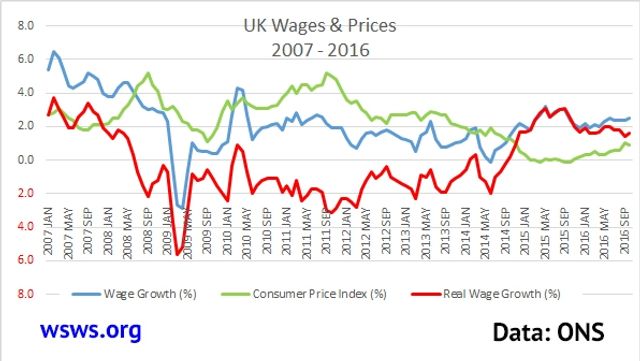
UK wages and prices 2007 to 2016
For most workers, the value of real wages began falling and failed to keep up with inflation for at least six years (see chart below) between 2008 and 2014. Despite modest pay increases from late 2014, the value of wages lost in the preceding period has still not been recouped by most workers.
In November, the Institute for Fiscal Studies (IFS) wrote that British workers faced the “worst decade for pay in 70 years.” It noted that, “average earnings fell 9 percent between 2008 and 2013 as wages failed to keep pace with inflation.” Moreover, the Office for Budget Responsibility forecast real wage growth would stall next year, and “even by 2021 average earnings will be below their 2008 level.”
According to the IFS, the “pain in the next few years” is likely to be concentrated “most heavily on low and middle-income families.” This was because continuing austerity measures being carried out by Theresa May’s Conservative government meant real terms cuts to means-tested benefits, so that “poorer households face a much sharper drop in incomes.”
The chancellor’s Autumn Statement (budget) made clear not only that there will be no let-up in austerity, the Conservatives have carried out an additional £12 billion in welfare cuts in the 18 months since the last general election, but that none of the more than £100 billion in cuts imposed by successive Labour and Tory governments since 2008 will be reversed. Chancellor Philip Hammond stressed his budget “re-states our commitment to living within our means.”
The Resolution Foundation and IFS warnings bookend the speech made earlier this month by Bank of England Governor Mark Carney who pointed out that British workers had suffered a “lost decade” in which real wage growth was the slowest since the 1860s.
With the end of 2016, workers in Britain have seen one attack after another on their pay, conditions and benefits, fueling the numbers in poverty and those who go hungry.
• One-in-three people have experienced poverty in Britain in the last three years.
• 13.5 million live in low-income households, 21 percent of the UK population.
• 3.8 million are in poverty, with the largest group being female employees.
• 55 percent of working families are in poverty—a record high.
• 3.9 million children now live in families that struggle to make ends meet—29 percent of all children—with two-thirds of poor children living in households with at least one working adult.
• 8.4 million struggle to put food on the table, over half of these regularly go a day without eating.
• When fully implemented, further benefit “reforms” will cost 2.1 million in-work families over £30 a week and 1.1 million out-of-work families at least £44 a week.
• Over 7 million people are in “precarious employment,” including self-employment, temporary work and zero-hours contracts.
• The number of self-employed reached 4.7 million, with over half on low-pay as compared to 30 percent of employees.
• 460,000 are falsely classified as “self-employed”—costing as much as £314 million a year in lost tax and employers National Insurance Contributions.

“New Year’s Eve in Cologne”: The scapegoating of Muslims and refugees deepens

Lena Sokoll

In Cologne as well as in other cities, this year’s New Year’s Eve celebrations were accompanied by a martial police operation. The number of state police was increased tenfold to 1,500. An additional 300 federal police and 600 crowd control police patrolled Cologne. The cathedral was surrounded by 40 newly-installed surveillance cameras and bag checks were instituted in the area around it.
In a clear case of racial profiling the German police stopped and controlled the papers of hundreds of dark-skinned men in and around the central station and environs. Police used a special racist designation—NAFRIs—to identify their victims.
One year after the events in Cologne on New Year’s Eve, it has become clear what really happened in 2016. Pickpocket gangs often engage in so-called “distraction scams” or sexual provocations at such events as the Munich Oktoberfest or various carnival festivities, but this time they were blown out of all proportion and used to whip up a racist hate campaign against refugees and Muslims.
This racist campaign served as a pretext for restricting fundamental democratic rights. The right to asylum was largely eliminated and the law on sexual crimes was expanded. The state apparatus was built up on a scale unprecedented during the period after World War II.
Racist slogans of the kind spread by the Alternative for Germany (AfD) and Pegida were introduced into the political mainstream. Sympathy for refugees, which was widespread in the German and European population, was denounced as “naiveté” and a security risk.
The clearest evidence that the “events on New Year’s Eve 2016 in Cologne” were a hysterical fiction is the police and court investigations that took place afterwards. The findings of the investigations make it clear that nothing more happened last year than what always accompanies the consumption of a large amount of alcohol at such crowded gatherings.
Proceedings were initiated against 330 accused and only 30 cases made it to sentencing. Only three of these cases involved a finding connected with a sexual crime. The legal proceedings reveal a picture of young petty criminals, who were fined or given suspended sentences for crimes such as cell phone theft.
The real criminal party in the “events in Cologne on New Year’s Eve” was the police campaign against foreigners, which was organized in the following days and in which all political parties and the entire media without exception took part. This campaign continues to this day.
However, the fact that only three of the accused were sentenced for sexual crimes is now being used to justify a further arming of the state. Federal Interior Minister Thomas de Maizière sharply criticized the investigating authorities and the judiciary at the end of 2016. “It is completely incomprehensible that after such a large number of sexual attacks so few perpetrators have been sentenced. I view that as a problem,” said the CDU politician to the Bild am Sonntag. The judiciary should “judge with all harshness.” In addition, he said that the trials lasted far too long. The thrust of these remarks is clear: there should be speedy trials handing out tough sentences, even if without evidence.
Let us review the facts once again.
The events at the main train station in Cologne on New Year’s Eve a year ago were the object of an extensive police investigation as well as hearings and inquiries on the state and national level. It has been established as fact that approximately 1,000 people were involved in festivities outside the train station and in the neighbouring grounds of the cathedral, that firecrackers were set off and that much alcohol was consumed. In and around the train station there was pickpocketing and in some cases the victims were distracted by jostling and groping.
The police evacuated the square shortly before midnight because of the danger of mass panic caused by the launching of fireworks, but later allowed people to return. After the reports of theft and sexual harassment came in, the police assembled a force of 150 and accompanied women to the train station. In the train station itself, there were 70 police on duty. The operation was so normal from the point of view of the police that the next day there was talk of a “relaxed deployment situation.”
Thomas Fischer, a federal judge in Karlsruhe recalled in his regular column in the Zeit that the situation is the same or worse every year at the Cologne Carnival or the Munich Octoberfest. It is sad that this happens, but it had never before prompted a larger debate.
However, a campaign was initiated at the beginning of January to discover a “collapse of civilization” and “new form of organized criminality” in the Cologne events. In a blanket designation, the “perpetrators” at the Cologne Main Train Station were identified as refugees and North Africans and the crimes committed were from then on no longer presented as pickpocketing, but as the expression of “Muslim norms of masculinity” (Julia Klöckner, state president of the CDU in Rhineland-Palatinate).
North Rhine Westphalia Interior Minister Ralf Jäger (Social Democratic Party, SPD) told the Cologne tabloid Express: “We do not tolerate groups of North African men organizing in order to degrade defenceless women with bold sexual attacks.”
The number of reports rose dramatically from 100 on New Year’s Eve to more than 1,200 in the following days. The reports included 500 sexual attacks. However, in spite of all the investigations and inquiries, there is still no detailed analysis of the supposed victims. Anyone can suddenly claim to have been harassed at the Cologne Main Train Station at the time in question. In the end, there were more criminal charges than participants.
The only thing that is certain is that representatives of the intelligence agencies and the security apparatus had already sharply attacked the refugee policy of the Merkel government weeks earlier and that the Cologne New Year’s Eve events were dramatically exaggerated and exploited for the purpose of a racist campaign. At the same time, fundamental democratic rights were restricted, the law on sexual crimes was expanded as a result of New Year’s Eve in Cologne and a massive expansion of domestic repression was initiated.
Moreover, the hysterical campaign concerning the New Year’s Eve events in Cologne had an even more specific political function. The supposedly massive attacks by aggressive groups of men on defenceless women were used as a pretext by the Left Party and its pseudo-left appendages to advocate the arming of the state and to integrate themselves into ruling class politics.
The Left Party did not view the debate about the events on New Year’s Eve as an attack on asylum and civil liberties, but stood on the side of a strong state in the name of the fight against sexual violence and for the rights of women.
The Left Party in Cologne welcomed a situation in which “in the future the police will be reinforced in troubled spots during public celebrations.”
The Left Party factional heads in federal parliament, Sahra Wagenknecht and Dietmar Bartsch, are using the events in Cologne as a pretext for advocating the arming of the state. Bartsch declared that the problem is the “inadequately equipped police” and—in the budget debate in parliament in September—he demanded “a state more capable of action.” This would include “well trained and equipped personnel in public service, especially in the police.” Wagenknecht is openly cozying up to the right wing. Speaking on New Year’s Eve in Cologne, she said: “whoever abuses the right to hospitality, has also lost the right to hospitality.”
The pseudo-left groups surrounding the Left Party have also taken advantage of the opportunity and called for a strengthening of the state and police apparatus under the cloak of “anti-sexism.” For instance, the SAV in Cologne expressed the view that sexual attacks can be prevented with police presence and deployments. Addressing the New Year’s Eve events, they said, “if the police had stayed in the square, the attacks could not have taken place.”
The long-time Pabloite Angela Klein wrote in January 2016 in International Viewpoint: “The left cannot compensate the state’s failures by its own structures. Therefore women have no choice but to demand sharper laws, which force the police to act.”
The year that began with a racist campaign connected with the New Year’s Eve events in Cologne ended with the attack in the Christmas market in Berlin by someone whose close connections with the intelligence agencies are becoming increasingly clear. This event was also used immediately to attack foreigners and to continue arming the police and the state.
Immediately following the attack in Berlin, the police were supplied with sub-machine guns everywhere in Germany, including Cologne, to conduct armed patrols of cities. The intensification of state sponsored animosity toward refugees and the campaign for a massive arming of the state apparatus in recent days show that growing sections of the ruling class are aiming for a much more right-wing government despite Merkel’s about-face in refugee policy.

US Special Operations troop deployments in Africa surged in 2016

Eddie Haywood 

At the close of 2016, Africa saw a dramatic surge in the number of US Special Operation forces deployed across the continent. Since 2006, the US military has increased its operations in Africa from just 1 percent of overall global Special Operations to more than 17 percent.
The rate at which troops have been surged on to the continent far surpasses that of any other region in the world, including Washington’s substantial military operations in the Middle East. There were 700 Special Operation commandos deployed across Africa in 2014; by 2016, the number had more than doubled, to 1,700.
According to a report in the Intercept, the US has deployed elite military forces in 33 nations across the African continent at any given moment, comprising 60 percent of the continent’s 54 countries. Since 2014, these commandos have carried out hundreds of operations in Africa.
The Special Operations force is made up of the “elite” fighting personnel from all four US military branches, and includes Navy SEALs, Green Berets, and Rangers. These are the same elite forces that were responsible for the operation that led to the assassination of Osama bin Laden in Abbottabad, Pakistan, in 2011.
These troops are party of the US Special Operations Command, or SOCOM, which largely carries out its dirty work in secret. Well aware that its wars are deeply unpopular with the American population, the Obama administration has utilized these groups of elite killers, as well as private contractors, to carry out its brutal operations away from the public eye.
The SOCOM operations in Africa are themselves a component of the Pentagon’s US Africa Command (AFRICOM), the military command post overseeing the entire continent. It is part of a cooperative relationship between SOCOM, the State Department and the respective African nations’ government and military forces.
Headquartered in Stuttgart, Germany, AFRICOM, through a variety of organizations and military cooperatives, carries out training of African military forces, oversees weapons and military equipment sales, and provides military advisors to African governments. In others words, AFRICOM is the spearhead of Washington’s objective of hegemony over the continent.
Africa contains vast economic resources that are coveted by wealthy Western corporate and banking interests. The decline of American capitalism is expressed by Washington’s turn to military force to meet the insatiable lust for profit by the American aristocracy.
The exponential growth of SOCOM in Africa represents a new stage in Washington’s drive for global dominance. While the US government deploys the phony pretext of the “War on Terror,” the justification for every intervention across the globe since the attacks of September 11, 2001, the real target is China, and to a lesser extent Russia, and the two nations’ economic influence on the continent.
In an interview conducted last September with US Special Operations Commander and Brigadier General Donald C. Bolduc in African Defense, a US military trade publication, Bolduc made clear that SOCOM’s objective on the African continent is to ensure the continent’s vast economic and natural resources remain in the hands of Western capitalists.
“We’re supporting African military professionalization and capability-building efforts,” Bolduc said. “The [Special Operations forces] network helps create specific tailored training for partner nations to empower military and law enforcement to conduct operations against our mutual threats.”
Further making clear that Washington’s aim is to neutralize threats posed by its economic rivals, Bolduc said, “The “triple threat” facing Africa—population growth, resource scarcity and continued instability—is producing vulnerable populations primed for extremist recruiting while creating opportunities for exploitation from China, Russia, Iran and North Korea.”
SOCOM is currently conducting offensives coordinated with national militaries in Libya, Somalia, South Sudan, Uganda, Central African Republic, Mali, and the Democratic Republic of the Congo. In the case of Libya, SOCOM is attempting to secure the installation of Washington’s puppet government set up in the aftermath of the US and NATO-led assault in 2011, which culminated in the assassination of Muammar Qaddafi, killed tens of thousands and left the country in ruins.
In Somalia, SOCOM is largely tasked with providing security to the Western puppet government in Mogadishu, which wields little influence outside the capital, where much of the country is ruled by tribal warlords and the Islamist terrorist militia Al-Shabbab. Somalia’s vast coast along the Gulf of Aden, which forms the waterway for much of the world’s oil traffic, makes it a prime target for Washington.
China’s economic influence on the African continent is widespread, and comprises significant mining enterprises, oil extraction, and infrastructure investments. Washington’s expanded African military operations are ultimately aimed at curbing this Chinese influence.
SOCOM’s cooperative offensive with the US-backed government of South Sudan is aimed at counteracting China’s oil infrastructure investments in the country, which also include Sudan to the north. Washington has targeted Sudan and its president, Omar Bashir, for not cooperating with its agenda for the region and his friendly relations with China.
The carving off of South Sudan in 2011 was done with the backing of the US and Europe with the aim of putting in place a pliant government subservient to Western interests and asserting control over a substantial portion of Sudan’s oil fields. The imperialist power’s drive for control of Sudan’s oil extraction has led to the massacre of thousands.
The crisis of American capitalism is fueling Washington’s drive to utilize its military power to reassert its dominance as the world’s sole economic power. The fact that the United States currently has military operations of one kind or another on every continent in the world underscores the desperation and recklessness with which Washington pursues its aim of global hegemony.
SOCOM’s expanded buildup in Africa, together with the provocative actions against Russia from the outgoing Obama administration, the threat of the incoming Trump administration to target China, and Washington’s extended military operations in the Middle East, threatens the world’s population with an even broader conflagration between nuclear-armed powers.

Islamic State claims New Year attack on Istanbul nightclub killing 39

Alex Lantier & Halil Celik

Yesterday, the Islamic State in Iraq and Syria (ISIS) militia claimed responsibility for a bloody terror attack on Istanbul’s Reina nightclub. Around 700 people were celebrating the New Year at the nightclub when, at 1:30 a.m. on January 1, an individual armed with an assault rifle shot unarmed security guards at the nightclub and entered the premises, shooting and killing 39 patrons, including 15 foreigners. Sixty-five others were wounded.
Police operations had been stepped up in Istanbul in the two weeks before the attack, after Turkey's National Intelligence Agency (MİT) received warnings that ISIS was preparing attacks on nightclubs or parties in Istanbul, the capital city of Ankara, or other major Turkish cities. A total of 147 ISIS suspects were detained, including at least 63 ISIS members, according to Interior Ministry sources. Eight ISIS members were detained in Ankara while planning an attack on New Year's Eve.
On New Year’s Eve itself, amid a state of emergency in Turkey, some 25,000 police officers were on duty and patrolling the streets in Istanbul to guard against a possible terror attack. The US embassy warned of terror attacks on New Year’s Eve and recommended that American citizens in Turkey not celebrate the New Year in crowded places.
Astonishingly, a lone gunman nevertheless was able to take a taxi to a location near the upscale nightclub, which is across the street from a police station. He then walked to the club, pulled an assault rifle from his bag, and launched an assault that killed or wounded over 100 people—largely Turks and tourists from other Muslim countries.
ISIS hailed the horrific attack in a statement it released, denouncing Turkey for allying with the United States and the European powers against it in the fighting in Iraq and Syria. It declared, “In continuation of the blessed operations that Islamic State is conducting against the protector of the cross, Turkey, a heroic soldier of the caliphate struck one of the most famous nightclubs where the Christians celebrate their apostate holiday.”
“We let infidel Turkey know that the blood of Muslims that is being shed by its airstrikes and artillery shelling will turn into fire on its territories,” the statement added.
Immediately after the attack, Turkey’s Radio and Television Supreme Council (RTÜK) announced a gag order, submitting reporting of the attack to state censorship. A massive man-hunt is still underway across Turkey to locate the shooter and identify potential accomplices.
Anti-terrorism experts who looked at footage of the security cameras at the nightclub said that the shooter seemed well-trained and efficient in the use of his assault rifle and shot wounded victims in the head, execution-style. He cleaned his weapon and changed his clothes, spending 13 minutes in the nightclub’s kitchen, and later escaped the scene by hailing a taxi. Police who examined the videos are working on the hypothesis that he is an ISIS fighter aged roughly 25, from the ex-Soviet republics of Uzbekistan or Kyrgyzstan, or the Xinjiang region of western China.
The initial account of the attack that is emerging raises serious political issues, however. How was a lone gunman, who was carrying out a mass shooting near a police station amid a high alert and under a state of emergency, allowed to slaughter people undisturbed for over a quarter of an hour, and then to escape?
In the aftermath of the attack, rumors spread that police deployments to secure the area around the nightclub had been deliberately scaled back just before the attack—raising the issue of whether some section of the authorities had foreknowledge of the shooting.
Yesterday, the US Embassy in Ankara felt compelled to react to these rumors by issuing a statement denying any US foreknowledge that an ISIS attack would target the Reina nightclub. “Contrary to rumors circulating in social media, the US government had no information about threats to specific entertainment venues, including the Reina Club, and the US government did not warn Americans to stay away from specific venues or neighborhoods,” it said.
Turkish and international officials simply issued statements condemning the attack, however. Turkeys ruling Justice and Development Party (AKP) promised to “end” terror, while Turkish President Recep Tayyip Erdogan warned that the goal of the attack was to spread chaos. The opposition Republican People’s Party (CHP) called for intensifying the security crackdown in Turkey and attacked recent Islamist statements by some AKP deputies denouncing New Year’s celebrations.
White House spokesman Eric Schultz said that US President Barack Obama “expressed condolences for the innocent lives lost, directed his team to offer appropriate assistance to the Turkish authorities, as necessary, and keep him updated as warranted.”
European Union (EU) foreign policy chief Federica Mogherini condemned the attack from her Twitter account, writing: “2017 starts with an attack in Istanbul. Our thoughts are with victims and their loved ones. We continue to work to prevent these tragedies.”
In fact, this horrific shooting flows from the military intervention of the United States and the EU into the Middle East and Turkey and, in particular, the AKP government’s collaboration with the US-led proxy war in Syria. If ISIS has a large network of dozens or even hundreds of operatives inside Turkey, this is because the CIA and its European and Middle East allies used Turkey as a staging ground to arm and support Islamist opposition militias operating across the border in Syria.
The Turkish ruling elite’s decision to turn Turkey into a major staging post to arm opposition militias carrying out raids, terror bombings, and war crimes in Syria has not only had horrific consequences for the population of Syria. The devastation and depopulation of Syria also plunged Turkey into escalating bloodshed.
ISIS has repeatedly carried out terror attacks, and the Turkish army’s crackdown on the Kurdish population—fearing that Washington would strengthen Kurdish nationalists too much by arming Syrian Kurdish militias as proxies in Syria—plunged the country’s Kurdish areas into civil war.
ISIS was responsible for the bloodiest single attack in Turkey’s history, on October 10, 2015, killing at least 109 people and wounding more than 500 in a twin suicide bombings against a peace rally in Ankara. In 2016, the Islamic State carried out six terrorist attacks in Turkey, in which 127 people were killed and some 320 others wounded.
Split-offs from the Kurdish nationalist movement such as the Kurdistan Freedom Falcons (TAK) also carried out several terror attacks, including bombings in December in Istanbul and Kayseri.
In this New Year’s attack, the specific grievance cited by ISIS was the Turkish government’s alliance with Russia and Iran to try to crush Islamist opposition militias like ISIS inside Syria. Last week, Turkey negotiated a ceasefire in Syria with Russian and Iranian officials covering much of Syria, but it has pressed on with bloody attacks on Al Bab aiming to seize ISIS’ capital in Syria, Raqqa. ISIS appears to have retaliated by organizing another terror attack on Turkish soil.

New US Congress to launch assault on social programs

Patrick Martin

The 115th US Congress assembles in Washington today, with the ceremonial swearing in of new senators by outgoing Vice President Joe Biden, and the swearing in of the entire House of Representatives by House Speaker Paul Ryan. For the first time in a decade, the Republican Party will be in control of the House and Senate alongside a Republican president, Donald Trump, set to be inaugurated January 20.
The new government being formed in the US capital is like nothing that has ever been seen in Washington. It carries the reactionary policies of the Obama administration and previous Congresses, whether under Democratic or Republican control, to new political depths.
The incoming Congress, working with the Trump administration, is preparing an assault on whatever remains of social programs implemented under the New Deal and the Great Society. The true content of Trump’s call to “Make America Great Again” is to roll back social conditions for the working class to those that existed at the end of the 19th century--the era of child labor, unlimited working hours and robber barons.
Entire federal departments such as Education, Labor, Housing and Urban Development, Health and Human Services and the Environmental Protection Agency have been turned over to right-wing ideologues committed to scrapping all restraints on business operations and ending all protections for workers, consumers and those who need social services.
Trump set the tone for the week at a New Year’s Eve party at his luxury estate at Mar-a-Lago in Palm Beach, Florida, where he toasted his well-heeled guests with the promise that the new Trump administration would “lower your taxes, cut regulations and repeal Obamacare,” to thunderous applause.
The taxes to be lowered will be those of the super-rich. The regulations to be abolished are those that restrict in any way the operations of big business and the financial swindling of Wall Street, at the expense of working people.
In calling for a repeal of Obamacare, Trump is demagogically appealing to broadly felt popular opposition to the program, which is seen as a boondoggle for health insurance companies, pharmaceutical conglomerates and giant hospital chains. But the actual content of his proposals will be to slash subsidies included in Obamacare as sweeteners while using revisions of the program to make substantial inroads into Medicare and Medicaid, the health insurance programs for the elderly, disabled and poor.
Despite Trump’s promises during the election campaign to replace Obamacare’s hated “individual mandate” and provisions that limit the choice of doctors and hospitals with “something great,” there is not the slightest effort in that direction. On the contrary, the Republican-controlled Congress will make the repeal of Obamacare the starting point for moves to privatize Medicaid, Medicare, the Children’s Health Insurance Program and other federal healthcare programs.
According to press reports Monday, the congressional Republican leadership plans to make repeal of Obamacare the first legislative action of the new session of Congress, although the timing is still uncertain because of the complexities of the law, enacted in 2010.
Obedient to the financial interests involved, the House and Senate Republican leaders aim to repeal Obamacare in a way that does not damage the profits that corporations have begun to reap from the program. This likely means that repeal of the individual mandate, which compels millions to buy private insurance or pay an increasingly stiff tax penalty, will be pushed back, lest it abruptly deprive the insurance companies of paying customers.
The planned repeal of Obamacare will proceed in several stages, beginning with passage of a budget resolution that will include so-called “reconciliation” rules that require only a 51-vote majority in the Senate, rather than the 60 votes required to overcome the expected Democratic filibuster.
Because the reconciliation process is limited to fiscal provisions that impact the budget, the actual dismantling of healthcare.gov and the federal exchange through which more than 10 million people have purchased insurance will require winning the support of at least eight Senate Democrats. The same procedure applies to rolling back the expansion of Medicaid, which extended the federal health insurance program for the poor to an additional 10 million lower-income working class families.
Congressional Republicans have vowed to combine Obamacare repeal with far-reaching attacks on both Medicaid and Medicare. Vice President Mike Pence is a leading advocate of destroying Medicaid as an entitlement program--one for which people are automatically eligible based on their income--and transforming it into a block grant to the states. This would limit the program in each state to the amount of the block grant, regardless of the number of people who apply for aid, forcing states to set up increasingly restrictive systems to ration assistance.
As for Medicare, Obamacare was actually financed in part by cuts in the program’s reimbursements to hospitals and other providers, estimated in the hundreds of billions of dollars. These funds, if recaptured through Obamacare repeal, will not be returned to Medicare, but will be made available instead for the real priorities of the Trump administration, increased military spending and a huge tax cut for the wealthy.
Trump’s appointment of Representative Tom Price to head the Department of Health and Human Services, which administers Medicare and Social Security, was a clear signal that he has discarded his campaign promise that there would be no cuts in either of these critical federal programs, which underwrite health care and retirement income for more than 70 million elderly and retired workers.
Price and House Speaker Paul Ryan have long advocated privatization of Medicare, transforming it into a voucher system modeled on the Medical Savings Accounts used by corporate employers to put a lid on healthcare spending by their employees.
The other major legislative initiative—and the one that has attracted the greatest attention from corporate lobbyists and Wall Street—is the gigantic tax-cutting package, likely to be the largest in history, exceeding even the windfalls for the wealthy enacted under Ronald Reagan and George W. Bush.
Trump has promised to slash the corporate tax rate from the present (largely nominal) rate of 25 percent to only 10 percent, as well as cutting higher-end individual tax rates and abolishing the estate tax, paid only by a tiny fraction of extremely wealthy families—those like Trump himself, and his cabinet of billionaires and multimillionaires.
A reactionary provision expected to be incorporated either into the Obamacare repeal or the budget and tax legislation is an outright ban on any federal funds going to Planned Parenthood, which provides health services, including cancer screening, contraception and abortion, to millions of working class women. The organization has been targeted by the Christian fundamentalist right because it is one of the few providers of abortion services in many states, and because it aggressively defends women’s rights to the full range of family planning services.
While the Trump administration and the congressional Republicans prepare an unprecedented onslaught against social programs for working people, the Democratic Party is engaged in cynical posturing to give itself a political cover for its inevitable capitulation to the demands of Wall Street and the financial oligarchy.
The incoming leader of the Senate Democrats, Charles Schumer, declared that the Democrats would fight “tooth and nail” against the overhaul of Medicare, carefully avoiding any such pledge in relation to Medicaid, the more immediate target.
Schumer, House Minority Leader Nancy Pelosi and 2016 presidential candidate Senator Bernie Sanders sent a letter to congressional Democrats calling for a “day of action” on January 15 “to vigorously oppose the Republican plan to end Medicare as we know it and throw our health care system into chaos.” Again, the Democratic politicians are deliberately downplaying of the attack on Medicaid.
Sanders has played a particularly rotten and demagogic role, issuing a series of appeals to Trump to “keep your promise” made during the campaign not to cut Medicare and Social Security.
Donna Brazile, the interim chairwoman of the Democratic National Committee, made her own appeal to Trump, saying that he had an “enormous” opportunity to obtain Democratic support, and urging him “to show that he’s eager to find common ground, to meet with Democrats.”
None of these Democratic leaders will state the obvious—that Trump cares nothing for his campaign promises and is carrying out the program of the financial aristocracy, which seeks to plunder the resources of the federal Treasury to enrich themselves while building up the police and the military to lay waste to enemies both foreign and domestic. That is because the Democrats serve that same financial aristocracy and in many cases are charter members of it.
Genuine resistance to the program of Trump, the Republicans and Wall Street will come only from the working class, from the great majority of the American people, who were ignored, betrayed or misled in the course of the 2016 election campaign and now face an attack on their jobs, living standards, social benefits and democratic rights on a scale that has no parallel in history.

Socialism and the centenary of the Russian Revolution: 1917-2017

David North & Joseph Kishore

1. A specter is haunting world capitalism: the specter of the Russian Revolution.
This year marks the centenary of the world-historical events of 1917, which began with the February Revolution in Russia and culminated in October with “ten days that shook the world”—the overthrow of the capitalist provisional government and conquest of political power by the Bolshevik Party, under the leadership of Vladimir Lenin and Leon Trotsky. The overthrow of capitalism in a country of 150 million people and establishment of the first socialist workers’ state in history was the most consequential event of the twentieth century. It vindicated, in practice, the historical perspective proclaimed just 70 years earlier, in 1847, by Karl Marx and Friedrich Engels in The Communist Manifesto.
In the course of one year, the uprising of the Russian working class, rallying behind it tens of millions of peasants, not only brought to an end centuries of rule by a semi-feudal autocratic dynasty. The extraordinary leap in Russia from “Tsar to Lenin”—the establishment of a government based on workers’ councils (soviets)—marked the beginning of a world socialist revolution that raised the consciousness of the working class and the masses oppressed by capitalism and imperialism in every part of the planet.
The Russian Revolution—which erupted in the midst of the horrifying carnage of World War I—proved the possibility of a world beyond capitalism, without exploitation and war. The events of 1917 and their aftermath penetrated deep into the consciousness of the international working class and provided the essential political inspiration for the revolutionary struggles of the twentieth century that swept across the globe.
2. The Bolshevik Party based its struggle for power in 1917 on an international perspective. It recognized that the objective basis for the socialist revolution in Russia was rooted, in the final analysis, in the international contradictions of the world imperialist system—above all, in the conflict between the archaic national-state system and the highly integrated character of modern world economy. Therefore, the fate of the Russian Revolution depended on the extension of workers’ power beyond the borders of Soviet Russia. As Trotsky explained so clearly:
The completion of the socialist revolution within national limits is unthinkable. One of the basic reasons for the crisis of bourgeois society is the fact that the productive forces created by it can no longer be reconciled with the framework of the national state. From this follow, on the one hand, imperialist wars, on the other, the utopia of a bourgeois United States of Europe. The socialist revolution begins on the national arena, it unfolds on the international arena, and is completed on the world arena. Thus, the socialist revolution becomes a permanent revolution in a newer and broader sense of the word: it attains completion only in the final victory of the new society on our entire planet. [The Permanent Revolution (London: New Park Publications, 1971), p. 155]
3. The fate of the Bolshevik Party, the Soviet Union and the socialist revolution in the twentieth century hinged on the outcome of the conflict of two irreconcilable perspectives: the revolutionary internationalism championed by Lenin and Trotsky in 1917 and during the first years of the existence of the Soviet Union, and the reactionary nationalist program of the Stalinist bureaucracy that usurped political power from the Soviet working class. Stalin’s anti-Marxist perspective of “socialism in one country” underlay the disastrous economic policies within the Soviet Union and the catastrophic international political defeats of the working class that culminated in 1991, after decades of bureaucratic dictatorship and misrule, in the dissolution of the Soviet Union and the restoration of capitalism in Russia.
But the end of the USSR did not invalidate the Russian Revolution or Marxist theory. Indeed, in the course of his struggle against the Stalinist betrayal of the revolution, Leon Trotsky had foreseen the consequences of the national program of “socialism in one country.” The Fourth International, founded under Trotsky’s leadership in 1938, warned that the destruction of the USSR could be prevented only through the overthrow of the Stalinist bureaucracy, the reestablishment of Soviet democracy, and the renewal of the struggle for the revolutionary overthrow of world capitalism.
4. The imperialist leaders and their ideological accomplices greeted the dissolution of the USSR in December 1991 with raptures. The fact that virtually none of them had foreseen this event did not prevent them from proclaiming its “inevitability.” Seeing no further than their own noses, they improvised theories that reinterpreted the twentieth century in a manner that suited their collective class arrogance. All the self-deluding nonsense and stupidity of the ruling elites and their academic hirelings found its quintessential expression in Francis Fukuyama’s “End of History” thesis. The October Revolution, he argued, was nothing more than an accidental departure from the normal and, therefore, timeless bourgeois-capitalist course of history. In the form of capitalist economics and bourgeois democracy, humanity had arrived at the highest and final stage of development. Following the dissolution of the Soviet Union, there could be no thought of an alternative to capitalism, let alone one based on workers’ power and the socialist reorganization of world economy.
Endorsing Fukuyama’s revelation, historian Eric Hobsbawm, a lifelong Stalinist, dismissed the October Revolution and, for that matter, the revolutionary and counterrevolutionary upheavals of the twentieth century, as unfortunate accidents. The years between 1914 (which witnessed the outbreak of World War I) and 1991 (the dissolution of the Soviet Union) were a misguided “age of extremes” that comprised the “short twentieth century.” Hobsbawm did not claim to know what the future would bring, or whether the twenty-first century would be short or long. He was certain of only one thing: there would never again be a socialist revolution in any way comparable to the events of 1917.
5. Twenty-five years have passed since Fukuyama proclaimed the “End of History.” Supposedly liberated from the menace of socialist revolution, the ruling class has had an opportunity to demonstrate what capitalism could accomplish if allowed to plunder the world as it pleased. But what is the outcome of its orgies? A short list of achievements would include: the filthy enrichment of an infinitesimal portion of the world’s population, vast social inequality and mass poverty, endless wars of aggression that have cost the lives of millions, the relentless strengthening of the repressive organs of the state and the decay of democratic forms of rule, the institution of murder and torture as basic instruments of imperialist foreign policy, and the general degradation of every aspect of culture.
6. A quarter century after the fall of the Soviet Union, it is impossible to deny that the entire world has entered a period of profound economic, political and social crisis. All the unresolved contradictions of the past century are reemerging with explosive force on the surface of world politics. The events of 1917 are acquiring a new and intense contemporary relevance. In countless publications, bourgeois commentators are calling attention nervously to parallels between the world of 2017 and that of 1917.
“Bolshiness is back,” warns the Economist’s Adrian Wooldridge in the magazine’s preview of the New Year. “The similarities to the world that produced the Russian revolution are too close for comfort.” He writes: “This is a period of miserable centenaries. First, in 2014, came that of the outbreak of the first world war, which destroyed the liberal order. Then, in 2016, that of the Battle of the Somme, one of the bloodiest conflicts in military history. In 2017 it will be 100 years since Lenin seized power in Russia.”
None other than Fukuyama now describes the United States, which he once hailed as the apotheosis of bourgeois democracy, as a “failed state.” He writes, “The American political system has become dysfunctional,” and “has undergone decay over recent decades as well-organized elites have made use of vetocracy to protect their interests.” Finally, Fukuyama warns: “[W]e cannot preclude the possibility that we are living through a political disruption that will in time bear comparison with the collapse of Communism a generation ago.”
7. For world capitalism, 2016 was the year from hell. All the structures of world politics established in the closing years of the Second World War and its aftermath are in an advanced state of disintegration. The contradiction between the inexorable processes of economic globalization and the confines of the national state is driving world politics. 2016 was the year of the accelerating breakdown of the European Union, exemplified in the Brexit vote and the growth of extreme right-wing nationalist parties.
The past year also witnessed the relentless intensification of military tensions, to the extent that the possibility—even the likelihood—of a Third World War is openly discussed in countless books, journals and newspapers. The innumerable regional tensions throughout the world are developing into an increasingly direct and open confrontation involving the major, nuclear-armed powers. No one can say for sure who will fight whom. Will the United States move first against China, or must that conflict be delayed until after accounts have been settled with Russia? This question is presently the subject of bitter strategic debate and conflict within the highest echelons of the American state. Even among the closest post-World War II allies, the friction of geopolitical and economic competition is fraying alliances. Germany is seeking to translate its economic strength into military power and discarding the last vestiges of its post-Nazi “pacifism.”
8. The crisis of the global capitalist system finds its most advanced expression within its very center, the United States. More than any other country, the United States imagined that it would be the prime beneficiary of the dissolution of the USSR. The first President Bush immediately proclaimed the birth of a “new world order,” in which the United States would function as the unchallengeable hegemon. Unmatched in its military power, the United States would exploit the “unipolar moment” to restructure the world in its own interests. Its strategists harbored dreams not simply of a new American Century, but of American centuries! In the words of Robert Kaplan, a leading foreign policy strategist:
The more successful our foreign policy, the more leverage America will have in the world. Thus, the more likely that future historians will look back on the twenty-first century United States as an empire as well as a republic, however different from that of Rome and every other empire throughout history. For as the decades and centuries march on, and the United States has had a hundred presidents, or 150 even, instead of forty-three, and they appear in long lists like the rulers of bygone empires—Roman, Byzantine, Ottoman—the comparison with antiquity may grow rather than diminish. Rome, in particular, is a model for hegemonic power, using various means to encourage a modicum of order in a disorderly world… [Warrior Politics: Why Leadership Demands a Pagan Ethos (New York: Random House, 2002), p. 153.]
9. Kaplan’s ode to empire, written in 2002, testifies to the semi-deranged state of mind that prevailed in the American ruling class as it launched its “war on terror” and prepared for the second invasion of Iraq in 2003. The American ruling class mistook the approaching abyss for a rainbow. The “unipolar moment” proved, indeed, to be little more than the briefest of historical interludes, and the new “American Century” lasted considerably less than a decade.
The euphoric response of the American ruling class to the dissolution of the Soviet Union expressed a disastrous misreading of the historical situation. The ruling elites convinced themselves that they could employ military power—undeterred by the danger of Soviet retaliation—to reverse decades of erosion of the economic supremacy of the United States. This miscalculation formed the basis of a massive escalation of American military operations throughout the world, which has led to one disaster after another. Fifteen years after 9/11, the fraudulent “war on terror” has left the Middle East in chaos, culminating in the debacle of America’s regime-change operation in Syria.
10. The military disasters of the past quarter century have been compounded by the deterioration of the global economic stature of the United States, which has found ever more direct expression in the decline in living standards for broad masses of the population. According to a recent report by economists Thomas Piketty, Emmanuel Saez and Gabriel Zucman, the pretax share of national income received by the bottom half of the population in the United States has fallen from 20 percent in 1980 to 12 percent today, while—in an exact reversal—the share of the top one percent has risen from 12 percent to 20 percent. For four decades, the real incomes of the bottom half have remained flat, while the incomes of the top one percent have risen by 205 percent, and for the top .001 percent by a staggering 636 percent.
The younger generation of Americans is drowning in debt, unable to make enough to start a family or move out of their parents’ homes. While in 1970, 92 percent of 30-year-olds made more than their parents did at a similar age, only 51 percent did so in 2014. Millions of Americans are suffering from inadequate health care. For the first time in more than two decades, overall life expectancy fell in 2015 due to the shocking rise in mortality from suicide, drug abuse and other manifestations of social crisis.
11. As American society has become more unequal, it has become increasingly difficult for its ideologists to maintain the pretense that democracy still prevails. One of the essential functions of identity politics—centered on race, ethnicity, gender and sexuality—has been to shift attention away from the deep class divisions within the United States. The election of Donald Trump has exposed, in all its disgusting nakedness, the reality of oligarchic rule in the United States. It must be stressed, however, that Trump is not some sort of monstrous interloper in what had been, until Election Day 2016, a flawed but essentially decent society. Trump—the product of the criminal and diseased couplings of the real estate, finance, gambling and entertainment industries—is the genuine face of the American ruling class.
12. The incoming Trump administration, in its aims as in its personnel, has the character of an insurrection of the oligarchy. As a doomed social class approaches its end, its effort to withstand the tides of history not infrequently assumes the form of an attempt to reverse what it perceives as the longstanding erosion of its power and privilege. It seeks to return conditions to the way they once were (or as it imagines they were), before the inexorable forces of social and economic change began gnawing away at the foundations of its rule. Charles I blocked the summoning of parliament in England for 11 years prior to the outbreak of revolution in 1640. When the Etats-General assembled in Paris on the eve of revolution in 1789, the French nobility intended to reestablish privileges that had been ebbing away since 1613. The Civil War in the United States was preceded by the effort of the Southern elite to extend slavery throughout the country. The firing on Fort Sumter in April 1861 marked the beginning of what was, in effect, a slave-owners’ insurrection.
Trump’s pledge to “Make America Great Again” means, in practice, the eradication of whatever remains of the progressive social reforms—achieved through decades of mass struggles—that ameliorated conditions of life for the working class. In Trump’s own mind, “making America great” entails returning the country to the conditions of the 1890s, when the Supreme Court ruled that the income tax was communistic and unconstitutional. The institution of the income tax in 1913 and all the ensuing social legislation and regulation that placed limits on the exploitation of workers, the broader public, and the environment, represented, as far as Trump is concerned, an assault on the right of the rich to make money as they pleased. The funding of public education and the establishment of the minimum wage, Social Security, Medicare, Medicaid and other social welfare programs sanctioned the diversion of financial resources away from the rich. Assembling a cabinet comprised of billionaires and multimillionaires, Trump intends to lead a government of the rich, by the rich and for the rich.
Alongside his rich cronies, Trump has brought into his cabinet and selected as his principal advisers a cabal of ex-generals and outright fascists. Their task will be to develop a foreign policy based on the unbridled assertion of the global interests of US imperialism. This is the real significance of the revival of the slogan of “America First.” It is the deterioration of America’s economic dominance that imparts to its imperialist agenda an increasingly savage character. The Democratic Party—that corrupt alliance of Wall Street financiers and state intelligence agencies—has concentrated its criticism of Trump on his alleged “softness” toward Russia. It need not worry. The Trump administration will continue and escalate the conflict with all countries whose interests--geopolitical and/or economic—clash with those of American imperialism.
13. Both in their international and domestic manifestations, the policies of Trump reflect a convulsive movement of the capitalist ruling elites to the right. The rise of Trump is paralleled by the growth in the political influence of the National Front in France, Pegida in Germany, the Five Star Movement in Italy and the UK Independence Party, which led the campaign for Brexit. In Germany, the ruling class is using the Christmas Market attack in Berlin to escalate the anti-refugee campaign led by Alternative for Germany. The political and economic essence of this process is embedded in the nature of imperialism, as explained by Lenin:
The fact that imperialism is parasitic or decaying capitalism is manifested first of all in the tendency to decay, which is characteristic of every monopoly under the system of private ownership of the means of production. The difference between the democratic-republican and the reactionary-monarchist imperialist bourgeoisie is obliterated because they are both rotting alive… [“Imperialism and the Split in Socialism,” in Lenin Collected Works, Volume 23 (Moscow: Progress Publishers, 1977), p. 106]
All the major imperialist powers are preparing for war, as states representing gigantic corporations and banks battle for control of resources, trade routes and markets. At the same time, the resort to nationalism is aimed at creating the framework for the violent suppression of class conflicts within each country.
14. The same capitalist crisis that produces imperialist war also produces the political radicalization of the working class and the development of socialist revolution. Trump will preside over a country riven by deep and intractable class conflict. Similar conditions prevail throughout the world. A recent study found that a quarter of all people in Europe, or 118 million, suffer from poverty or social exclusion. The poverty rate in Spain is 28.6 percent, and in Greece it is 35.7 percent. These are countries that have been targeted for brutal austerity measures dictated by the European Union and the banks. The number of unemployed young people worldwide rose to 71 million this year, increasing for the first time since 2013. In Venezuela, mass poverty and hyperinflation have led to food riots. In China, growing working-class militancy is expressed in a sharp increase in strikes and other forms of protest. Within Russia, the shock of capitalist restoration and the ensuing demoralization of the working class are giving way to renewed social militancy. The extreme social inequality and the kleptocratic character of the capitalist regime led by Putin are encountering ever-greater opposition.
15. Up until now, the political right, using the demagogic slogans of chauvinism, has exploited social discontent within the working class and broad sections of the middle class. But the initial successes of the reactionary parties of the chauvinist right have depended upon the political cynicism, deceit and bankruptcy of the organizations of what passes for the “left”—the Social Democrats, the Stalinists, the trade union bureaucrats and the array of petty-bourgeois anti-Marxist parties such as the Greens, the Left Party in Germany, Syriza in Greece and Podemos in Spain. To these one must add the many state-capitalist and Pabloite organizations, such as the International Socialist Organization (ISO) in the United States and the New Anti-capitalist Party in France (NPA). All the political energies of these reactionary organizations of the middle class are expended on falsifying Marxism to disorient the working class and impede the development of its struggle against capitalism.
16. But the pressure of events is driving the working class to the left. Among the billions of workers and young people around the world, there is a growing mood of anger and militancy. There are signs of both a resurgence of class struggle and a renewal of interest in socialism and Marxism. In the United States, 13 million people voted for a supposed socialist, Bernie Sanders, in the Democratic Party primary elections not because of his opportunist politics, but because of his denunciations of the “billionaire class” and his calls for a “political revolution.” This is part of an international process, which is dictated by the very nature of global capitalism. The class struggle, as it gains in strength and political self-awareness, will tend more and more to sweep over the borders of nation states. As the International Committee of the Fourth International noted as far back as 1988, “It has long been an elementary proposition of Marxism that the class struggle is national only as to form, but that it is, in essence, an international struggle. However, given the new features of capitalist development, even the form of the class struggle must assume an international character.”
17. Confidence in the revolutionary potential of the working class, however, is not a justification for political complacency. It would be irresponsible to ignore the fact that there exists a vast disparity between the advanced stage of the international crisis of capitalism and the political consciousness of the working class. It must be acknowledged that herein lies a great danger. Without a socialist revolution, the very survival of human civilization is in question. The fundamental political task of this epoch consists of overcoming the gap between objective socioeconomic reality and subjective political consciousness. Can this be accomplished?
18. This question can be answered only on the basis of historical experience. Amidst all the massive upheavals of the twentieth century, there exists one example of the working class rising to the level of the tasks posed by history: the October Revolution. In confronting the great problems of this epoch, it is necessary to study that historical event and assimilate its lessons.
In this centenary year of the Russian Revolution, there is a profound intersection and interaction between contemporary politics and historical experience. The 1917 Revolution arose out of the imperialist catastrophe of World War I. In the political maelstrom that followed the overthrow of the tsarist regime, the Bolshevik Party emerged as the dominant force within the working class. But the role played by the Bolsheviks in 1917 was the outcome of a long and difficult struggle for the development of socialist consciousness in the working class and the working out of a correct revolutionary perspective.
19. The critical elements of that struggle were: 1) the defense and elaboration of dialectical and historical materialism, in opposition to philosophical idealism and anti-Marxist revisionism, as the theoretical basis of the education and revolutionary practice of the working class; 2) the unrelenting struggle against the many forms of opportunism and centrism that obstructed or undermined the fight to establish the political independence of the working class; and 3) the working out, over many years, of the strategic perspective that oriented the Bolshevik Party toward the struggle for power in 1917. In this latter process, the adoption by Lenin of the Theory of Permanent Revolution, developed by Trotsky during the previous decade, was the critical advance that guided the strategy of the Bolsheviks in the months leading up to the overthrow of the provisional government.
20. The victory of the socialist revolution in October 1917 proved that the conquest of political power by the working class depends, in the final analysis, upon the building of a Marxist party in the working class. No matter how large and powerful the mass movement of the working class, its victory over capitalism requires the conscious political leadership of a Marxist-Trotskyist party. There is no other way the victory of the socialist revolution can be achieved.
The recognition of this political imperative will guide the work of the International Committee in this centenary year. As the development of the international class struggle creates a broader audience for Marxist theory and politics, the International Committee will do all that it can to expand knowledge of the Russian Revolution and educate new layers of the working class and youth, politically awakened and radicalized by the crisis, in the “Lessons of October.”
As 2017 begins, we call on the many thousands of readers of the World Socialist Web Site to become active in the revolutionary struggle and to join and build the Fourth International as the World Party of Socialist Revolution. This is the most appropriate and effective way to celebrate the 100th anniversary of the Russian Revolution and the victory of October 1917.