Jerry White & E.P Bannon
Workers at two of the largest oil refineries in the Midwest United
States are scheduled to join the weeklong oil workers strike on Saturday
at midnight. More than 1,000 workers at BP Whiting Refinery, near
Hammond, Indiana, and another 600 at a Toledo, Ohio refinery owned
jointly by BP and Husky, will join the walkout by 3,800 workers at nine
of the 65 refineries across the US organized by the United Steelworkers
(USW).
Among rank-and-file workers there is support for an all out national
strike by the 30,000 workers covered by the national labor agreement.
The USW has sought to contain this opposition but the oil companies have
not given union officials anything they could sell to their members as a
concession. On Thursday, union officials rejected the sixth proposal
from Royal Dutch Shell, which is the lead bargainer for BP, ExxonMobil,
Chevron and other oil giants, and talks on a new three-year agreement
have been suspended until next week.
Like workers throughout the rest of the economy, oil workers are
seeking to recoup lost wages, lower out-of-pocket health care costs,
shorten their hours of labor and improve working conditions. The oil
conglomerates, which have spent billions on dividends and stock buybacks
to enrich their investors and corporate executives, have pointed to the
fall in crude oil prices to oppose any improvement in workers’ living
standards and expand the use of lower-paid, part-time and temporary
workers. Earlier this month, BP froze pay for all non-union employees
company-wide.
BP management responded provocatively to the strike notice, saying,
“We are committed to ensuring a safe and orderly transition as USW
employees choose to strike and trained replacement workers take their
place,” Scott Dean, a spokesman for BP, said by e-mail Friday. “BP has
trained replacement workers comprised primarily of current and former BP
employees to safely and compliantly operate the refinery for the
duration of this strike.”
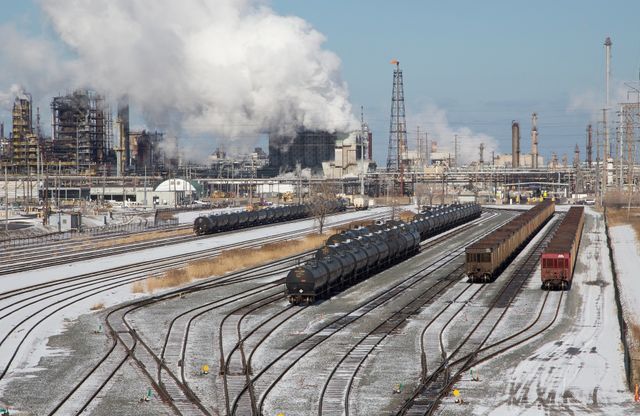
The Whiting refinery, BP’s largest, produces gasoline for much of the
Midwest, as well as aviation fuel, kerosene, propane and more than
eight percent of the country’s asphalt. The Toledo facility processes
160,000 barrels of oil daily, including from the tar sands of Alberta,
Canada.
On Thursday the Obama White House weighed in calling for a quick end
to the strike. In a statement, the president’s deputy press secretary
Frank Benenati wrote, “We are monitoring the situation and urge labor
and management to resolve their differences using the time-tested
process of collective bargaining.”
To this point, the partial strike has had limited economic impact,
with about 13 percent of the nation’s refining capacity affected with
the two BP refineries added. The Obama administration, however, is
concerned that the USW could lose control and the struggle could inspire
other sections of workers into action against decades of falling living
standards.
In recent months, various think tanks have warned of the danger of a
“wages push” by American workers who have suffered the longest period of
wage stagnation since the Great Depression even as corporate profits
and the stock market have soared. (See: “The Coming Fight Over Wages in the US”).
Despite Obama’s rhetoric about “inclusive prosperity” and “middle
class economics,” the administration’s economic policy has been based on
an unrelenting campaign to drive down wages and shift health care costs
from corporations to the backs of workers.
And like his Republican predecessor, Obama is no less a stooge of Big
Oil. This was shown in his kid gloves treatment of BP after the Gulf
oil spill and the decision by the US Justice Department last year to
drop charges against Tesoro whose criminal disregard for the safety led
to the explosion which killed seven Tesoro workers in Anacortes,
Washington, in 2010.
What does the White House mean about using the “time-tested process
of collective bargaining” to resolve the issues in the strike?
The president is well aware that the trade unions are committed, just
as much as the oil companies, to boost the profits and competitiveness
of American capitalism at the expense of the working class. He is
concerned that the intransigence of the oil giants and any effort to
impose their demands without the assistance of the unions could provoke
an explosive response by workers.
Since taking office, the Obama administration has relied on the
unions to suppress the opposition of the working class to the greatest
transfer of wealth from the bottom to top in American history. This
includes the help of the United Auto Workers in cutting labor costs in
the auto industry by nearly 35 percent. This is why Obama appointed USW
President Leo Gerard to his Advanced Manufacturing Partnership (AMP)
Steering Committee where he works with corporate executives from Dow
Chemical, Alcoa, Caterpillar and other Fortune 500 companies to slash
labor costs in the name of boosting their “international
competitiveness.”
Meanwhile Gerard & Co. spread the poison of economic nationalism,
claiming that the loss of jobs and declining living standards in
America are caused by “currency manipulation” by Japan and China, not
the capitalist profit system. This only serves to divide and weaken
workers in the face of the attack by global corporations like BP, Shell
and Exxon Mobil, while lining up American workers for another war.
The USW presents Obama as “pro-worker” and invited Democratic
congressmen Gene Green and Al Green to lead the singing of “We Shall
Overcome” at Friday’s rally at Shell’s Houston headquarters. But if oil
workers were to break the restraints of the USW and shut down the oil
industry, Obama and the Democrats would prove to be their enemies no
less than the Republicans. In the event of such a struggle, these
erstwhile “friends of labor” would use anti-strike laws, mobilize the
police and National Guard to escort scabs through the picket lines and
arrest strikers in the name of defending “national security.”
In the face of this anti-working class gang-up, the USW is trying to
silence strikers and “control the message” by claiming that the strike
is over safety not wages. For workers it is not an “either/or” issue.
Workers have the right to improved living standards and a safe job! The claim that multi-billion corporations cannot afford both is a fraud.
Oil workers must break out of the straitjacket being imposed by the
USW, spread the strike throughout the entire industry and fight for the
mobilization of the widest sections of the working class in a common
struggle to defend jobs and living standards. To do this, rank-and-file
strike committees, made up of the most class-conscious and militant
workers, should be organized, independently of the USW and both big
business parties.
8 Feb 2015

Haiti: Martelly to rule by decree
John Marion
Haiti’s parliament stopped sitting on January 12, when the terms of all 99 deputies in the lower house and 10 of the country’s senators expired. The remaining 10 senators are scheduled to serve another two years but cannot meet without a quorum consisting of half the members of each house. The Senate is supposed to have 30 members, the terms of which 10 expired two years ago without elections to replace them.
Under Haiti’s 1987 Constitution, deputies serve four-year terms, the duration of a parliament, and senators serve six-year terms on a staggered schedule.
There have been no parliamentary elections in the country since 2010. The current crisis was brought about by the refusal of President Michel Martelly and the Senate to agree on a law for administering elections. While blaming the crisis on a group of six opposition senators, Martelly is the clear beneficiary and the US government has come down on his side.
With backing from the US and UN, Martelly is now able to rule by decree until at least the fall, when the next presidential election is due. Having been forced—by a commission chaired by the head of Haiti’s National Chamber of Commerce and Industry—to fire Prime Minister Laurent Lamothe in December, Martelly waited until after parliament’s dissolution to install a new government.
Martelly’s new Prime Minister Evans Paul is a career politician who has moved dramatically to the right since he managed Jean-Bertrand Aristide’s presidential campaign in 1990. In January 2014, Paul appeared alongside Martelly, Jean-Claude Duvalier, and former coup leader General Prosper Avril at a ceremony commemorating the 210th anniversary of Haiti’s revolution against French colonialism.
After being sworn in as prime minister, Paul met dutifully with US Ambassador Pamela White and the US State Department’s Special Coordinator Thomas Adams. White had visited parliament on January 11 with the Canadian Ambassador and a UN official in an attempt to convince the deputies and senators to extend the end dates of their own terms. The diplomats were concerned about maintaining a pretense of democracy in the face of growing street protests. Several senators are reported to have skipped the last session out of spite.
Meanwhile, the social conditions for the masses in Haiti continue to deteriorate. A strike by public transportation workers over the price of gas and diesel fuel received widespread public support on Monday, shutting down commerce and schools in Port-au-Prince. The government, which buys petroleum from Venezuela at a steep discount through the PetroCaribe treaty, nonetheless sets the price of gasoline at more than $4 per gallon. The strike was sold out by the unions after only one day.
The US openly backs Martelly, a former musical performer linked to the old Duvalierist dictatorship. In a January 16 phone call to Martelly, US Vice President Joe Biden also took the position that parliament is to blame for the electoral impasse and praised the president’s attempts at “compromise.” He went on to implicitly approve a Martelly dictatorship, stating “the United States remains Haiti’s committed friend and partner … as President Martelly’s administration works to build a more prosperous and secure future for the Haitian people.”
On Tuesday, Le Nouvelliste published an interview with an unnamed businessman involved in forcing Lamothe out of office. After telling the paper that the government should not print more money to cover its debts, this power behind the throne noted that US $250 million will be needed just to keep the government afloat until the next scheduled elections. Such money is likely to come from foreign governments, and he who pays the piper calls the tune.
For his part, Evans Paul warned the CEP (Provisional Electoral Council) not to spend too much on democracy. Martelly appointed the latest version of the CEP—there have been five during his presidency—after parliament’s dissolution, in violation of Haiti’s 1987 constitution. Promising “good elections at a better cost,” Paul stated: “we cannot always make elections and see that it is others who pay for us.”
Such thrift will not apply in protecting the interests of imperialist nations and Haiti’s bourgeoisie. MINUSTAH, the UN occupation force that has been in place since 2004 and which introduced cholera to the country, has a budget of US $500.1 million for the year ending June 30, 2015.
Representatives of the 15 member states of the United Nations Security Council visited Port-au-Prince and Cap Haitien this weekend. While making noises about the need for elections, they also concerned themselves with reviewing Martelly’s national police force (PNH). The UN has been insisting that Haiti create a national police as a condition for withdrawing any of the more than 7,000 uniformed MINUSTAH personnel still in the country. The army, which historically had carried out this policing function, was disbanded by Aristide in 1995.
Reacting to the possibility of a MINUSTAH draw-down, the new Minister of Justice Pierre Richard Casimir said, “I reiterate to the UN Security Council our request to not reduce the Minustah forces during the electoral process. On the contrary, it is necessary to reinforce the UN contingent in Haiti; indeed, electoral periods are sometimes marked by tensions and troubles.”
Martelly’s own ascension to the presidency in 2010-2011 was anything but democratic. Voter turnout in the first round of elections was less than 23 percent, in part because of the devastation wrought by the earthquake but also because Aristide’s Fanmi Lavalas was excluded on a technicality.
In November 2010, Jude Célestin, the candidate of the Inite party of then-president René Préval, placed second ahead of Martelly in the first round. This result qualified Célestin for the runoff election against frontrunner Mirlande Manigat, but there were immediate accusations of fraud. After the intervention of Secretary of State Hillary Clinton and the Organization of American States, Célestin withdrew.
A post-election statistical analysis carried out by the Center for Economic and Policy Research found that if all disputed ballots were excluded, the participation rate was only 20.1 percent of eligible voters. Martelly received support from only 4.5 percent of eligible voters in the first round.
An “Expert Verification Mission” from the Organization of American States, of which nearly all members were from the US, Canada, and France, advocated giving Martelly second place in the first vote. In a January 2011 debate at the UN Security Council, then-US Ambassador Susan Rice “threatened Haiti with a possible cut-off of aid if the government did not accept the Mission’s recommendations,” according to CEPR. Préval was also threatened with exile if he didn’t comply.
The CEPR’s statistical analysis found that the OAS completely excluded 1,053 disputed tally sheets. These were from areas “that were more pro-Célestin than the general electorate.” The OAS admitted to CEPR that these should have been included, and also that it had not done any statistical inference from the sheets it did count.
Voter participation was only 23 percent in the second round, which occurred four months later. Martelly beat Manigat in that election by at least 20 percent, in part because of support from a public relations firm with ties to John McCain. The firm, Ostos and Sola, also had a hand in the election of Mexico’s Felipe Calderon in 2006. In the second round, Martelly’s campaign spent about US $6 million on electronic messaging in a country where more than half of the population lives on less than $2 per day.
Haiti’s parliament stopped sitting on January 12, when the terms of all 99 deputies in the lower house and 10 of the country’s senators expired. The remaining 10 senators are scheduled to serve another two years but cannot meet without a quorum consisting of half the members of each house. The Senate is supposed to have 30 members, the terms of which 10 expired two years ago without elections to replace them.
Under Haiti’s 1987 Constitution, deputies serve four-year terms, the duration of a parliament, and senators serve six-year terms on a staggered schedule.
There have been no parliamentary elections in the country since 2010. The current crisis was brought about by the refusal of President Michel Martelly and the Senate to agree on a law for administering elections. While blaming the crisis on a group of six opposition senators, Martelly is the clear beneficiary and the US government has come down on his side.
With backing from the US and UN, Martelly is now able to rule by decree until at least the fall, when the next presidential election is due. Having been forced—by a commission chaired by the head of Haiti’s National Chamber of Commerce and Industry—to fire Prime Minister Laurent Lamothe in December, Martelly waited until after parliament’s dissolution to install a new government.
Martelly’s new Prime Minister Evans Paul is a career politician who has moved dramatically to the right since he managed Jean-Bertrand Aristide’s presidential campaign in 1990. In January 2014, Paul appeared alongside Martelly, Jean-Claude Duvalier, and former coup leader General Prosper Avril at a ceremony commemorating the 210th anniversary of Haiti’s revolution against French colonialism.
After being sworn in as prime minister, Paul met dutifully with US Ambassador Pamela White and the US State Department’s Special Coordinator Thomas Adams. White had visited parliament on January 11 with the Canadian Ambassador and a UN official in an attempt to convince the deputies and senators to extend the end dates of their own terms. The diplomats were concerned about maintaining a pretense of democracy in the face of growing street protests. Several senators are reported to have skipped the last session out of spite.
Meanwhile, the social conditions for the masses in Haiti continue to deteriorate. A strike by public transportation workers over the price of gas and diesel fuel received widespread public support on Monday, shutting down commerce and schools in Port-au-Prince. The government, which buys petroleum from Venezuela at a steep discount through the PetroCaribe treaty, nonetheless sets the price of gasoline at more than $4 per gallon. The strike was sold out by the unions after only one day.
The US openly backs Martelly, a former musical performer linked to the old Duvalierist dictatorship. In a January 16 phone call to Martelly, US Vice President Joe Biden also took the position that parliament is to blame for the electoral impasse and praised the president’s attempts at “compromise.” He went on to implicitly approve a Martelly dictatorship, stating “the United States remains Haiti’s committed friend and partner … as President Martelly’s administration works to build a more prosperous and secure future for the Haitian people.”
On Tuesday, Le Nouvelliste published an interview with an unnamed businessman involved in forcing Lamothe out of office. After telling the paper that the government should not print more money to cover its debts, this power behind the throne noted that US $250 million will be needed just to keep the government afloat until the next scheduled elections. Such money is likely to come from foreign governments, and he who pays the piper calls the tune.
For his part, Evans Paul warned the CEP (Provisional Electoral Council) not to spend too much on democracy. Martelly appointed the latest version of the CEP—there have been five during his presidency—after parliament’s dissolution, in violation of Haiti’s 1987 constitution. Promising “good elections at a better cost,” Paul stated: “we cannot always make elections and see that it is others who pay for us.”
Such thrift will not apply in protecting the interests of imperialist nations and Haiti’s bourgeoisie. MINUSTAH, the UN occupation force that has been in place since 2004 and which introduced cholera to the country, has a budget of US $500.1 million for the year ending June 30, 2015.
Representatives of the 15 member states of the United Nations Security Council visited Port-au-Prince and Cap Haitien this weekend. While making noises about the need for elections, they also concerned themselves with reviewing Martelly’s national police force (PNH). The UN has been insisting that Haiti create a national police as a condition for withdrawing any of the more than 7,000 uniformed MINUSTAH personnel still in the country. The army, which historically had carried out this policing function, was disbanded by Aristide in 1995.
Reacting to the possibility of a MINUSTAH draw-down, the new Minister of Justice Pierre Richard Casimir said, “I reiterate to the UN Security Council our request to not reduce the Minustah forces during the electoral process. On the contrary, it is necessary to reinforce the UN contingent in Haiti; indeed, electoral periods are sometimes marked by tensions and troubles.”
Martelly’s own ascension to the presidency in 2010-2011 was anything but democratic. Voter turnout in the first round of elections was less than 23 percent, in part because of the devastation wrought by the earthquake but also because Aristide’s Fanmi Lavalas was excluded on a technicality.
In November 2010, Jude Célestin, the candidate of the Inite party of then-president René Préval, placed second ahead of Martelly in the first round. This result qualified Célestin for the runoff election against frontrunner Mirlande Manigat, but there were immediate accusations of fraud. After the intervention of Secretary of State Hillary Clinton and the Organization of American States, Célestin withdrew.
A post-election statistical analysis carried out by the Center for Economic and Policy Research found that if all disputed ballots were excluded, the participation rate was only 20.1 percent of eligible voters. Martelly received support from only 4.5 percent of eligible voters in the first round.
An “Expert Verification Mission” from the Organization of American States, of which nearly all members were from the US, Canada, and France, advocated giving Martelly second place in the first vote. In a January 2011 debate at the UN Security Council, then-US Ambassador Susan Rice “threatened Haiti with a possible cut-off of aid if the government did not accept the Mission’s recommendations,” according to CEPR. Préval was also threatened with exile if he didn’t comply.
The CEPR’s statistical analysis found that the OAS completely excluded 1,053 disputed tally sheets. These were from areas “that were more pro-Célestin than the general electorate.” The OAS admitted to CEPR that these should have been included, and also that it had not done any statistical inference from the sheets it did count.
Voter participation was only 23 percent in the second round, which occurred four months later. Martelly beat Manigat in that election by at least 20 percent, in part because of support from a public relations firm with ties to John McCain. The firm, Ostos and Sola, also had a hand in the election of Mexico’s Felipe Calderon in 2006. In the second round, Martelly’s campaign spent about US $6 million on electronic messaging in a country where more than half of the population lives on less than $2 per day.
Official enthusiasm over January jobs report belied by economic reality
Nick Barrickman
The US Labor Department released its monthly jobs report Friday, showing that US businesses added 257,000 positions for the month of January. The unemployment rate increased slightly, from 5.6 to 5.7 percent, while the labor force participation rate rose to 62.9 percent. The Labor Department said the increase in the unemployment rate was due to unemployed workers returning to the job market.
The Obama Administration hailed the figures, proclaiming in a statement that, “with today’s strong employment report, we have now seen eleven straight months of job gains above 200,000—the first time that has happened in nearly two decades.”
Media commentators cited the figures as proof that US workers were experiencing the effects of an economic recovery. “The January jobs report isn't just a single piece of good news. It marks a sea change in the labor market in which the middle class and working class are finally starting to get ahead,” wrote Bloomberg economic editor Peter Coy.
The ecstatic response to the jobs report came despite the announcement this week of some of the worst mass layoffs and store closings in recent memory. On Wednesday, Office supply retailer Staples announced plans to buy its rival Office Depot, which would result in the closure of up to a thousand stores and tens of thousands of layoffs.
On Thursday, electronics retailer RadioShack filed for bankruptcy, saying it plans to close up to 3,500 stores, meaning tens of thousands of additional layoffs.
Also this week, the e-commerce giant eBay announced plans to let go of 2,400 workers this quarter due to “weak holiday sales.” Mass layoffs have been announced within the last month by American Express, Schlumberger, Baker Hughes, DreamWorks Animation, and clothing retailers J.C. Penney and Macy’s.
In January, all major groups of workers saw either increasing or stagnant unemployment rates. Teenagers saw the highest amount of joblessness, increasing to 18.8 percent.
Job growth in January was dominated by the mostly low-paying retail sector, accounting for 46,000 positions – the largest amount from any industry. Construction firms and manufacturers added 39,000 and 22,000 jobs, respectively, and hotels, restaurants and other service sector areas added 37,100 positions.
The number of officially jobless US workers remained at roughly 9 million. The long term jobless, those out of work for 27 months or more, made up 2.8 million of the total amount, or over 31 percent. The report notes that over the past year, this group has seen only a slight decrease in its ranks.
Underemployed workers, or those working part-time for economic reasons, were counted at nearly 6.8 million. According to the Economic Policy Institute, the US economy still has more than 5.8 million “missing workers” who have given up on looking for work. If these workers were to be included in official counts, the unemployment rate would stand at roughly 9 percent today.
Wage growth in the US has remained virtually stagnant. January’s 12 cent wage increase, bringing average US wages to $24.75 an hour, represents an increase of less than 0.5 percent. A report released last September by the US Federal Reserve noted that average US household income dropped by 12 percent from 2007 to 2013, a decline of nearly $6,400 a year for the typical American household. According to the Census Bureau’s Supplemental Poverty Measure, 47 percent of Americans have incomes below 200 percent of the official poverty level, characterizing half of the country as either poor or near-poor.
The economic “recovery” long touted by the US political establishment has seen an expansion of low-paying jobs as higher-paying ones have been eliminated. A 2014 report by the National Employment Law Project notes that while US businesses have added 1.85 million low-wage jobs over the past six years, they have eliminated 1.83 million medium-wage and high-wage jobs.
This week, Jim Clifton, head of the Gallup polling agency, penned a scathing denunciation of the claims that the US unemployment rate is back to “normal” levels.
“There’s no other way to say this,” he wrote. “The official unemployment rate, which cruelly overlooks the suffering of the long-term and often permanently unemployed as well as the depressingly underemployed, amounts to a Big Lie.”
“Gallup defines a good job as 30+ hours per week for an organization that provides a regular paycheck. Right now, the U.S. is delivering at a staggeringly low rate of 44%, which is the number of full-time jobs as a percent of the adult population, 18 years and older. We need that to be 50% and a bare minimum of 10 million new, good jobs to replenish America’s middle class.”
He added, “I hear all the time that “unemployment is greatly reduced, but the people aren’t feeling it. When the media, talking heads, the White House and Wall Street start reporting the truth—the percent of Americans in good jobs; jobs that are full time and real—then we will quit wondering why Americans aren’t ‘feeling’ something that doesn’t remotely reflect the reality in their lives.”
The US Labor Department released its monthly jobs report Friday, showing that US businesses added 257,000 positions for the month of January. The unemployment rate increased slightly, from 5.6 to 5.7 percent, while the labor force participation rate rose to 62.9 percent. The Labor Department said the increase in the unemployment rate was due to unemployed workers returning to the job market.
The Obama Administration hailed the figures, proclaiming in a statement that, “with today’s strong employment report, we have now seen eleven straight months of job gains above 200,000—the first time that has happened in nearly two decades.”
Media commentators cited the figures as proof that US workers were experiencing the effects of an economic recovery. “The January jobs report isn't just a single piece of good news. It marks a sea change in the labor market in which the middle class and working class are finally starting to get ahead,” wrote Bloomberg economic editor Peter Coy.
The ecstatic response to the jobs report came despite the announcement this week of some of the worst mass layoffs and store closings in recent memory. On Wednesday, Office supply retailer Staples announced plans to buy its rival Office Depot, which would result in the closure of up to a thousand stores and tens of thousands of layoffs.
On Thursday, electronics retailer RadioShack filed for bankruptcy, saying it plans to close up to 3,500 stores, meaning tens of thousands of additional layoffs.
Also this week, the e-commerce giant eBay announced plans to let go of 2,400 workers this quarter due to “weak holiday sales.” Mass layoffs have been announced within the last month by American Express, Schlumberger, Baker Hughes, DreamWorks Animation, and clothing retailers J.C. Penney and Macy’s.
In January, all major groups of workers saw either increasing or stagnant unemployment rates. Teenagers saw the highest amount of joblessness, increasing to 18.8 percent.
Job growth in January was dominated by the mostly low-paying retail sector, accounting for 46,000 positions – the largest amount from any industry. Construction firms and manufacturers added 39,000 and 22,000 jobs, respectively, and hotels, restaurants and other service sector areas added 37,100 positions.
The number of officially jobless US workers remained at roughly 9 million. The long term jobless, those out of work for 27 months or more, made up 2.8 million of the total amount, or over 31 percent. The report notes that over the past year, this group has seen only a slight decrease in its ranks.
Underemployed workers, or those working part-time for economic reasons, were counted at nearly 6.8 million. According to the Economic Policy Institute, the US economy still has more than 5.8 million “missing workers” who have given up on looking for work. If these workers were to be included in official counts, the unemployment rate would stand at roughly 9 percent today.
Wage growth in the US has remained virtually stagnant. January’s 12 cent wage increase, bringing average US wages to $24.75 an hour, represents an increase of less than 0.5 percent. A report released last September by the US Federal Reserve noted that average US household income dropped by 12 percent from 2007 to 2013, a decline of nearly $6,400 a year for the typical American household. According to the Census Bureau’s Supplemental Poverty Measure, 47 percent of Americans have incomes below 200 percent of the official poverty level, characterizing half of the country as either poor or near-poor.
The economic “recovery” long touted by the US political establishment has seen an expansion of low-paying jobs as higher-paying ones have been eliminated. A 2014 report by the National Employment Law Project notes that while US businesses have added 1.85 million low-wage jobs over the past six years, they have eliminated 1.83 million medium-wage and high-wage jobs.
This week, Jim Clifton, head of the Gallup polling agency, penned a scathing denunciation of the claims that the US unemployment rate is back to “normal” levels.
“There’s no other way to say this,” he wrote. “The official unemployment rate, which cruelly overlooks the suffering of the long-term and often permanently unemployed as well as the depressingly underemployed, amounts to a Big Lie.”
“Gallup defines a good job as 30+ hours per week for an organization that provides a regular paycheck. Right now, the U.S. is delivering at a staggeringly low rate of 44%, which is the number of full-time jobs as a percent of the adult population, 18 years and older. We need that to be 50% and a bare minimum of 10 million new, good jobs to replenish America’s middle class.”
He added, “I hear all the time that “unemployment is greatly reduced, but the people aren’t feeling it. When the media, talking heads, the White House and Wall Street start reporting the truth—the percent of Americans in good jobs; jobs that are full time and real—then we will quit wondering why Americans aren’t ‘feeling’ something that doesn’t remotely reflect the reality in their lives.”
National Security Strategy document affirms US drive for world domination
Patrick Martin
The Obama administration issued its National Security Strategy document Friday, ostensibly laying out the principles on which its foreign policy will be based for the final two years that Obama occupies the White House.
The document was presented by National Security Adviser Susan Rice at the Brookings Institution on Friday afternoon, no doubt aimed at focusing attention on US threats against Russia over Ukraine. The Obama administration is currently considering providing direct arms to the US-backed regime in Kiev, a move that could lead very quickly to a direct war with Russia, a nuclear-armed power.
Rice was introduced by the think tank’s president, Strobe Talbott, one of eight representatives of the US foreign policy establishment who issued an appeal earlier this week for the Obama administration to provide billions in arms for the right-wing regime in Ukraine established by last year’s fascist-led coup.
Echoing the document itself, Rice denounced “Russian aggression” in Ukraine, declaring its operations in the east of the country “a heinous and deadly affront to longstanding international law and norms.” She praised efforts “to impose steep political and economic costs on Russia,” adding that the US “will continue to turn up the pressure unless Russia decisively reverses course.”
In keeping with the style of the president, the document itself is full of bureaucratic mush that may put the unwary to sleep, anaesthetizing the reader to the deeper meaning of its insistence that the United States must remain the unchallenged global power. The New York Times counted more than 100 uses of the words “lead,” “leader” and “leadership” in the 29-page text.
The language of the report is deliberately evasive and misleading. Its 16,000 words do not include “drone” or “bomb.” There is one reference to “mass killing,” describing the actions of groups like the Islamic State of Iraq and Syria. “Deaths” are referred to three times, all caused by disease or poor nutrition, not US military operations.
These are not defects of composition or drafting, but intrinsic to the process of creating a document whose content is the product of protracted negotiations between the White House National Security Council, Pentagon, CIA and State Department. In other words, it is a lie from beginning to end, the collective product of rival groups of mass murderers and their lawyers and press spokesmen, who have labored to make the global strategy of American imperialism sound like the mission statement of a charity.
The document’s introduction lists eight “top strategic risks to our interests.” Four of them are traditional security issues—attacks on the US homeland, on US citizens or allies, weapons of mass destruction, and the collapse of failing states—but defined so generally that they could apply to any country in the world.
The other four strategic risks are worth quoting: “global economic crisis or widespread economic slowdown”; “severe global infectious disease outbreaks”; “climate change”; and “major energy market disruptions.” This has considerable significance: the US government now regards virtually any form of economic, social or environmental disruption as a strategic security issue potentially justifying American military intervention.
The introduction also includes a call for Congress to end limits on military spending that have been part of “sequestration,” a shift that has also been included in Obama’s recently proposed budget.
The introduction concludes by stating the principal shift in the orientation of US foreign policy from Bush to Obama (without referring to the previous administration): “This strategy eschews orienting our entire foreign policy around a single threat or region. It establishes instead a diversified and balanced set of priorities appropriate for the world’s leading global power with interests in every part of an increasingly interconnected world.”
In other words, instead of the Bush administration’s obsessive focus on the Middle East, under Obama the entire world is the field of action for American bullying, up to and including military action. There is no country that the US does not consider part of its “backyard.”
Another area of attention was what the document describes as operations in “shared spaces”—cyber, air, oceans and outer space—which belong to no nation-state, but where US imperialism claims the right both to make rules and enforce them.
Two of the major sections of the document, titled “Prosperity” and “Values,” are particularly cynical, coming from the country that gave the world the 2008 financial crash, and the buildup of police-state methods, from torture to mass surveillance, over nearly two decades. Again the omissions are revealing: the document makes no reference to the National Security Agency and its program of global surveillance, gathering up the telecommunications and Internet traffic of the entire world’s population.
The document makes no reference to such spying, but the introductory section briefly rubber-stamps the operations of the vast US machinery of spying and surveillance: “All our tools are made more effective by the skill of our intelligence professionals and the quality of intelligence they collect, analyze, and produce.”
There are the usual claims about America being the great advocate of freedom and democracy around the world, before the document goes on to declare an exception to this rule: “Where our strategic interests require us to engage governments that do not share all our values, we will continue to speak out clearly for human rights and human dignity in our public and private diplomacy.”
These lines were a backhanded reference to the fact that the Obama administration is a principal prop of the Egyptian military junta (“we will maintain strategic cooperation with Egypt to enable it to respond to shared security threats”) and the monarchy in Saudi Arabia.
The name of the latter country does not appear in the document, but Saudi Arabia has been at the center of recent revelations documenting its extensive funding for Al Qaeda and Islamic fundamentalist organizations, at the behest of US imperialism. Nor does the word “Gaza” appear, where Israeli forces armed and equipped by the United States killed more than 2,000 people last summer, at least 500 of them children.
The Obama administration issued its National Security Strategy document Friday, ostensibly laying out the principles on which its foreign policy will be based for the final two years that Obama occupies the White House.
The document was presented by National Security Adviser Susan Rice at the Brookings Institution on Friday afternoon, no doubt aimed at focusing attention on US threats against Russia over Ukraine. The Obama administration is currently considering providing direct arms to the US-backed regime in Kiev, a move that could lead very quickly to a direct war with Russia, a nuclear-armed power.
Rice was introduced by the think tank’s president, Strobe Talbott, one of eight representatives of the US foreign policy establishment who issued an appeal earlier this week for the Obama administration to provide billions in arms for the right-wing regime in Ukraine established by last year’s fascist-led coup.
Echoing the document itself, Rice denounced “Russian aggression” in Ukraine, declaring its operations in the east of the country “a heinous and deadly affront to longstanding international law and norms.” She praised efforts “to impose steep political and economic costs on Russia,” adding that the US “will continue to turn up the pressure unless Russia decisively reverses course.”
In keeping with the style of the president, the document itself is full of bureaucratic mush that may put the unwary to sleep, anaesthetizing the reader to the deeper meaning of its insistence that the United States must remain the unchallenged global power. The New York Times counted more than 100 uses of the words “lead,” “leader” and “leadership” in the 29-page text.
The language of the report is deliberately evasive and misleading. Its 16,000 words do not include “drone” or “bomb.” There is one reference to “mass killing,” describing the actions of groups like the Islamic State of Iraq and Syria. “Deaths” are referred to three times, all caused by disease or poor nutrition, not US military operations.
These are not defects of composition or drafting, but intrinsic to the process of creating a document whose content is the product of protracted negotiations between the White House National Security Council, Pentagon, CIA and State Department. In other words, it is a lie from beginning to end, the collective product of rival groups of mass murderers and their lawyers and press spokesmen, who have labored to make the global strategy of American imperialism sound like the mission statement of a charity.
The document’s introduction lists eight “top strategic risks to our interests.” Four of them are traditional security issues—attacks on the US homeland, on US citizens or allies, weapons of mass destruction, and the collapse of failing states—but defined so generally that they could apply to any country in the world.
The other four strategic risks are worth quoting: “global economic crisis or widespread economic slowdown”; “severe global infectious disease outbreaks”; “climate change”; and “major energy market disruptions.” This has considerable significance: the US government now regards virtually any form of economic, social or environmental disruption as a strategic security issue potentially justifying American military intervention.
The introduction also includes a call for Congress to end limits on military spending that have been part of “sequestration,” a shift that has also been included in Obama’s recently proposed budget.
The introduction concludes by stating the principal shift in the orientation of US foreign policy from Bush to Obama (without referring to the previous administration): “This strategy eschews orienting our entire foreign policy around a single threat or region. It establishes instead a diversified and balanced set of priorities appropriate for the world’s leading global power with interests in every part of an increasingly interconnected world.”
In other words, instead of the Bush administration’s obsessive focus on the Middle East, under Obama the entire world is the field of action for American bullying, up to and including military action. There is no country that the US does not consider part of its “backyard.”
Another area of attention was what the document describes as operations in “shared spaces”—cyber, air, oceans and outer space—which belong to no nation-state, but where US imperialism claims the right both to make rules and enforce them.
Two of the major sections of the document, titled “Prosperity” and “Values,” are particularly cynical, coming from the country that gave the world the 2008 financial crash, and the buildup of police-state methods, from torture to mass surveillance, over nearly two decades. Again the omissions are revealing: the document makes no reference to the National Security Agency and its program of global surveillance, gathering up the telecommunications and Internet traffic of the entire world’s population.
The document makes no reference to such spying, but the introductory section briefly rubber-stamps the operations of the vast US machinery of spying and surveillance: “All our tools are made more effective by the skill of our intelligence professionals and the quality of intelligence they collect, analyze, and produce.”
There are the usual claims about America being the great advocate of freedom and democracy around the world, before the document goes on to declare an exception to this rule: “Where our strategic interests require us to engage governments that do not share all our values, we will continue to speak out clearly for human rights and human dignity in our public and private diplomacy.”
These lines were a backhanded reference to the fact that the Obama administration is a principal prop of the Egyptian military junta (“we will maintain strategic cooperation with Egypt to enable it to respond to shared security threats”) and the monarchy in Saudi Arabia.
The name of the latter country does not appear in the document, but Saudi Arabia has been at the center of recent revelations documenting its extensive funding for Al Qaeda and Islamic fundamentalist organizations, at the behest of US imperialism. Nor does the word “Gaza” appear, where Israeli forces armed and equipped by the United States killed more than 2,000 people last summer, at least 500 of them children.
Europe on the brink of war
Alex Lantier
Reports that Washington is considering arming the Western-backed regime in Kiev with weapons to attack pro-Russian separatists in eastern Ukraine have placed the risk of world war at the center of political life in Europe.
Earlier this week, French President François Hollande warned of the risk of “total war” before jetting off to Moscow for talks with German Chancellor Angela Merkel and Russian President Vladimir Putin. These comments were echoed Friday by former Swedish Prime Minister Carl Bildt.
“Unfortunately, war with Russia is conceivable,” Bildt told the Frankfurter Allgemeine Zeitung in an interview at the Munich Security Conference. “We are definitely living through one of the more dangerous historical phases,” Bildt said, “especially if you view the situation from a European perspective. There is fighting to the east, there is fighting to the south. The flames are coming very close to us. What makes the situation so explosive is that there is also great uncertainty about global power relations.”
World capitalism faces a crisis as profound as those that twice in the last century—in 1914 and 1939—plunged humanity into world war. Tens of millions were massacred in the course of these imperialist wars, which would pale in comparison to the devastation caused by a Third World War waged by nuclear-armed powers.
The risk of a nuclear catastrophe has emerged largely behind the back of the world’s population and amid silence from a complicit media. The Frankfurter Allgemeine Zeitung did not ask Bildt the obvious question: If the Swedish government can now conceive of war with nuclear-armed Russia, is it taking into account, as it formulates its policy, the risk that nuclear missiles will explode in Stockholm? Does it believe that it is worth risking the annihilation of Sweden to defend the far-right regime in Kiev? How many millions of lives are the imperialist powers prepared to sacrifice to the cold calculus of geo-political ambition?
While NATO governments have pointed to the historical character of the crisis they confront, none of them has any idea how to resolve it. Instead, they are pouring fuel on the fire. The imperialist powers are preparing to dispatch tens of thousands of NATO rapid reaction troops to Eastern European countries that border Russia while they send warships to the Black Sea.
Even as Merkel and Hollande met for peace talks in Moscow, ostensibly driven by concern over the implications of US weapons deliveries to Kiev, German Defense Minister Ursula Von der Leyen boasted of Germany’s participation in the rapid reaction forces that are aimed at Russia.
“Germany is not only a framework nation and key enabler of the new NATO spearhead force,” she declared, “but we are also helping to set up the Multinational Corps Northeast as well as the bases that NATO is establishing in its eastern and southern member states.” She praised “the untiring commitment of the [German] federal government to strengthen the role of the OSCE [Organization for Security and Cooperation in Europe] and ensure that the EU adopts a common position with regard to Russia.”
As a possible alternative to US proposals to arm Ukraine directly, voices in Europe are pressing for more economic sanctions, including cutting Russia off from the SWIFT international transaction system—an economic blow that could itself be seen as an act of war.
In the meantime, the European media work relentlessly to pollute public opinion, denouncing the Kremlin as the aggressor and blaming it for the crisis over Ukraine.
Le Monde published an editorial Friday warning that “history is teetering between a localized if deadly conflict and a larger and more worrisome conflict… one of those chain reactions Europe knows all too well.” The newspaper proceeded to place blame for the crisis squarely on Putin. It wrote: “Essentially, everything depends on one man: Vladimir Putin. Does the Russian president think he has punished Kiev enough for trying to ally with the European Union? Does he want to dial tensions down, or keep stoking war?”
Le Monde’s fairy tale involving a one-man chain reaction is part of a demonization of Russia that is based on absurd lies. Driving the war danger are the reckless actions of the imperialist powers, spurred on by their hegemonic ambitions and the intractable crisis of the capitalist system.
Washington and the European powers have been shaken by the global economic crisis, by their fading weight in the global economy, and by rising opposition to austerity within the working class. Terrified by what Bildt calls “uncertainty about global power relations,” they have sought to solidify their geo-political position by seizing Ukraine—by means of a putsch spearheaded by fascist paramilitary forces—and dealing a devastating blow to its neighbor, Russia, with the aim of transforming that country into a semi-colony.
Last year, Washington and Berlin led the NATO powers in backing a coup in Kiev headed by forces such as the fascist Right Sector militia. Having toppled pro-Russian President Viktor Yanukovych, they installed a right-wing regime that imposed brutal austerity measures on the working class and sought to drown opposition in pro-Russian regions of eastern Ukraine in blood.
The NATO powers seized upon armed resistance to the Kiev regime in eastern Ukraine, such as in Crimea and the Donbass, to justify a military build-up in Eastern Europe. They have supported the Kiev regime’s war in the Donbass that has killed over 5,000 people and forced millions to flee their homes. Now that the Kremlin has signaled that it will intervene militarily to halt a broader offensive against the Donbass, the NATO powers are indicating that they are prepared to respond with total war.
To the war frenzy of the imperialist powers, the international working class must counterpose the strategy of world socialist revolution.
The threat of war has become a constant feature of political life. Recent years have seen a series of war scares—in September 2013, when the United States and France nearly attacked Syria; in 2014, when threats were issued against Russia following the still-unsolved downing of flight MH17 over Ukraine; and now, over the war in eastern Ukraine. Absent a mass intervention by the working class in struggle against imperialism, one or another of these crises will trigger an uncontrollable war threatening the survival of humanity.
As the International Committee of the Fourth International wrote last year in its statement, “Socialism and the Fight Against Imperialist War:”
“The collision of imperialist and national state interests expresses the impossibility, under capitalism, of organizing a globally-integrated economy on a rational foundation and thus ensuring the harmonious development of the productive forces. However, the same contradictions driving imperialism to the brink provide the objective impulse for social revolution. The globalization of production has led to a massive growth of the working class. Only this social force, which owes no allegiance to any nation, is capable of putting an end to the profit system, which is the root cause of war.”
Reports that Washington is considering arming the Western-backed regime in Kiev with weapons to attack pro-Russian separatists in eastern Ukraine have placed the risk of world war at the center of political life in Europe.
Earlier this week, French President François Hollande warned of the risk of “total war” before jetting off to Moscow for talks with German Chancellor Angela Merkel and Russian President Vladimir Putin. These comments were echoed Friday by former Swedish Prime Minister Carl Bildt.
“Unfortunately, war with Russia is conceivable,” Bildt told the Frankfurter Allgemeine Zeitung in an interview at the Munich Security Conference. “We are definitely living through one of the more dangerous historical phases,” Bildt said, “especially if you view the situation from a European perspective. There is fighting to the east, there is fighting to the south. The flames are coming very close to us. What makes the situation so explosive is that there is also great uncertainty about global power relations.”
World capitalism faces a crisis as profound as those that twice in the last century—in 1914 and 1939—plunged humanity into world war. Tens of millions were massacred in the course of these imperialist wars, which would pale in comparison to the devastation caused by a Third World War waged by nuclear-armed powers.
The risk of a nuclear catastrophe has emerged largely behind the back of the world’s population and amid silence from a complicit media. The Frankfurter Allgemeine Zeitung did not ask Bildt the obvious question: If the Swedish government can now conceive of war with nuclear-armed Russia, is it taking into account, as it formulates its policy, the risk that nuclear missiles will explode in Stockholm? Does it believe that it is worth risking the annihilation of Sweden to defend the far-right regime in Kiev? How many millions of lives are the imperialist powers prepared to sacrifice to the cold calculus of geo-political ambition?
While NATO governments have pointed to the historical character of the crisis they confront, none of them has any idea how to resolve it. Instead, they are pouring fuel on the fire. The imperialist powers are preparing to dispatch tens of thousands of NATO rapid reaction troops to Eastern European countries that border Russia while they send warships to the Black Sea.
Even as Merkel and Hollande met for peace talks in Moscow, ostensibly driven by concern over the implications of US weapons deliveries to Kiev, German Defense Minister Ursula Von der Leyen boasted of Germany’s participation in the rapid reaction forces that are aimed at Russia.
“Germany is not only a framework nation and key enabler of the new NATO spearhead force,” she declared, “but we are also helping to set up the Multinational Corps Northeast as well as the bases that NATO is establishing in its eastern and southern member states.” She praised “the untiring commitment of the [German] federal government to strengthen the role of the OSCE [Organization for Security and Cooperation in Europe] and ensure that the EU adopts a common position with regard to Russia.”
As a possible alternative to US proposals to arm Ukraine directly, voices in Europe are pressing for more economic sanctions, including cutting Russia off from the SWIFT international transaction system—an economic blow that could itself be seen as an act of war.
In the meantime, the European media work relentlessly to pollute public opinion, denouncing the Kremlin as the aggressor and blaming it for the crisis over Ukraine.
Le Monde published an editorial Friday warning that “history is teetering between a localized if deadly conflict and a larger and more worrisome conflict… one of those chain reactions Europe knows all too well.” The newspaper proceeded to place blame for the crisis squarely on Putin. It wrote: “Essentially, everything depends on one man: Vladimir Putin. Does the Russian president think he has punished Kiev enough for trying to ally with the European Union? Does he want to dial tensions down, or keep stoking war?”
Le Monde’s fairy tale involving a one-man chain reaction is part of a demonization of Russia that is based on absurd lies. Driving the war danger are the reckless actions of the imperialist powers, spurred on by their hegemonic ambitions and the intractable crisis of the capitalist system.
Washington and the European powers have been shaken by the global economic crisis, by their fading weight in the global economy, and by rising opposition to austerity within the working class. Terrified by what Bildt calls “uncertainty about global power relations,” they have sought to solidify their geo-political position by seizing Ukraine—by means of a putsch spearheaded by fascist paramilitary forces—and dealing a devastating blow to its neighbor, Russia, with the aim of transforming that country into a semi-colony.
Last year, Washington and Berlin led the NATO powers in backing a coup in Kiev headed by forces such as the fascist Right Sector militia. Having toppled pro-Russian President Viktor Yanukovych, they installed a right-wing regime that imposed brutal austerity measures on the working class and sought to drown opposition in pro-Russian regions of eastern Ukraine in blood.
The NATO powers seized upon armed resistance to the Kiev regime in eastern Ukraine, such as in Crimea and the Donbass, to justify a military build-up in Eastern Europe. They have supported the Kiev regime’s war in the Donbass that has killed over 5,000 people and forced millions to flee their homes. Now that the Kremlin has signaled that it will intervene militarily to halt a broader offensive against the Donbass, the NATO powers are indicating that they are prepared to respond with total war.
To the war frenzy of the imperialist powers, the international working class must counterpose the strategy of world socialist revolution.
The threat of war has become a constant feature of political life. Recent years have seen a series of war scares—in September 2013, when the United States and France nearly attacked Syria; in 2014, when threats were issued against Russia following the still-unsolved downing of flight MH17 over Ukraine; and now, over the war in eastern Ukraine. Absent a mass intervention by the working class in struggle against imperialism, one or another of these crises will trigger an uncontrollable war threatening the survival of humanity.
As the International Committee of the Fourth International wrote last year in its statement, “Socialism and the Fight Against Imperialist War:”
“The collision of imperialist and national state interests expresses the impossibility, under capitalism, of organizing a globally-integrated economy on a rational foundation and thus ensuring the harmonious development of the productive forces. However, the same contradictions driving imperialism to the brink provide the objective impulse for social revolution. The globalization of production has led to a massive growth of the working class. Only this social force, which owes no allegiance to any nation, is capable of putting an end to the profit system, which is the root cause of war.”
40 MISTAKES MEN MAKE WHILE HAVING SEX WITH WOMEN.....
1) NOT
KISSING FIRST.
Avoiding her lips and diving straight for the erogenous
zones makes her feel like you're paying by the hour and trying to get your
money's worth by cutting out nonessentials. A proper passionate kiss is the
ultimate form of foreplay.
2) BLOWING
TOO HARD IN HER EAR.
Admit it, some kid at school told you girls love this.
Well, there's a difference between being erotic and blowing as if you're trying
to extinguish the candles on your 50th birthday cake. That hurts.
3) NOT
SHAVING.
You often forget you have a porcupine strapped to your
chin which your rake repeatedly across your partner's face and thighs. When she
turns her head from side to side, it's not passion, it's avoidance.
4) SQUEEZING
HER BREAST.
Most men act like a housewife testing a melon for
ripeness when they get their hand on a pair. Stroke, caress, and smooth them.
5) BITING
HER NIPPLES.
Why do men fasten onto a woman's nipples, then clamp down
like they're trying to deflate her body via her breasts? Nipples are highly sensitive.
They can't stand up to chewing. Lick and suck them gently. Flicking your tongue
across them is good. Pretending they're a doggie toy isn't.
6) TWIDDLING
HER NIPPLES.
Stop doing that thing where you twiddle the nipples
between finger and thumb like you're trying to find a radio station in a hilly
area. Focus on the whole breasts, not just the exclamation points.
7) IGNORING
THE OTHER PARTS OF HER BODY.
A woman is not a highway with just three turnoffs:
Breastville East and West, and the Midtown Tunnel. There are vast areas of her
body which you've ignored far too often as you go bombing straight into
downtown Vagina. So start paying them some attention.
8) GETTING
THE HAND TRAPPED.
Poor manual dexterity in the underskirt region can result
in tangled fingers and underpants. If you're going to be that aggressive, just
ask her to take the damn things off.
9) LEAVING
HER A LITTLE PRESENT.
Condom disposal is the man's responsibility. You wore it,
you store it.
10)
ATTACKING THE CLITORIS.
Direct pressure is very unpleasant, so gently rotate your
fingers alongside of the clitoris.
11) STOPPING
FOR A BREAK.
Women, unlike men, don't pick up where they left off. If
you stop, they plummet back to square one very fast. If you can tell she's not there,
keep going at all costs, numb jaw or not.
12)
UNDRESSING HER AWKWARDLY.
Women hate looking stupid, but stupid she will look when
naked at the waist with a sweater stuck over her head. Unwrap her like an
elegant present, not a kid's toy.
13) GIVING
HER A WEDGIE DURING FOREPLAY.
Stroking her gently through her panties can be very sexy.
Pulling the material up between her thighs and yanking it back and forth is
not.
14) BEING
OBSESSED WITH THE VAGINA.
Although most men can find the clitoris without maps,
they still believe that the vagina is where it's all at. No sooner is your hand
down there than you're trying to stuff stolen banknotes up a chimney. This is
okay in principle, but if you're not careful, it can hurt so don't get carried
away. It's best to pay more attention to her clitoris and the exterior other than
vagina at first, then gently slip a finger inside her and see if she likes it.
15)
MASSAGING TOO ROUGHLY.
You're attempting to give her a sensual, relaxing massage
to get her in the mood. Hands and fingertips are okay; elbows and knees are
not.
16)
UNDRESSING PREMATURELY.
Don't force the issue by stripping before she's at least
made some move toward getting your stuff off, even if it's just undoing a couple
of buttons.
17) TAKING
YOUR PANTS OFF FIRST.
A man in socks and underpants is a at his worst. Lose the
socks first.
18) GOING
TOO FAST.
When you get to the penis-in-vagina situation, the worst
thing you can do is pump away like an industrial power tool - she'll soon feel
like an assembly-line worker made obsolete by your technology. Build up
slowly, with clean, straight, regular thrusts.
19) GOING
TOO HARD.
If you bash your great triangular hip bones into her
thigh or stomach, the pain is equal to two weeks of horseback riding
concentrated into a few seconds.
20) COMING
TOO SOON.
Every man's fear. With reason. If you shoot before you
see the whites of her eyes, make sure you have a backup plan to ensure her
pleasure too.
21) NOT
COMING SOON ENOUGH.
It may appear to you that humping for an hour without
climaxing is the mark of a sex god, but to her it's more likely the mark of a
numb vagina. At least buy some intriguing wall hangings, so she has something
to hold her interest while you're playing Marathon Man.
22) ASKING
IF SHE HAS COME.
You really ought to be able to tell. Most women make
noise. But if you really don't know, don't ask.
23)
PERFORMING ORAL SEX TOO GENTLY.
Don’t acts like a giant cat at a saucer of milk. Get your
whole mouth down there, and concentrate on gently rotating or flicking your
tongue on her clitoris.
24) NUDGING
HER HEAD DOWN.
Men persist in doing this until she's eyeball-to-penis,
hoping that it will lead very swiftly to mouth-to-penis. All women hate this.
It’s about three steps from being dragged to a cave by their hair. If you want
her to use her mouth, use yours; try talking seductively to her.
25) NOT
WARNING HER BEFORE YOU CLIMAX.
Sperm tastes like sea water mixed with egg white. Not
everybody likes it when she's performing oral sex, warn her before you come so
she can do what's necessary.
26) MOVING
AROUND DURING FELLATIO.
Don't thrust. She'll do all the moving during fellatio.
You just lie there. And don't grab her head.
27) TAKING
ETIQUETTE ADVICE FROM PORN MOVIES.
In X-rated movies, women seem to love it when men
ejaculate over them. In real life, it just means more laundry to do.
28) MAKING
HER RIDE ON TOP FOR AGES.
Asking her to be on top is fine. Lying there grunting
while she does all the hard work is not. Caress her gently, so that she doesn't
feel quite so much like the captain of a schooner. And let her have a rest.
29)
ATTEMPTING ANAL SEX AND PRETENDING IT WAS AN ACCIDENT.
This is how men earn a reputatio n for not being able to
follow directions. If you want to put it there, ask her first. And don't think
that being drunk is an excuse.
30) TAKING
PICTURES.
When a man says, "Can I take a photo of you?"
she'll hear the words "__to show my buddies." At least let her have
custody of them.
31) NOT
BEING IMAGINATIVE ENOUGH.
Imagination is anything from drawing patterns on her back
to pouring honey on her and licking it off. Fruit, vegetables, ice and feathers
are all handy props; hot candle wax and permanent dye are a no no.
32) SLAPPING
YOUR STOMACH AGAINST HERS.
There is no less erotic noise. It's as sexy as a belching
contest.
33)
ARRANGING HER IN STUPID POSES.
If she wants to do advanced yoga in bed, fine, but unless
she's a Romanian gymnast, don't get too ambitious. Ask yourself if you want a
sexual partner with snapped hamstrings.
34) LOOKING
FOR HER PROSTATE.
Read this carefully: Anal stimulation feels good for men
because they have a prostate. Women don't.
35) GIVING
LOVE BITES.
It is highly erotic to exert some gentle suction on the
sides of the neck, if you do it carefully. No woman wants to have to wear
turtlenecks and jaunty scarves for weeks on end.
36) BARKING
INSTRUCTIONS.
Don't shout encouragement like a coach with a megaphone.
It's not a big turn-on.
37) TALKING
DIRTY.
It makes you sound like a lonely magazine editor calling
a 1-900 line. If she likes nasty talk, she'll let you know
38) NOT
CARING WHETHER SHE COMES.
You have to finish the job. Keep on trying until you get
it right, and she might even do the same for you.
39)
SQUASHING HER.
Men generally weigh more than women, so if you lie on her
a bit too heavily, she will turn blue.
40) THANKING
HER.
Never thank a woman for having sex with you. Your bedroom
is not a soup kitchen.
Meeting in Moscow fails to produce agreement as US plots escalation in Ukraine
Niles Williamson
German Chancellor Angela Merkel and French President François Hollande met for approximately five hours with Russian President Vladimir Putin in Moscow on Friday in an attempt to hash out what has been described as a last-ditch effort to resolve the ongoing crisis in Ukraine.
The talks concluded Friday evening without any agreement, and the two European leaders left Moscow late at night without making a press statement. There were pledges of further discussions this weekend on a ceasefire between Ukrainian armed forces and pro-Russian separatists in the country’s eastern Donbass region.
Dmitry Peskov, a Kremlin spokesman, told reporters after the meeting that the leaders had agreed to continue working towards an agreement on implementing the lapsed ceasefire plan signed in Minsk last September. “At the moment joint work is under way on preparing the text of a possible joint document on implementation of the Minsk agreements—a document which would include proposals made by the president of Ukraine and proposals formulated today and added by Russian President Putin,” Peskov said.
Merkel, Hollande, Putin and Ukrainian President Petro Poroshenko are expected to discuss the possible framework by phone on Sunday.
Prior to Friday’s meeting Merkel told reporters that the European leaders were, “convinced there will be no military solution to the conflict.” She also sought to lower expectations for the meeting’s possible outcome, saying, “We know, however, that it remains completely open whether we will be able to reach a cease-fire through these talks.”
The meeting between the European leaders and Putin took place amidst threats by the US to directly arm the regime in Kiev that was installed in a right-wing coup one year ago. Ukraine has suffered a series of setbacks in the east and is facing a deepening economic crisis.
US Vice President Joe Biden and European Council President Donald Tusk, the former Prime Minister of Poland, made a joint appearance in Brussels on Friday ahead of the talks in Moscow, calling for unity between the US and EU in maintaining an aggressive stance towards Russia.
“Russia cannot be allowed to redraw the map of Europe,” Biden told reporters. In fact, it is the United States and the European powers that have utilized the coup in Ukraine as the basis for a vast militarization of all of Eastern Europe, including the doubling of NATO combat forces announced on Thursday. NATO will station six command and control units in Poland, Romania, Bulgaria and the Baltic states of Lithuania, Latvia, and Estonia.
Biden later cast aspersions on the trip by Merkel and Hollande to Moscow, “President Putin continues to call for new peace plans as his troops roll through the Ukrainian countryside, and he absolutely ignores every agreement his country has signed in the past.”
Tusk told reporters, “The European Union and the United States need to continue standing shoulder to shoulder, coordinating our efforts and uphold the pressure on Russia for as long as necessary.” He also warned against an agreement with Russia that would result in the partition of Ukraine, “We cannot compromise on Ukraine’s independence, sovereignty and territorial integrity.”
Ukrainian President Poroshenko announced on Ukrainian television Friday that his government would only accept an agreement in line with the cease-fire plan negotiated in Minsk in September of last year.
In addition to armored Humvees, drones, and radar equipment, the Obama administration is also considering delivering small arms and anti-armor missiles to aid in the bloody suppression of pro-Russian separatists. Direct military aid to Ukraine could be seen as an act of war by the US against Russia, provoking a Russian response and a possible direct confrontation between the two nuclear-armed powers.
Underlining the danger of the plan, NATO Commander General Phillip Breedlove issued a warning on Thursday that such a move must take into account a possible military reaction from Russia. It was reported earlier this week that Breedlove and other key figures had recently shifted their position in favor of providing Ukraine with weapons and other military equipment, opening the way for a final decision by US President Barack Obama this coming week.
There are indications of significant differences between Washington and European powers over the arming of Ukraine. German Defense Minster Ursula von der Leyen said in an interview with the Süddeustsche Zeitung that providing defensive weapons to the Kiev regime would “be a fire accelerant.” She warned that weapons deliveries might “give the Kremlin the excuse to openly intervene in this conflict.”
Rather than military aid, Germany and other European powers have indicated a preference for increasing economic sanctions against Russia as a means of forcing it to back down. The EU is set to consider such action next week.
These maneuvers take place amidst ongoing fighting in eastern Ukraine. The Kiev regime has suffered a series of embarrassing setbacks after launching a renewed offensive in recent weeks, with the separatists making territorial gains and pushing Ukrainian forces out of the strategic Donetsk airport.
The separatists have made significant advances on the city of Debaltseve, an important rail hub between Luhansk and Donetsk, where several thousand Ukrainian government troops are entrenched. The separatists have captured the village of Vuhlehirsk, which is approximately six miles to the west of the city.
Consistent artillery shelling from both sides has destroyed much of the town’s infrastructure, knocking out heat, running water and power. A brief ceasefire was agreed to by both sides on Friday allowing for the evacuation of the approximately 3,000 out of 25,000 residents who had remained amidst the fighting.
German Chancellor Angela Merkel and French President François Hollande met for approximately five hours with Russian President Vladimir Putin in Moscow on Friday in an attempt to hash out what has been described as a last-ditch effort to resolve the ongoing crisis in Ukraine.
The talks concluded Friday evening without any agreement, and the two European leaders left Moscow late at night without making a press statement. There were pledges of further discussions this weekend on a ceasefire between Ukrainian armed forces and pro-Russian separatists in the country’s eastern Donbass region.
Dmitry Peskov, a Kremlin spokesman, told reporters after the meeting that the leaders had agreed to continue working towards an agreement on implementing the lapsed ceasefire plan signed in Minsk last September. “At the moment joint work is under way on preparing the text of a possible joint document on implementation of the Minsk agreements—a document which would include proposals made by the president of Ukraine and proposals formulated today and added by Russian President Putin,” Peskov said.
Merkel, Hollande, Putin and Ukrainian President Petro Poroshenko are expected to discuss the possible framework by phone on Sunday.
Prior to Friday’s meeting Merkel told reporters that the European leaders were, “convinced there will be no military solution to the conflict.” She also sought to lower expectations for the meeting’s possible outcome, saying, “We know, however, that it remains completely open whether we will be able to reach a cease-fire through these talks.”
The meeting between the European leaders and Putin took place amidst threats by the US to directly arm the regime in Kiev that was installed in a right-wing coup one year ago. Ukraine has suffered a series of setbacks in the east and is facing a deepening economic crisis.
US Vice President Joe Biden and European Council President Donald Tusk, the former Prime Minister of Poland, made a joint appearance in Brussels on Friday ahead of the talks in Moscow, calling for unity between the US and EU in maintaining an aggressive stance towards Russia.
“Russia cannot be allowed to redraw the map of Europe,” Biden told reporters. In fact, it is the United States and the European powers that have utilized the coup in Ukraine as the basis for a vast militarization of all of Eastern Europe, including the doubling of NATO combat forces announced on Thursday. NATO will station six command and control units in Poland, Romania, Bulgaria and the Baltic states of Lithuania, Latvia, and Estonia.
Biden later cast aspersions on the trip by Merkel and Hollande to Moscow, “President Putin continues to call for new peace plans as his troops roll through the Ukrainian countryside, and he absolutely ignores every agreement his country has signed in the past.”
Tusk told reporters, “The European Union and the United States need to continue standing shoulder to shoulder, coordinating our efforts and uphold the pressure on Russia for as long as necessary.” He also warned against an agreement with Russia that would result in the partition of Ukraine, “We cannot compromise on Ukraine’s independence, sovereignty and territorial integrity.”
Ukrainian President Poroshenko announced on Ukrainian television Friday that his government would only accept an agreement in line with the cease-fire plan negotiated in Minsk in September of last year.
In addition to armored Humvees, drones, and radar equipment, the Obama administration is also considering delivering small arms and anti-armor missiles to aid in the bloody suppression of pro-Russian separatists. Direct military aid to Ukraine could be seen as an act of war by the US against Russia, provoking a Russian response and a possible direct confrontation between the two nuclear-armed powers.
Underlining the danger of the plan, NATO Commander General Phillip Breedlove issued a warning on Thursday that such a move must take into account a possible military reaction from Russia. It was reported earlier this week that Breedlove and other key figures had recently shifted their position in favor of providing Ukraine with weapons and other military equipment, opening the way for a final decision by US President Barack Obama this coming week.
There are indications of significant differences between Washington and European powers over the arming of Ukraine. German Defense Minster Ursula von der Leyen said in an interview with the Süddeustsche Zeitung that providing defensive weapons to the Kiev regime would “be a fire accelerant.” She warned that weapons deliveries might “give the Kremlin the excuse to openly intervene in this conflict.”
Rather than military aid, Germany and other European powers have indicated a preference for increasing economic sanctions against Russia as a means of forcing it to back down. The EU is set to consider such action next week.
These maneuvers take place amidst ongoing fighting in eastern Ukraine. The Kiev regime has suffered a series of embarrassing setbacks after launching a renewed offensive in recent weeks, with the separatists making territorial gains and pushing Ukrainian forces out of the strategic Donetsk airport.
The separatists have made significant advances on the city of Debaltseve, an important rail hub between Luhansk and Donetsk, where several thousand Ukrainian government troops are entrenched. The separatists have captured the village of Vuhlehirsk, which is approximately six miles to the west of the city.
Consistent artillery shelling from both sides has destroyed much of the town’s infrastructure, knocking out heat, running water and power. A brief ceasefire was agreed to by both sides on Friday allowing for the evacuation of the approximately 3,000 out of 25,000 residents who had remained amidst the fighting.
6 Feb 2015
UK Conservatives set out “English Votes for English Laws”
Julie Hyland
The Conservative government has outlined proposals to introduce legislation on “English Votes for English Laws” (EVEL), if it wins the May 7 General Election.
Under the measures set out by Conservative Party leader of the House William Hague, Members of Parliament representing constituencies in England will be given an effective veto over matters only affecting England, or, where appropriate, England and Wales. MPs representing Scottish seats at Westminster will be confined to a “residual debating” role on such matters.
The proposals flow from the pledge made by Prime Minister David Cameron following the referendum on Scottish independence on September 18 last year. The vote against separation was won by 55.3 percent to 44.7 percent, but the last week of the campaign caused fear that the “No” vote could lose.
Leading the “Yes” campaign, the Scottish National Party (SNP) was able to capitalise on widespread alienation from Westminster to posture as a progressive alternative to the “London-based” parties, a false claim assiduously promoted by the pseudo-left groups. With a poll showing that the 307-year union between England and Scotland was threatened, prompting a sharp fall on the London stock market, Cameron, Labour leader Ed Miliband and Liberal Democrat leader Nick Clegg pledged greater powers to the devolved Scottish parliament in the event of a “No” vote.
Their panicked vow effectively overturned the decision to rule an option on greater devolution (Devo Max) out of the referenda. Despite a “No” majority of some 10 percentage points, it helped ensure that the crisis of the British nation state would only deepen.
Immediately after the vote, Cameron poured petrol on the fire, insisting that it was now time to listen to the “millions of voices of England.” Greater powers for Scotland would be matched by the introduction of EVEL, he said, announcing the establishment of a cross-party commission, headed by Lord Robert Smith, to explore a new constitutional settlement.
The prime minister’s appeal to English nationalism is indicative of the utter recklessness and short-term calculations that constitute bourgeois politics, not only in Britain but internationally. Having effectively destroyed the social, democratic and political foundations of the UK over the preceding 30 years, and beholden entirely to the interests of the financial elite, the bourgeoisie is appealing to the most reactionary, grasping sentiments to try and shore up its rule.
Greater devolution, whether in its Scottish or English guise, is directed towards a layer of the upper middle class hostile to any semblance of redistributive economic measures. Through devolution, they hope to retain a greater share of their wealth and establish a direct political stake in the exploitation of the working class.
At breakneck speed, the Smith Commission drew up proposals for the greatest decentralisation of powers in the history of the Union. In just weeks, it recommended devolving control over income tax rates to the Scottish parliament, along with control over certain welfare benefits and workfare programmes, air passenger duty and the licensing of onshore oil and gas extraction (fracking) in Scotland.
Supposedly to ensure the constitutional integrity of the UK, it proposed that all MPs would “continue to decide the UK’s Budget, including Income Tax.” This clause was inserted on Labour’s insistence so as to thwart calls for a complete ban on Scottish MPs in Westminster from voting on “English” matters.
This demand was similarly determined by short-term expediency. Neither the Conservatives nor Labour look able to form a majority government after the May 7 poll. Currently polling only around 30 percent each, and with the Liberal Democrats flatlining, many are forecasting a hung parliament.
If, as expected, Labour loses a significant number of seats in Scotland, it would be dependent on forming a government in some form of coalition with the SNP. To this end, it is making a concerted appeal to woo the Scottish nationalists.
Miliband has promised Labour will place a Home Rule Bill for Scotland before parliament within 100 days should it win the election. Devolution “will be one of the first things on” his new government’s agenda, he said.
Former Labour Prime Minister Gordon Brown and Scottish Labour leader Jim Murphy have also taken to the stump to pledge a radical extension of Scotland’s power over welfare and that Labour will produce a separate Scottish manifesto for the election.
Brown attacked the proposal for EVEL, accusing Cameron of killing off the Union, likening him to Lord Fredrick North who, as prime minister between 1770 and 1782, led Britain through most of the American War of Independence.
As “North is remembered for only one thing—losing America,” he wrote in the Guardian, would Cameron be remembered for lighting the “fuse that eventually blew the union apart?”
In reality, it was Labour that piloted devolution in 1997 for Scotland and Wales, as part of its big business and tax-cutting agenda. It also sought to introduce greater devolution in England for the same purpose, proposing the introduction of regional assemblies, but had to retreat when this was overwhelmingly rejected in several local referenda. A number within Labour’s ranks are known to favour EVEL.
Hague tried to package the Conservative’s proposals as being in line with the Smith Commission’s recommendations and one that would maintain the union. Legislation affecting England would be considered in committee by English-only MPs until a third and final reading that would involve all MPs. Untangling just what constitutes “English-only” matters would be decided by the Speaker of the House.
This has not satisfied many in his own party who want a complete ban on Scottish MPs voting at Westminster. The right-wing 1922 committee of Conservative backbench MPs are demanding the party go further than EVEL to English Votes for English Issues (EVEI) and English votes for English needs (EVEN).
Virtually wiped out in Scotland, the Tories’ best chance of winning office is to win the majority of seats in England. Therefore, even if it were unable to win a majority across the whole of the UK, it would still have a determining influence in domestic policy. Failing that, EVEL has the advantage of potentially paralysing a Labour/SNP coalition.
But some amongst the Tories complain that by effectively provoking a larger vote for the SNP, they could be building up problems for a future Conservative administration.
For its part, the SNP is insisting that Scottish MPs must be allowed to vote on all legislation, including that only affecting England and Wales.
The SNP is a right-wing, bourgeois party indistinguishable in all essentials from the “London parties” it rails against. Its aim is to gain control over tax and fiscal policies so as to slash corporation tax and offer Scotland up as a cheap-labour, low-tax haven.
This was underscored in the remarks by SNP deputy leader Stewart Hosie, who stressed that “Until Income Tax—for example—is devolved in full, it is illogical and wrong for anyone to carve Scottish MPs out of important decision making.”
Hague’s proposals had only strengthened the case for “full fiscal devolution” in Scotland, he said.
The Conservative government has outlined proposals to introduce legislation on “English Votes for English Laws” (EVEL), if it wins the May 7 General Election.
Under the measures set out by Conservative Party leader of the House William Hague, Members of Parliament representing constituencies in England will be given an effective veto over matters only affecting England, or, where appropriate, England and Wales. MPs representing Scottish seats at Westminster will be confined to a “residual debating” role on such matters.
The proposals flow from the pledge made by Prime Minister David Cameron following the referendum on Scottish independence on September 18 last year. The vote against separation was won by 55.3 percent to 44.7 percent, but the last week of the campaign caused fear that the “No” vote could lose.
Leading the “Yes” campaign, the Scottish National Party (SNP) was able to capitalise on widespread alienation from Westminster to posture as a progressive alternative to the “London-based” parties, a false claim assiduously promoted by the pseudo-left groups. With a poll showing that the 307-year union between England and Scotland was threatened, prompting a sharp fall on the London stock market, Cameron, Labour leader Ed Miliband and Liberal Democrat leader Nick Clegg pledged greater powers to the devolved Scottish parliament in the event of a “No” vote.
Their panicked vow effectively overturned the decision to rule an option on greater devolution (Devo Max) out of the referenda. Despite a “No” majority of some 10 percentage points, it helped ensure that the crisis of the British nation state would only deepen.
Immediately after the vote, Cameron poured petrol on the fire, insisting that it was now time to listen to the “millions of voices of England.” Greater powers for Scotland would be matched by the introduction of EVEL, he said, announcing the establishment of a cross-party commission, headed by Lord Robert Smith, to explore a new constitutional settlement.
The prime minister’s appeal to English nationalism is indicative of the utter recklessness and short-term calculations that constitute bourgeois politics, not only in Britain but internationally. Having effectively destroyed the social, democratic and political foundations of the UK over the preceding 30 years, and beholden entirely to the interests of the financial elite, the bourgeoisie is appealing to the most reactionary, grasping sentiments to try and shore up its rule.
Greater devolution, whether in its Scottish or English guise, is directed towards a layer of the upper middle class hostile to any semblance of redistributive economic measures. Through devolution, they hope to retain a greater share of their wealth and establish a direct political stake in the exploitation of the working class.
At breakneck speed, the Smith Commission drew up proposals for the greatest decentralisation of powers in the history of the Union. In just weeks, it recommended devolving control over income tax rates to the Scottish parliament, along with control over certain welfare benefits and workfare programmes, air passenger duty and the licensing of onshore oil and gas extraction (fracking) in Scotland.
Supposedly to ensure the constitutional integrity of the UK, it proposed that all MPs would “continue to decide the UK’s Budget, including Income Tax.” This clause was inserted on Labour’s insistence so as to thwart calls for a complete ban on Scottish MPs in Westminster from voting on “English” matters.
This demand was similarly determined by short-term expediency. Neither the Conservatives nor Labour look able to form a majority government after the May 7 poll. Currently polling only around 30 percent each, and with the Liberal Democrats flatlining, many are forecasting a hung parliament.
If, as expected, Labour loses a significant number of seats in Scotland, it would be dependent on forming a government in some form of coalition with the SNP. To this end, it is making a concerted appeal to woo the Scottish nationalists.
Miliband has promised Labour will place a Home Rule Bill for Scotland before parliament within 100 days should it win the election. Devolution “will be one of the first things on” his new government’s agenda, he said.
Former Labour Prime Minister Gordon Brown and Scottish Labour leader Jim Murphy have also taken to the stump to pledge a radical extension of Scotland’s power over welfare and that Labour will produce a separate Scottish manifesto for the election.
Brown attacked the proposal for EVEL, accusing Cameron of killing off the Union, likening him to Lord Fredrick North who, as prime minister between 1770 and 1782, led Britain through most of the American War of Independence.
As “North is remembered for only one thing—losing America,” he wrote in the Guardian, would Cameron be remembered for lighting the “fuse that eventually blew the union apart?”
In reality, it was Labour that piloted devolution in 1997 for Scotland and Wales, as part of its big business and tax-cutting agenda. It also sought to introduce greater devolution in England for the same purpose, proposing the introduction of regional assemblies, but had to retreat when this was overwhelmingly rejected in several local referenda. A number within Labour’s ranks are known to favour EVEL.
Hague tried to package the Conservative’s proposals as being in line with the Smith Commission’s recommendations and one that would maintain the union. Legislation affecting England would be considered in committee by English-only MPs until a third and final reading that would involve all MPs. Untangling just what constitutes “English-only” matters would be decided by the Speaker of the House.
This has not satisfied many in his own party who want a complete ban on Scottish MPs voting at Westminster. The right-wing 1922 committee of Conservative backbench MPs are demanding the party go further than EVEL to English Votes for English Issues (EVEI) and English votes for English needs (EVEN).
Virtually wiped out in Scotland, the Tories’ best chance of winning office is to win the majority of seats in England. Therefore, even if it were unable to win a majority across the whole of the UK, it would still have a determining influence in domestic policy. Failing that, EVEL has the advantage of potentially paralysing a Labour/SNP coalition.
But some amongst the Tories complain that by effectively provoking a larger vote for the SNP, they could be building up problems for a future Conservative administration.
For its part, the SNP is insisting that Scottish MPs must be allowed to vote on all legislation, including that only affecting England and Wales.
The SNP is a right-wing, bourgeois party indistinguishable in all essentials from the “London parties” it rails against. Its aim is to gain control over tax and fiscal policies so as to slash corporation tax and offer Scotland up as a cheap-labour, low-tax haven.
This was underscored in the remarks by SNP deputy leader Stewart Hosie, who stressed that “Until Income Tax—for example—is devolved in full, it is illogical and wrong for anyone to carve Scottish MPs out of important decision making.”
Hague’s proposals had only strengthened the case for “full fiscal devolution” in Scotland, he said.
Subscribe to:
Posts (Atom)